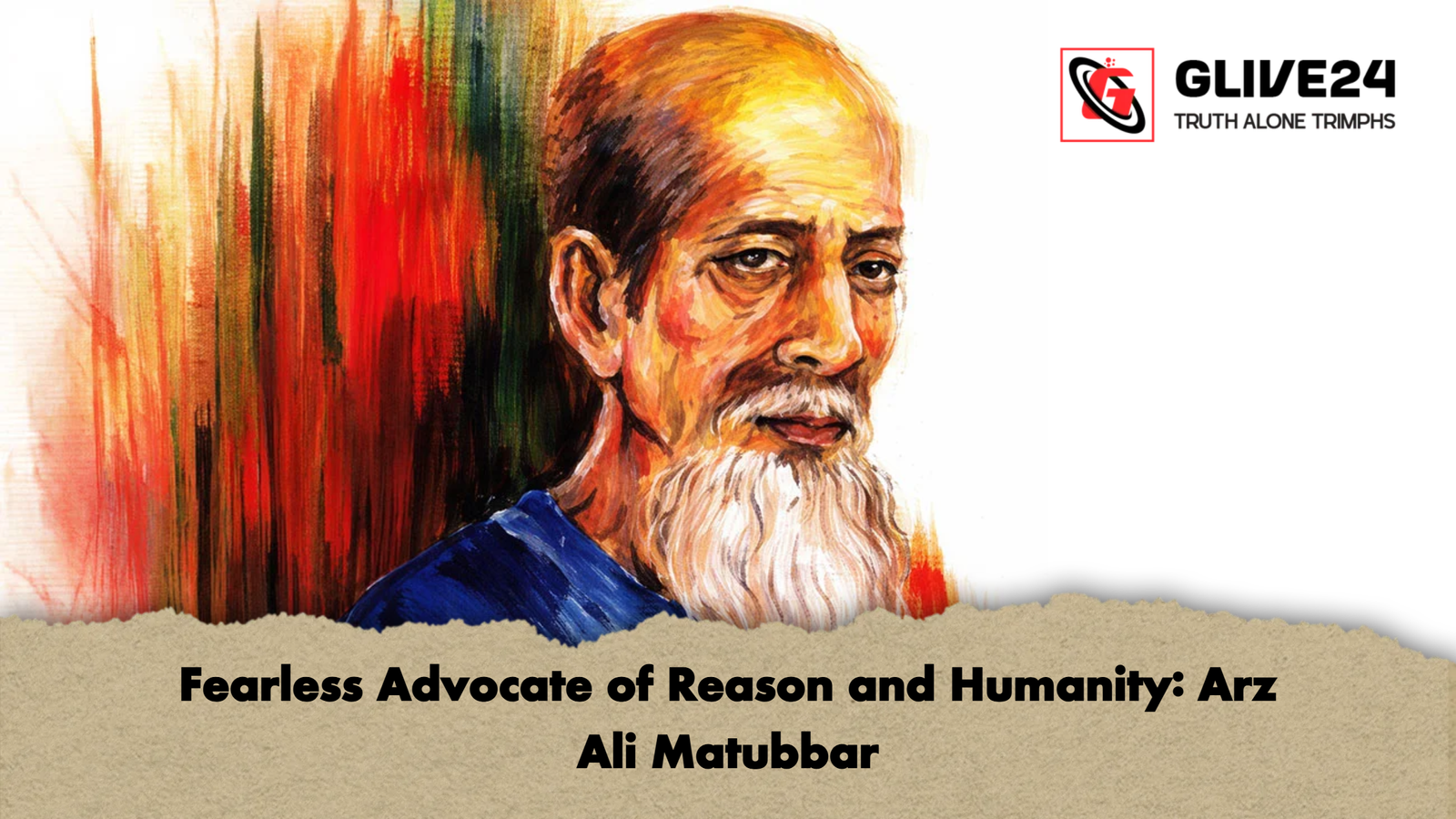
In the intellectual history of Bengal, some individuals emerge like distant stars—shining brightly, yet never seeking the spotlight. Their thoughts and daring questions resonate far beyond their lifetimes, stirring society’s deepest consciousness. Arz Ali Matubbar was one such extraordinary figure. Despite the severe limitations of formal education, he established a luminous legacy of rational thought, scepticism, and humanism in the Bengali intellectual sphere.
Born on 3rd Poush 1307 in the remote village of Lamchhari, Barisal, Matubbar’s early environment offered almost no access to formal education. Around the age of thirteen, however, he gained entry to a small maktab established by the local scholar Abdul Karim Munsi. Here, with Seetaram Basak’s Adarsha Lipi as his primer, he began his educational journey. The maktab, however, closed soon due to financial constraints, leaving him with little more than basic literacy.
Yet, this setback did not halt his pursuit of knowledge. Indeed, it marked the beginning of his real education—the world itself became his classroom. Using the foundation of literacy, he began an unrelenting practice of self-study, collecting books from students in Barisal and frequenting the public libraries of Barisal as well as the collection at Brojomohon College. The guidance of Professor Golam Qadir, a philosopher at the college, further enriched his intellectual growth. Motivated by this thirst for knowledge, he eventually established the “Arz Manzil Public Library” in his own village—a lasting testament to his reflective and inquisitive spirit.
Matubbar’s life was marked by hardship. Losing his father at a young age and witnessing his family land auctioned due to unpaid taxes, he faced adversity early on. His mother was his sole support. An incident surrounding her death profoundly shaped his worldview: when he sought to preserve her memory by photographing her after death, the villagers opposed it as sacrilegious. Only with the help of friends and relatives could he complete her funeral rites. This experience raised fundamental questions in his mind about ignorance and superstition, and their capacity to undermine human compassion.
From this reflection arose his lifelong pursuit of truth. He questioned religion, society, and conventional beliefs not with malice, but with reason, science, and philosophy. Matubbar explicitly stated: “Our campaign is against superstition, not any religion.” He believed that critical examination could purify religion and society, making them more humane.
Through this perspective, he pioneered a distinctly sceptical philosophical current in Bengali thought. He insisted that doubt and questioning are essential beginnings of knowledge, challenging entrenched dogmas, superstitions, and irrational practices. His major works include Satyer Sandhan (In Search of Truth), Onuman, Muktoman, Srishti-r Rahasya (Mysteries of Creation), and Smaranika. Notably, Mysteries of Creation became a miniature encyclopaedia of science and knowledge, written in a clear, unadorned style that was intellectually rigorous yet accessible.
Renowned Bengali thinkers admired his intellectual courage. Ahmed Sharif remarked that Matubbar’s free thinking, honesty, and liberal spirit were more striking than any new theory he proposed. Sirajul Islam Chowdhury observed that Matubbar’s writings did not merely narrate—they questioned, compelling readers to confront thought itself. The novelist Akhtaruzzaman Elias described him as a Renaissance figure, whose centre of thought was reason, not dogma.
Even in his final years, his humanism endured: he donated his eyes and body to Barisal Medical College, remarking, “If students can learn from my body, what greater gain could there be?” Matubbar passed away in 1392 Bengali era at Barisal Medical College Hospital. Yet, his fearless inquiry, unwavering commitment to reason, and quest for truth remain profoundly relevant.
Arz Ali Matubbar demonstrated that formal degrees are not prerequisites for knowledge; what matters is free thought, courage to question, and relentless pursuit of truth. Today, we remember him as not merely a thinker, but as an enduring beacon of rationalism in Bengali society.
লী মাতুব্বর,