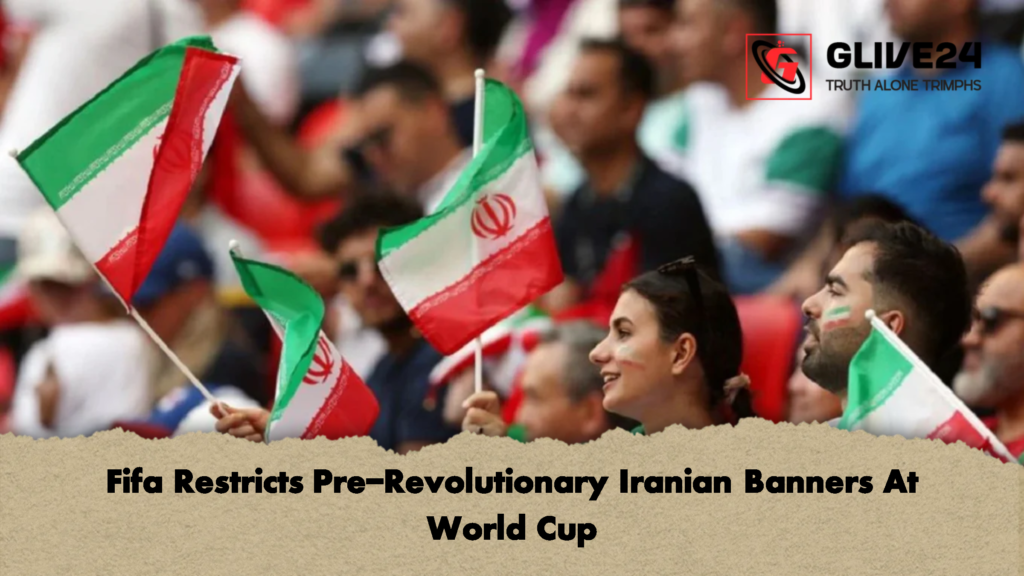
The Fédération Internationale de Football Association (Fifa) is set to maintain its strict prohibition on the entry of pre-revolutionary Iranian flags, as well as clothing, garments, or equipment featuring historical Iranian state symbols, into stadiums during the upcoming 2026 World Cup in North America. This administrative decision follows similar stringent restrictions enforced by match organisers and local authorities during the previous World Cup tournament held in Qatar. The directive was disclosed in an exclusive investigative report published by the prominent American sports media outlet, The Athletic.
According to the published report, the governing body of world football is upholding this regulation as part of its broader, institutionalised effort to prevent political manifestations and discriminatory conduct inside sports venues. Fifa maintains rigid protocols regarding match-day environments to ensure that global sporting spectacles remain focused entirely on football rather than geopolitical disputes or domestic civil unrest.
Historical Context of the Lion and Sun Emblem
The flag under restriction served as the official national symbol of Iran prior to the Islamic Revolution of 1979. A defining characteristic of this historical banner is the prominent “Lion and Sun” (Shir-va-Khorshid) emblem positioned directly at its centre. Following the systemic political and structural changes in 1979, this flag was officially decommissioned and replaced by the current state emblem of the Islamic Republic of Iran.
In contemporary times, the pre-revolutionary flag has taken on a multi-layered significance amongst the global Iranian diaspora distributed across various Western nations. It is frequently utilised by expatriate communities for three primary reasons:
-
Cultural Identity: It serves as a historical representation of Persian and Iranian heritage disconnected from the current state structure.
-
Political Dissidence: It functions as a highly visible symbol of active protest against the incumbent government administration in Tehran.
-
Solidarity Demonstrations: It is regularly displayed during international gatherings to signal political opposition and human rights advocacy related to internal Iranian affairs.
Because the symbol is deeply intertwined with active opposition to the current Iranian administration, its presence within international sporting arenas has consistently generated operational friction for event security teams.
Fifa Stadium Code of Conduct and Regulatory Justification
When formally queried by journalists regarding whether football supporters would be permitted to enter stadium venues at the 2026 World Cup whilst wearing apparel or carrying banners bearing the pre-revolutionary emblem, Fifa explicitly directed enquiries to its established Stadium Code of Conduct.
The governing body’s regulatory framework dictates precise parameters for spectator behaviour across all tournament host cities. The guidelines explicitly state that the display of any items containing political, offensive, or discriminatory messages is strictly prohibited within the security perimeter of the stadium.
Fifa categorises the historical Iranian flag under these guidelines due to its current function as an active political statement rather than a neutral sporting banner. The organisation maintains that permitting such symbols compromises its strict stance on geopolitical neutrality and violates safety protocols designed to prevent ideological clashes among rival factions in the spectator stands.
Precedent Set During the Qatar 2022 World Cup
The continuation of this policy reflects the volatile atmosphere observed during the 2022 World Cup in Qatar. Throughout the group stage matches involving the Iranian men’s national football team, substantial tension escalated within the stadium seating bowls.
During that tournament, stadium security personnel and local police authorities actively intervened to stop spectators carrying the pre-revolutionary flag from entering the venues. Furthermore, individuals wearing clothing printed with anti-government slogans or symbols linked to the Iranian protest movements were routinely intercepted at stadium security checkpoints.
In certain instances, security staff confiscated the materials before granting entry to the ticket holders, whilst other fans who refused to comply with the directives were denied access to the match entirely. By extending these exact restrictions to the 2026 tournament across venues in the United States, Canada, and Mexico, Fifa aims to establish a consistent, unified regulatory standard across its premier international competitions.