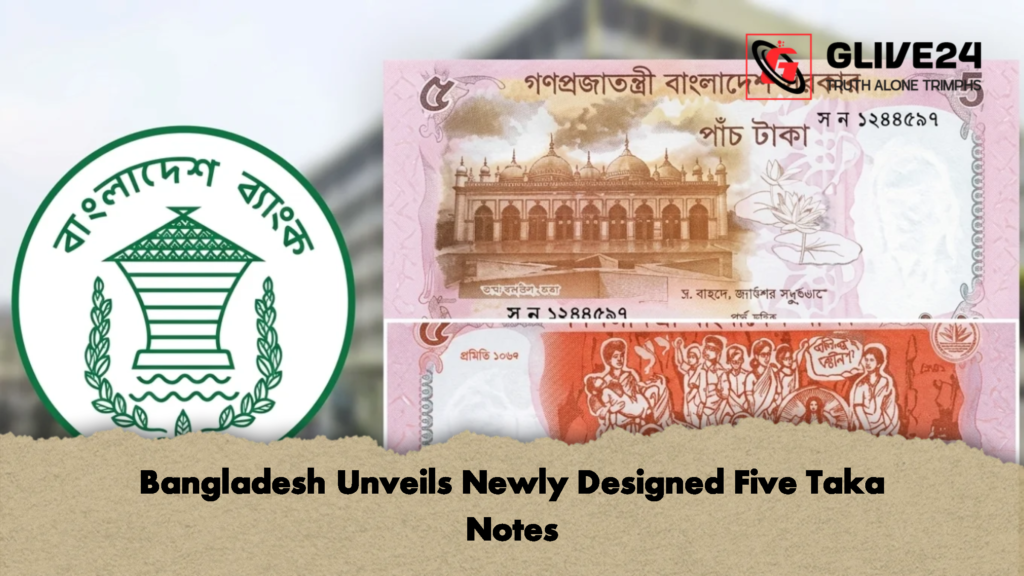
The Government of Bangladesh has officially introduced a newly designed series of five-taka paper currency notes into national circulation. This monetary update is part of a broader thematic initiative designed to celebrate and highlight the rich historical and archaeological architecture of the country. According to an official press release issued by the Finance Division of the Ministry of Finance, the new banknotes were formally placed into the public domain on Tuesday, 19 May. The updated notes have been printed carrying the official signature of the current Finance Secretary, Dr Md Khairuzzaman Mozumder.
In terms of the initial logistics and distribution strategy, the Ministry of Finance confirmed that the newly minted banknotes are first being supplied to the public through the Motijheel office of Bangladesh Bank in Dhaka. Following this initial rollout phase in the capital city, the central bank plans to systematically extend the availability of the new five-taka series by distributing stocks through its other regional branches across the country.
Physical Attributes and Obverse Aesthetics
The structural specifications and design elements of the newly issued five-taka paper note have been meticulously defined by the printing authorities. The physical size of the banknote has been fixed at a width of 117 millimetres and a height of 60 millimetres. The aesthetic composition on the obverse (front) face of the note predominantly carries a distinctive light pink colour tone, blending national heritage iconography with natural symbols.
-
The Left-Hand Panel: The front left-hand section of the note prominently displays an detailed architectural illustration of the historic Star Mosque, locally known as Tara Masjid, situated in Dhaka. This landmark stands as a testament to the country’s archaeological heritage.
-
The Central Motif: Positioned across the centre of the note is an intricate artistic layout featuring the fully blossomed design of the water lily, locally called the Shapla, accompanied by its leaves and buds. The water lily holds significant cultural importance as the national flower of Bangladesh.
Reverse Imagery and Anti-Counterfeiting Framework
On the reverse side, the banknote shifts from traditional landmarks to contemporary artistic expressions. It incorporates a prominent backdrop graphic based on the artwork titled “Graffiti-2024”. To maintain public trust and safeguard the currency against fraudulent duplication, the central bank has integrated several modern, advanced security layers into the paper and printing architecture of this new series.
-
Composite Watermark: When the paper note is examined, it reveals a clear watermark depicting the face of a Royal Bengal Tiger. Directly underneath this wildlife image, a bright electrotype watermark displaying the numeral “5” has been embedded, positioned alongside the official monogram of the Government of the People’s Republic of Bangladesh.
-
Embedded Security Thread: A windowed security thread measuring exactly 2 millimetres in width has been vertically integrated into the left side of the note. This metallic or polymer thread is designed to become clearly visible from both sides of the note when held up against a direct light source.
-
Microprinting Textures: The lower section of the front face features a highly complex guilloche pattern. Within the upper portion of this intricate pattern, printing technicians have embedded microprint technology consisting of numerous horizontally printed repetitions of the word “BANGLADESH” in miniature lettering, readable under close magnification.
Regulations on Existing Legal Tender and Collector Editions
The Ministry of Finance has explicitly stated that the introduction of this new series will not cause any disruption to the daily financial operations of the country or the existing monetary framework. All five-taka paper banknotes previously issued, alongside all metallic five-taka coins currently circulating in the market, will remain fully valid as legal tender. Citizens can continue to use the older notes and coins for standard commercial transactions alongside the newly designed pink-toned currency notes.
In tandem with the regular circulation pool, the authorities have addressed the specific demands of numismatists and currency collectors by printing a dedicated run of “Specimen” five-taka notes. These specimen notes are clearly marked and are strictly non-exchangeable, meaning they carry no valid monetary value and cannot be utilized in standard commercial markets. Instead, interested collectors and members of the public can purchase these unique specimen pieces for a designated price at the Bangladesh Bank Currency Museum, which is located in the Mirpur district of Dhaka.