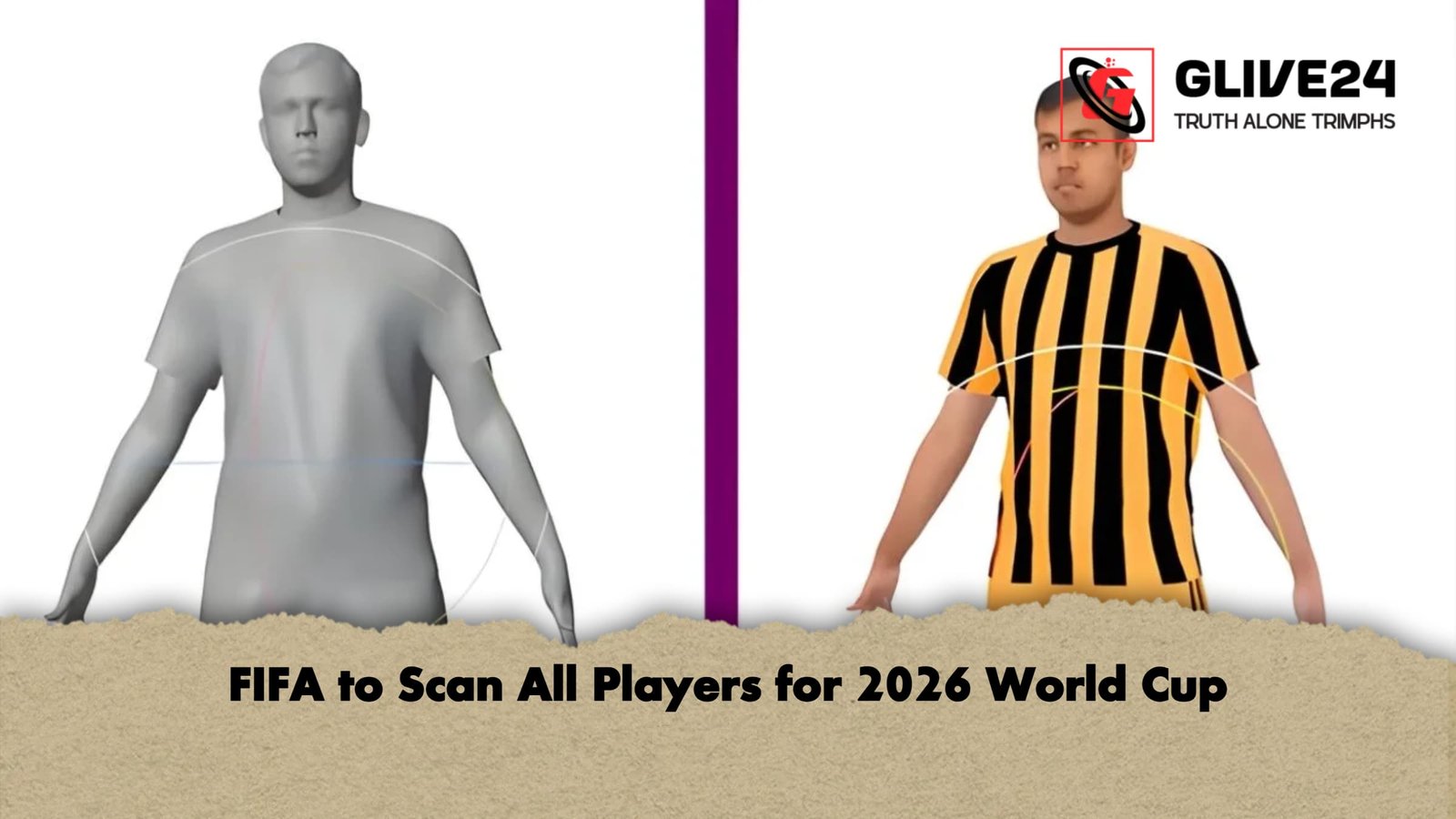
In a transformative fusion of elite sport and cutting-edge silicon, FIFA has announced that every footballer competing in the 2026 World Cup will be digitised into an AI-driven, three-dimensional “avatar”. The initiative, revealed by FIFA President Gianni Infantino at the Consumer Electronics Show in Las Vegas, is designed to propel Semi-Automated Offside Technology (SAOT) to a level of forensic accuracy never before seen on the pitch.
The Scale of Digitisation
The sheer logistics of the project are immense. With the tournament expanding to a 48-nation format, FIFA will create high-fidelity digital replicas for all 1,248 participating players (26 athletes per squad). These scans will be captured in a bespoke scanning chamber during the mandatory pre-tournament media days.
The process is designed to be non-invasive and lightning-fast: a player simply enters the booth, and within one second, the system captures their exact skeletal structure and muscular volume. This “digital twin” then serves as the blueprint for all VAR and offside graphical recreations throughout the tournament’s 104 matches.
Rectifying Graphical Discrepancies
The move to bespoke avatars addresses a significant criticism of current systems used in leagues like the English Premier League. Existing technology often relies on generic “skeleton” models that do not always mirror a player’s unique physique. This led to a notable controversy during a recent Newcastle-Manchester City match, where the digital representation of Ruben Dias appeared to be jumping in a manner that contradicted live broadcast footage.
By using an athlete’s actual dimensions, FIFA’s AI can track limbs through a crowd of players with surgical precision. The technology has already been field-tested during the Intercontinental Cup, where players from Flamengo and Pyramids FC were scanned prior to kick-off to ensure graphical alignment.
Table: Technical Evolution of FIFA Offside Officiating
| Feature | 2022 World Cup (Qatar) | 2026 World Cup (NA) |
| Participant Scanning | Standardised skeletal tracking | Bespoke 3D AI Avatars |
| Total Players Scanned | None (Standardised) | 1,248 Athletes |
| Data Methodology | 29 points per player | Full-surface anatomical scan |
| Match Count | 64 Matches | 104 Matches |
| Visual Accuracy | Occasional “mismatch” errors | High-fidelity 1:1 replication |
A Suite of High-Tech Officiating
Infantino described the upcoming North American showpiece as the “greatest event the planet has ever seen,” and the technology suite extends beyond offside lines. FIFA is currently pioneering:
Real-Time 3D Recreation: Assisting referees with “line-of-sight” decisions to see if a player is obstructing the goalkeeper.
Ball-Out-of-Play Sensors: Advanced tracking to determine if the ball crossed the line before a goal-scoring phase began.
These innovations aim to ensure that the outcome of the world’s most prestigious trophy is decided by the brilliance of the players rather than the limitations of the lens.