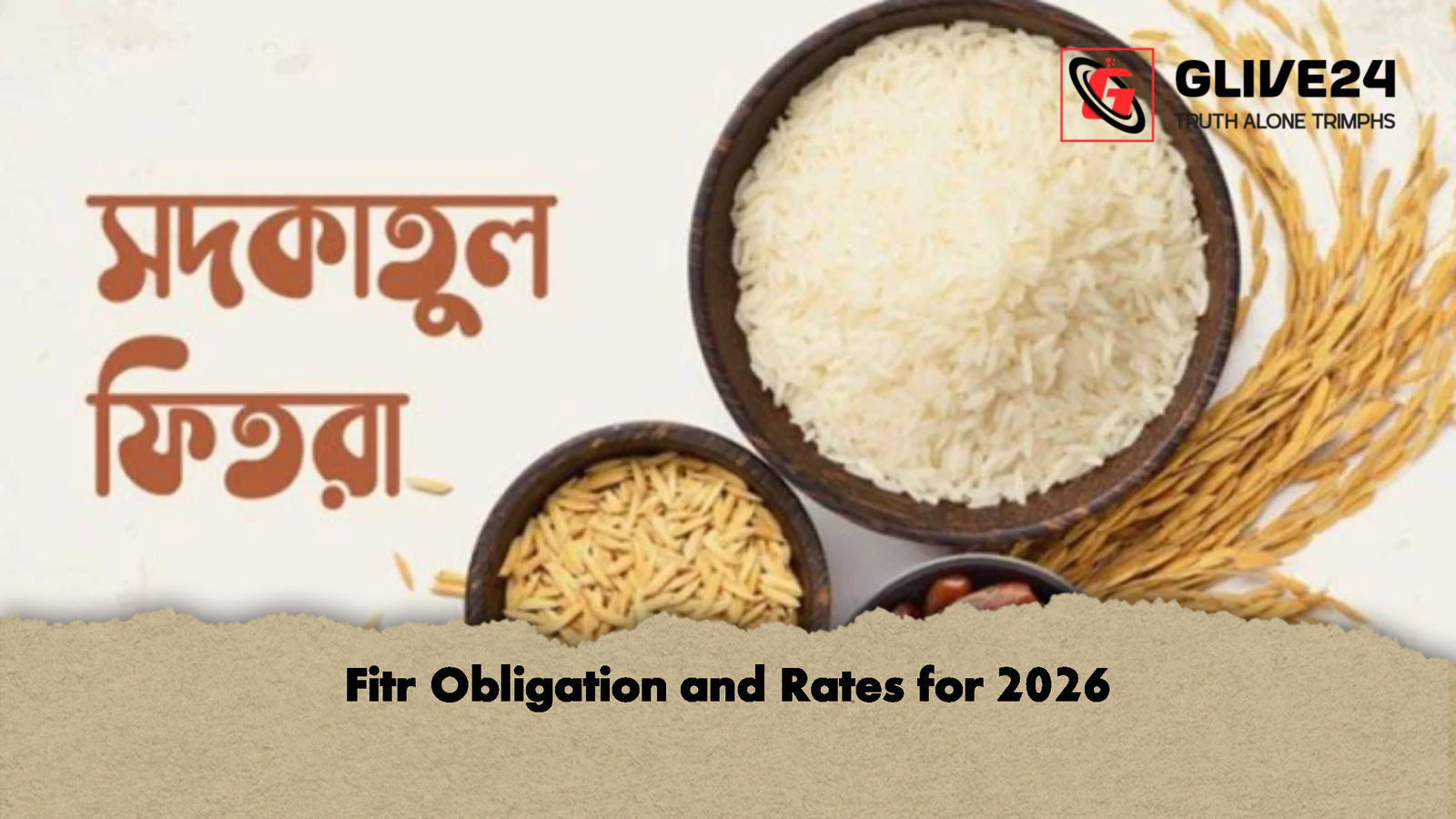
As the blessed month of Ramadan reaches its conclusion, Muslims around the world prepare to fulfil Sadaqat al-Fitr — a compulsory charitable contribution intrinsically linked to the completion of fasting. Commonly referred to as Fitr or Fitrana, this obligation ensures that the spiritual discipline of Ramadan culminates in both personal purification and social compassion.
For the year 1447 Hijri (2026), the National Sadaqatul Fitr Determination Committee has fixed the minimum Fitr amount at 110 Bangladeshi Taka per person, while the maximum has been set at 2,805 Taka. The variation reflects the differing market values of staple food commodities upon which classical calculations are based.
Table of Contents
Who Is Required to Pay?
Under Islamic jurisprudence, Fitr becomes obligatory (wājib) upon every Muslim who, at dawn on 1 Shawwal — the morning of Eid al-Fitr — possesses wealth exceeding their essential needs and meeting or surpassing the nisab threshold. Essential needs include:
One’s primary residence
Necessary clothing
Household furniture and appliances
Tools and equipment required for earning a livelihood
Any wealth beyond these essentials that equals or exceeds the nisab renders a person liable.
Unlike zakat, which requires ownership of nisab-level wealth for a complete lunar year, Fitr does not carry this condition. Even if one acquires sufficient wealth shortly before Eid, Fitr becomes due if the nisab threshold is met at dawn on Eid day.
Scriptural Foundations
The Qur’an states in Surah Al-A‘la (87:14):
“Successful indeed is the one who purifies himself.”
Many classical scholars interpret this verse as encompassing the purification achieved through charitable giving at the end of Ramadan.
Abdullah ibn Umar (may Allah be pleased with him) narrated that the Prophet Muhammad (peace be upon him) made Sadaqat al-Fitr obligatory, specifying its measure as one sa‘ of barley or one sa‘ of dates — binding upon young and old, free and enslaved alike (Sahih al-Bukhari, Hadith 1512).
Another narration from Ibn Abbas (may Allah be pleased with him) clarifies its dual purpose: to compensate for shortcomings in fasting and to provide food for the poor (Sunan Abu Dawud, Hadith 1609). Thus, Fitr simultaneously refines the individual’s worship and safeguards communal welfare.
Nisab and Zakat Calculation
According to the Fatwa Department of Jamiya Rahmania Arabia in Dhaka, this year’s nisab for both zakat and Fitr has been calculated on the basis of 52.5 tolas of silver, amounting to approximately 230,000 Taka.
A Muslim who has maintained wealth at or above this threshold for one lunar year must pay zakat at 2.5 per cent.
A Muslim who possesses wealth equal to this amount at dawn on Eid day must pay Fitr.
Fitr Rates Based on Food Commodities
The classical unit of measurement, one sa‘, is approximately 3.3 kilograms (or half that — 1.65 kg — in the case of wheat). Based on current market values, the following breakdown has been provided:
| Food Item | Approximate Quantity | Fitr Amount (Taka) |
|---|---|---|
| Raisins | 3.3 kg | 2,800 |
| Cheese | 3.3 kg | 2,650 |
| Dates | 3.3 kg | 2,000 |
| Barley | 3.3 kg | 450 |
| Wheat/Flour | 1.65 kg | 100 |
While the official minimum stands at 110 Taka, fluctuations in silver prices and staple goods may result in slight regional variations. Scholars therefore recommend verifying current local market rates before payment.
Timing and Distribution
Fitr may be given from sunset on the final day of Ramadan until before the Eid prayer. It is preferable to distribute it one or two days in advance so recipients may prepare for the festivities. If paid after the Eid prayer, it counts only as voluntary charity rather than Sadaqat al-Fitr.
A financially able Muslim must pay Fitr on their own behalf and on behalf of dependent minor children. Through this act, believers ensure that Eid is not merely a celebration for the affluent, but a shared joy that embraces the most vulnerable members of society — a fitting conclusion to a month devoted to discipline, gratitude, and compassion.