
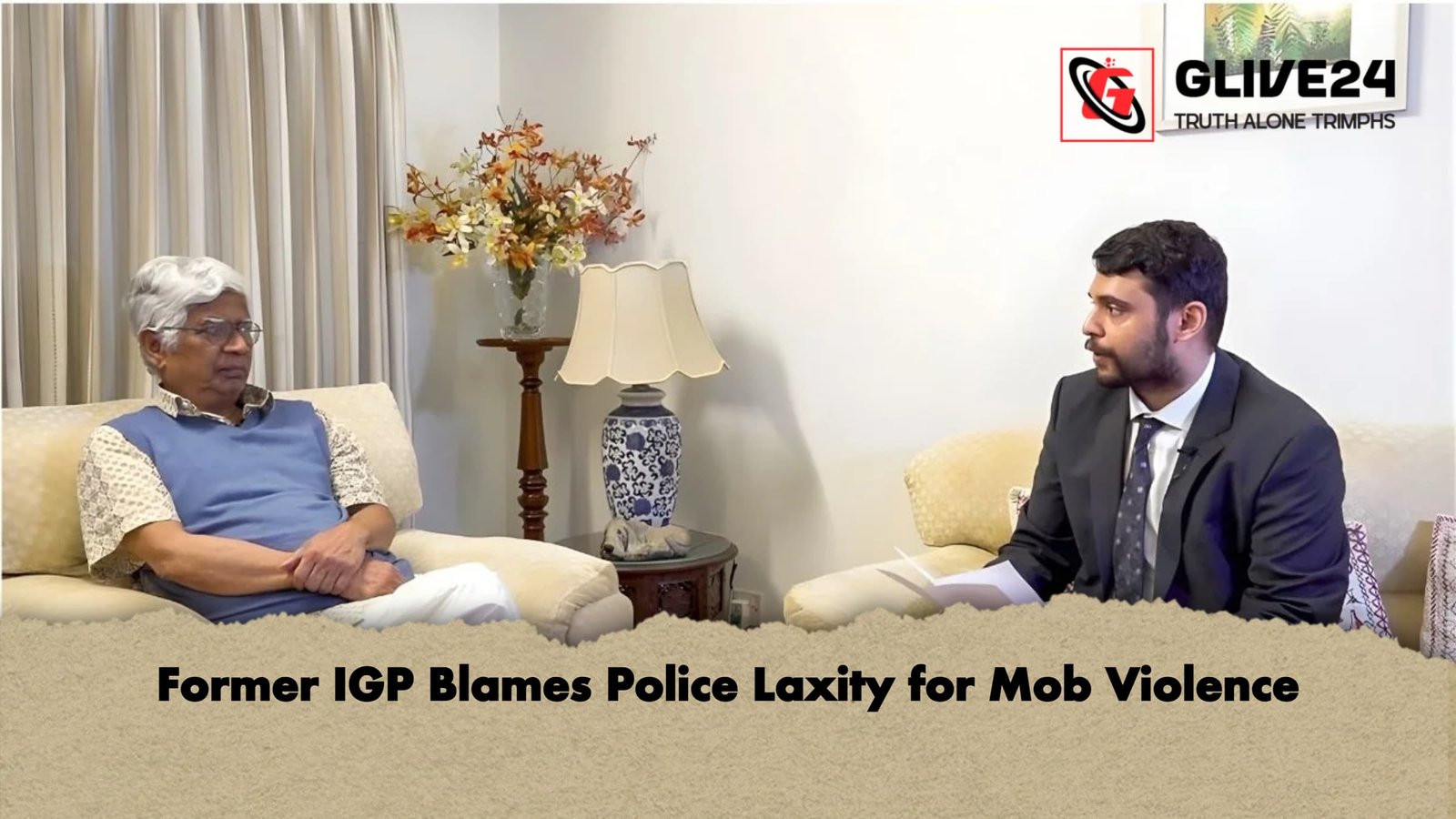
The recurring wave of “mob justice” currently unsettling Bangladesh is not a failure of intelligence, but a failure of institutional will, according to former Inspector General of Police (IGP) Mohammad Nurul Huda. During a candid discussion on the bdnews24.com talk show Inside Out, the veteran officer argued that the targeted violence witnessed on the night of 18 December—which saw attacks on major media outlets and cultural institutions—could have been prevented. He characterised the police’s current hesitation as “laxity” and firmly rejected the official justification that intervening in such crowds would result in unacceptable casualties, branding it a “poor excuse” for a professional force.
Drawing on three decades of experience, Huda noted that the 18 December attacks on organisations like Prothom Alo, The Daily Star, and Chhayanaut did not appear to be the work of a mere “unruly crowd.” Instead, he suggested these were coordinated efforts by groups with specific ideological agendas seeking to silence dissent and cultural expression. While acknowledging that the police force suffered significant trauma and a loss of public trust following the August uprising—where the previous administration essentially treated citizens as enemies—Huda insisted that nearly 18 months of transition should have been sufficient for the force to recover its operational footing.
Security Outlook: Police Constraints vs. Proposed Solutions
| Challenge | Current Institutional Stance | Former IGP’s Recommendation |
| Mob Violence | Inaction to avoid loss of life. | Proactive prevention and firm dispersal. |
| Force Morale | Psychological trauma from August events. | Move past excuses; focus on resilient personnel. |
| High-Risk Targets | Provision of state-assigned gunmen. | Temporary fix; encourage private arms licensing. |
| Communal Tensions | Reactive responses to lynchings. | Firm political will and educational reform. |
| Election Security | High risk of national disruption. | Detain known agitators; situation is manageable. |
Addressing the broader issue of communal violence, such as the recent blasphemy-related lynching in Mymensingh, Huda warned that “latent malice” is being weaponised by specific groups. He observed that throughout Bangladesh’s history—from Ramu to Brahmanbaria—communal riots have often seen participation from various political cadres, regardless of who is in power. To combat this, he urged for a zero-tolerance policy and “firm political decisions” that leave no room for leniency, noting that such incidents continue to tarnish the nation’s international standing.
Looking ahead to the prospect of national elections, the former police chief dismissed fears that the current instability would make a peaceful vote impossible. He explained that a nationwide election naturally disperses the concentration of protesters usually found in Dhaka back to their local constituencies, thereby reducing the “pressure point” on the capital. He proposed that the authorities utilise existing laws to preemptively detain approximately 500 to 1,000 known troublemakers until the polls conclude. For Huda, the solution is straightforward: reliable intelligence followed by swift, decisive action is all that is required to restore the rule of law.