
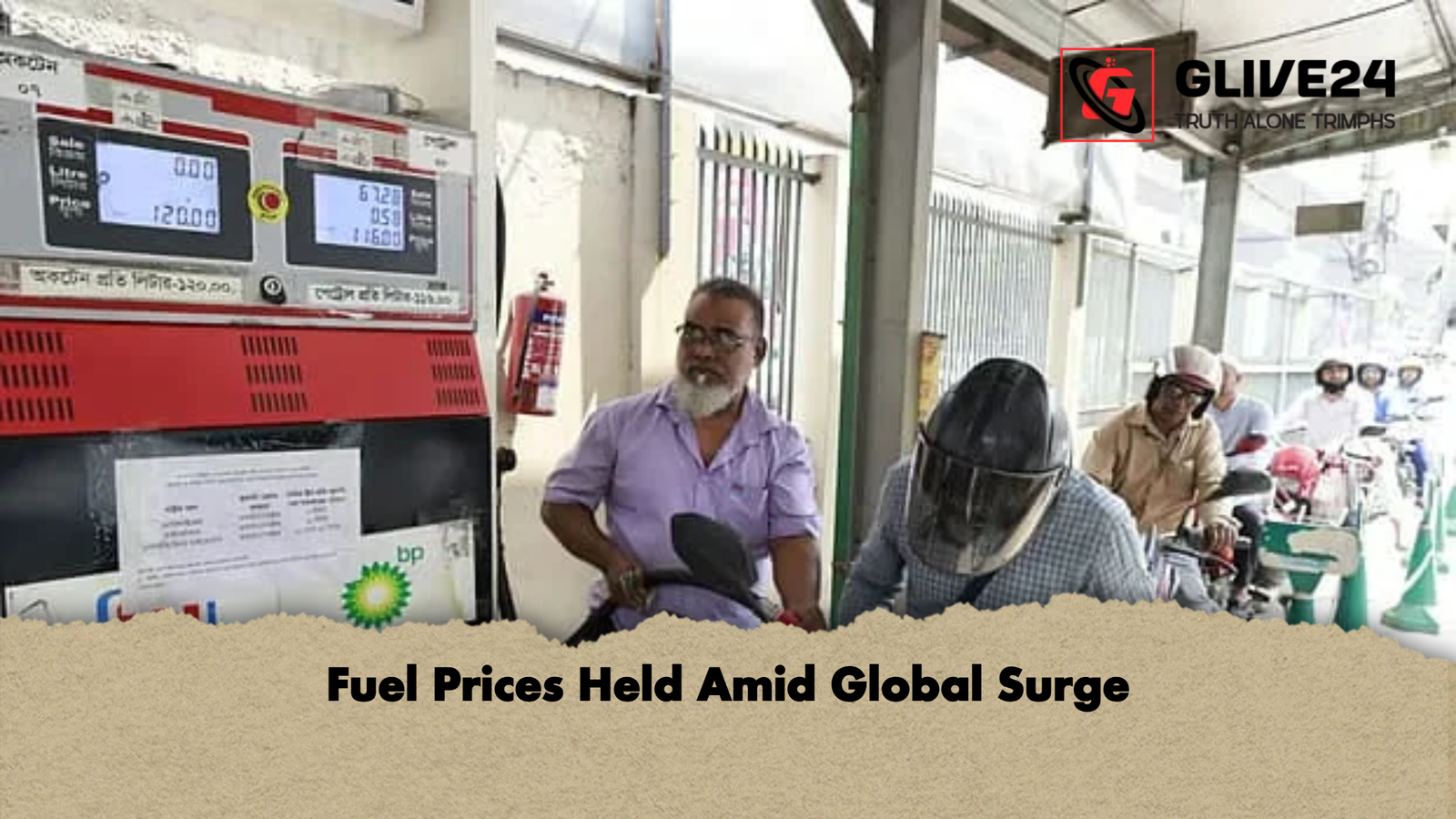
Despite a sharp escalation in global energy prices triggered by widening conflict across the Middle East, the government has opted to keep domestic fuel prices unchanged for a second consecutive month. The decision provides short-term relief to consumers, even as it places a considerable fiscal burden on the state.
According to an official order issued tuesday by the Ministry of Power, Energy and Mineral Resources, retail fuel prices will remain unchanged throughout April. As a result, petrol, octane, diesel, and kerosene will continue to be sold at their rates, identical to those maintained in February and March.
Under the current pricing structure, diesel is being sold at 100 taka per litre, kerosene at 112 taka, petrol at 116 taka, and octane at 120 taka. These prices reflect earlier downward adjustments made at the beginning of the year, when the government reduced fuel prices by 2 taka per litre in January and again by 2 taka in February.
This policy stance comes at a time when international fuel markets have experienced significant volatility. Officials report that global diesel prices have surged by approximately 98 per cent within a single month, driven largely by supply disruptions and geopolitical tensions in oil-producing regions. In some cases, international benchmark prices have more than doubled.
Since March 2024, Bangladesh has been operating an automatic fuel pricing mechanism designed to align domestic fuel prices with global market trends. Under this system, prices are revised monthly based on the previous month’s import costs, exchange rate fluctuations, and international price movements. The framework, formalised through guidelines issued on 29 February 2024, also recognises petrol and octane as relatively higher-value fuels, largely used in private transport, and therefore priced above diesel, which is more widely used in public and commercial sectors.
Fuel pricing responsibilities are divided between regulatory bodies. The Bangladesh Energy Regulatory Commission (BERC) determines the prices of jet fuel and furnace oil, while the Energy and Mineral Resources Division sets retail prices for diesel, kerosene, petrol, and octane through executive orders.
However, maintaining stable prices in the face of rising import costs has created a widening gap between procurement and retail rates. According to Bangladesh Petroleum Corporation (BPC) sources, the actual import cost of diesel has reached approximately 198 taka per litre, nearly double the current selling price. Similarly, octane, which is sold at 120 taka, costs the government around 150.72 taka per litre to procure and distribute.
The resulting subsidy burden is substantial. Officials estimate that the government will need to provide around 50 billion taka in subsidies within a single month to sustain current price levels.
The following table summarises the disparity between retail prices and estimated import costs:
| Fuel Type | Retail Price (Tk/litre) | Estimated Import Cost (Tk/litre) |
|---|---|---|
| Diesel | 100 | 198 |
| Kerosene | 112 | Not disclosed |
| Petrol | 116 | Not disclosed |
| Octane | 120 | 150.72 |
Energy Minister Iqbal Hassan Mahmood (Tuku) informed Parliament that the rapid increase in global prices has significantly strained public finances. Nonetheless, the government appears committed to shielding consumers from immediate price shocks.
While the decision offers temporary stability, analysts caution that prolonged reliance on subsidies may prove unsustainable. They suggest that a balanced approach—combining gradual price adjustments, improved energy efficiency, and diversification of energy sources—will be essential to maintaining fiscal stability in the long term.