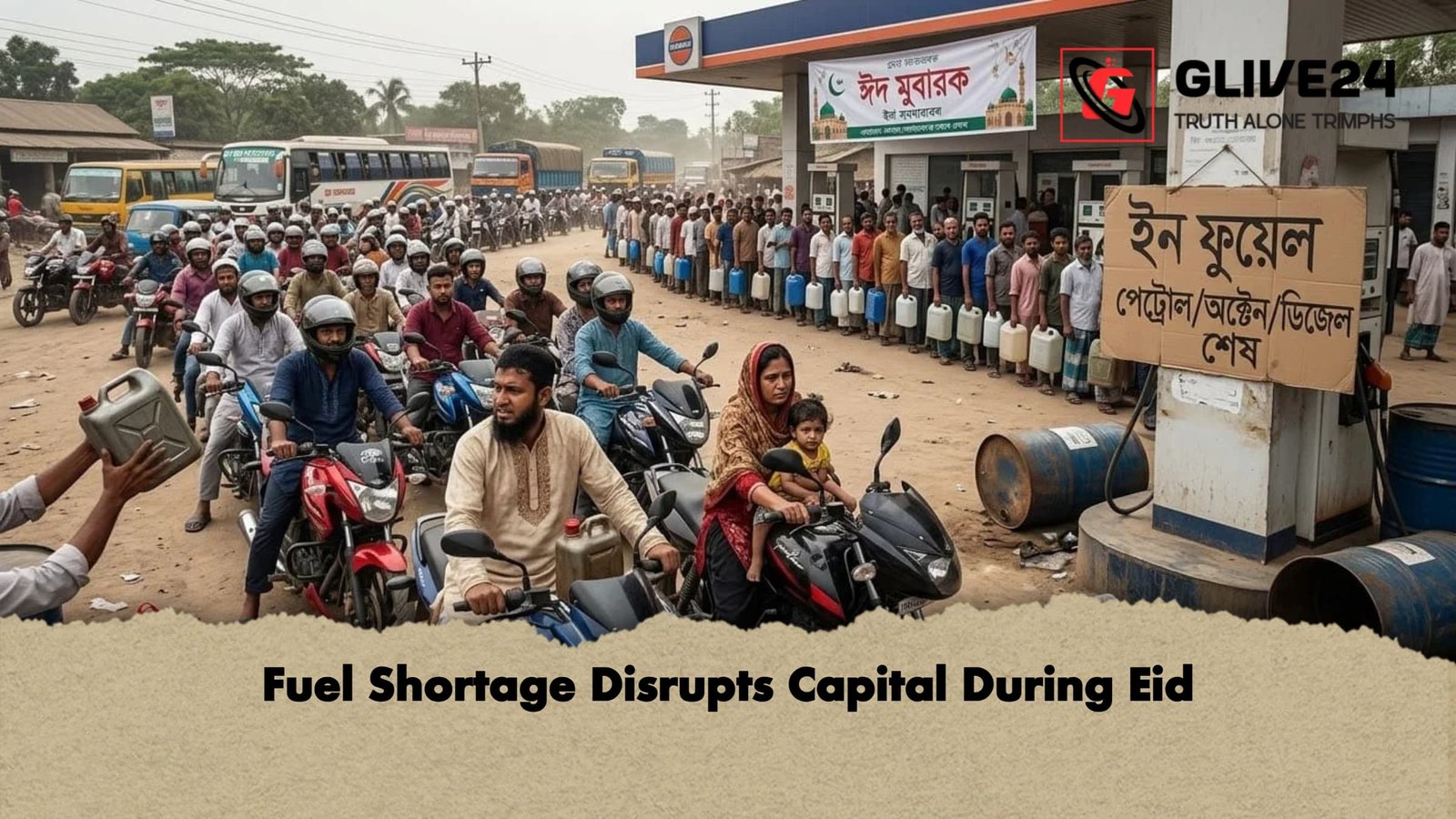
Residents of the capital are enduring significant hardship as a shortage of fuel continues into the second day of the Eid holidays. Long queues have formed at filling stations where fuel remains available, while many outlets have been forced to close temporarily due to depleted stocks. Unless the situation improves promptly, the disruption is expected to intensify in the coming days.
The الأزمة has been exacerbated by a temporary suspension of fuel supply from depots during Eid day and the following day, a routine measure that has coincided with increased holiday demand. Although limited distribution has been maintained in the days surrounding the festival, supply has not been sufficient to meet the surge in consumption.
Fuel importation and distribution in the country are overseen by the state-owned Bangladesh Petroleum Corporation. On its behalf, three public oil marketing companies—Padma, Meghna, and Jamuna—handle the delivery of fuel to dealers and filling stations. These companies operate depots across the country, supplying nearly 2,500 filling stations that retail petrol, octane, and diesel.
According to official directives issued earlier this week, fuel supply between 19 and 22 March is to be maintained at a minimum operational level. Depots will remain closed on Eid day and the following day, with supply expected to return to normal levels between 23 and 25 March, in line with demand recorded during the same period last year.
Sources within the Energy Division indicate that a total of 18 fuel-carrying vessels are scheduled to arrive this month. Of these, seven have already discharged their cargo. Five additional vessels are expected next week—four carrying diesel and one transporting furnace oil. However, the arrival schedule of another five vessels remains uncertain, raising concerns about potential supply instability. A further vessel is anticipated in the first week of April.
To mitigate the risk of prolonged shortages, the government has initiated discussions to procure fuel from alternative sources. Plans are in place to import 100,000 tonnes of diesel and 25,000 tonnes of octane from Saudi Arabia, while arrangements are underway to secure an additional 200,000 tonnes of diesel from Kazakhstan.
Fuel Shipment Overview
| Shipment Status | Number of Vessels | Type of Fuel | Remarks |
|---|---|---|---|
| Already arrived | 7 | Mixed | Cargo discharged |
| Confirmed upcoming | 5 | Diesel and furnace oil | Expected next week |
| Uncertain schedule | 5 | Mixed | Arrival dates not finalised |
| Expected in April | 1 | Mixed | Likely early April arrival |
Meanwhile, conditions on the ground reflect the severity of the shortage. On Wednesday morning, large numbers of motorcyclists and private car owners were seen waiting at filling stations across the. At several locations, customers reported waiting for hours, some arriving as early as dawn in the hope of securing fuel.
At one station in the Khilkhet area, fuel distribution had yet to begin by mid-morning, despite a growing queue. Staff indicated that supply had just arrived and would be dispensed shortly. In contrast, a station in Mohakhali reported having only diesel in stock, with octane deliveries expected later in the day.
Elsewhere, at Gulshan and Bijoy Sarani, queues of vehicles stretched for distances, underscoring the widespread impact of the disruption. Some stations were able to supply only compressed natural gas, having run out of liquid fuels overnight.
Industry observers suggest that the current is largely the result of a temporary mismatch between supply and heightened festive demand. While incoming shipments may ease the pressure in the coming days, uncertainty surrounding several consignments continues to pose a risk to market stability.