
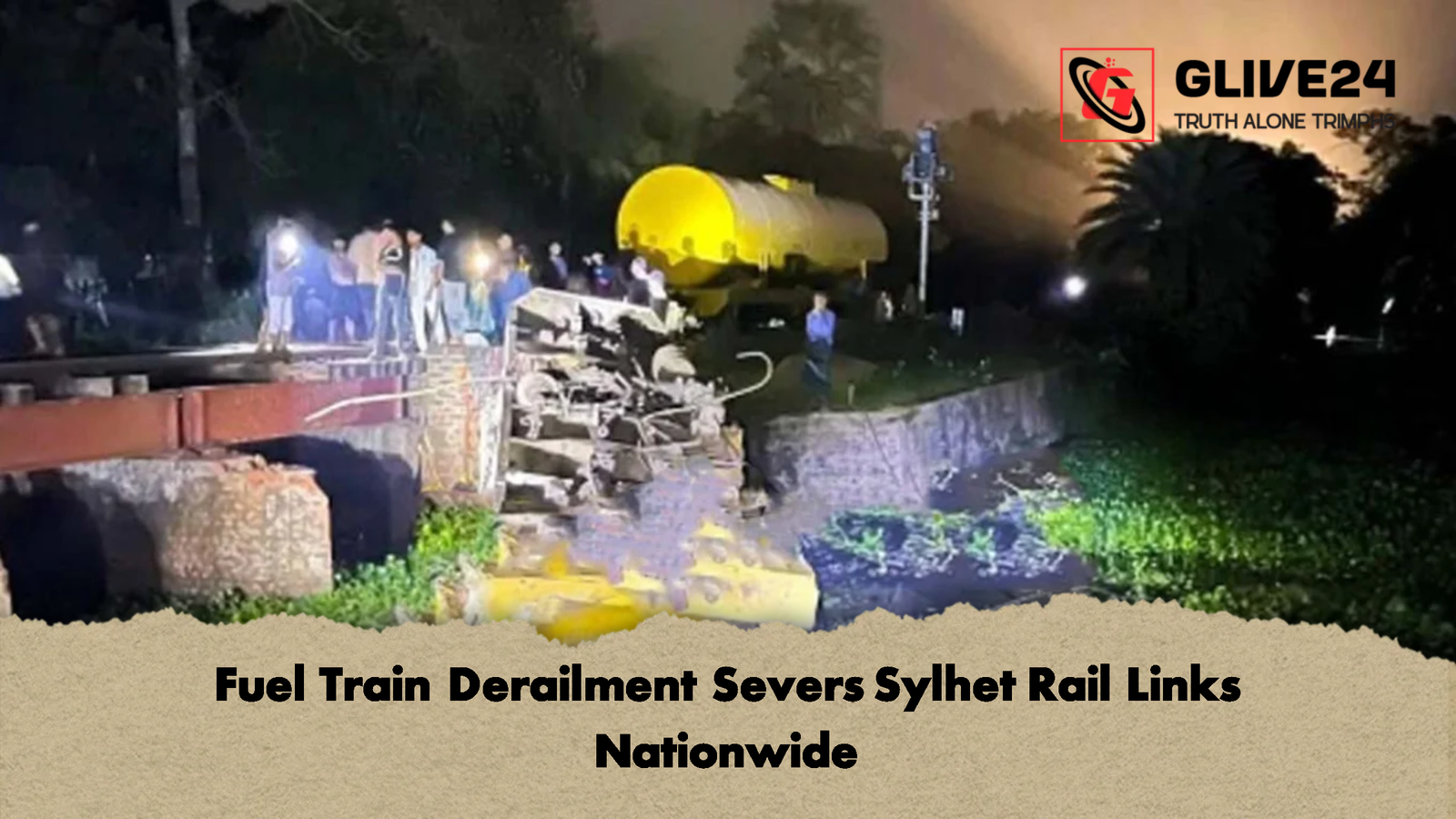
Rail connectivity between Sylhet and the rest of Bangladesh has been brought to a complete standstill after a fuel-laden freight train derailed in Habiganj’s Madhabpur upazila, disrupting operations along two of the country’s most significant railway corridors and leaving passengers stranded across multiple districts.
The accident occurred at approximately 9:30 pm on Wednesday (1 April) near Monotola Railway Station when a Chattogram-to-Sylhet bound oil tanker train unexpectedly derailed while traversing the area. According to preliminary reports, four fuel tank wagons along with a guard brake van left the tracks. Several of the derailed carriages veered off course and reportedly plunged into adjacent land and a nearby ditch, intensifying the scale of the disruption.
The impact of the derailment caused extensive damage to sections of the railway infrastructure, including portions of the track bed and associated signalling equipment. Railway engineers have expressed concern that the structural damage may be more severe than initially assessed, potentially requiring substantial reconstruction work before any resumption of services can be considered safe.
Although no fatalities or injuries have been reported, the presence of petroleum products on the derailed wagons has heightened operational sensitivity, with authorities prioritising containment and safety to prevent fire hazards or environmental contamination.
Table of Contents
Widespread Suspension of Rail Services
Following the incident, rail operations on both the Dhaka–Sylhet and Chattogram–Sylhet routes were immediately suspended as a precautionary measure. The suspension has effectively cut off Sylhet’s direct rail link with the rest of the country, severely disrupting passenger movement and freight logistics.
Confirming the situation, Station Master Monir Mia of Noapara Railway Station stated that train movement had been halted indefinitely due to urgent safety concerns. He added that railway authorities, along with police units, promptly arrived at the site following notification of the derailment.
A rescue train, along with technical and engineering response teams, has been dispatched to the location. However, officials noted that recovery operations could not commence immediately due to the complexity of the scene, particularly the safe handling of fuel tanker wagons and the risk of leakage or ignition.
Passenger Disruption and Operational Strain
The abrupt suspension of services has caused widespread disruption for passengers travelling across affected routes. Numerous commuters were left stranded at various stations along the network, while others faced uncertainty regarding ticket validity and onward travel arrangements.
In several areas, passengers reported prolonged waiting times and a lack of clear information regarding alternative transport options. The disruption has also placed additional pressure on road transport services, as travellers attempt to reroute journeys through already congested highways.
Railway authorities have acknowledged the inconvenience and stated that efforts are underway to restore normal operations as swiftly as conditions permit. However, officials have emphasised that safety considerations remain paramount, particularly given the involvement of hazardous fuel cargo.
Preliminary Incident Overview
| Category | Details |
|---|---|
| Incident Type | Freight train derailment |
| Train Route | Chattogram to Sylhet (fuel tanker service) |
| Location | Monotola Railway Station area, Madhabpur, Habiganj |
| Time of Incident | Approximately 9:30 pm, Wednesday (1 April) |
| Rolling Stock Affected | Four fuel tank wagons and one guard brake van |
| Casualties Reported | None |
| Infrastructure Damage | Significant track and signalling damage suspected |
| Suspended Routes | Dhaka–Sylhet; Chattogram–Sylhet |
| Immediate Response | Rescue train deployed; emergency teams mobilised |
| Current Status | Investigation and recovery operations ongoing |
Investigation and Restoration Efforts
Authorities have launched a formal investigation into the cause of the derailment. Railway engineers are currently examining multiple possible factors, including potential track defects, mechanical failure of rolling stock, or operational irregularities.
Specialised recovery teams are expected to undertake a phased clearance operation, beginning with the stabilisation and removal of fuel tank wagons, followed by detailed track inspection and repair work. Officials have indicated that service restoration will depend entirely on the completion of safety assessments and infrastructure rehabilitation.
Given the extent of disruption, railway authorities have cautioned that full normalisation of services may take an extended period. Until then, Sylhet remains disconnected from the national rail network, with passengers strongly advised to consider alternative transport arrangements.
The incident has once again highlighted the vulnerability of key transport corridors to infrastructure failures and the critical importance of maintenance and safety oversight in the movement of hazardous freight across the national railway system.