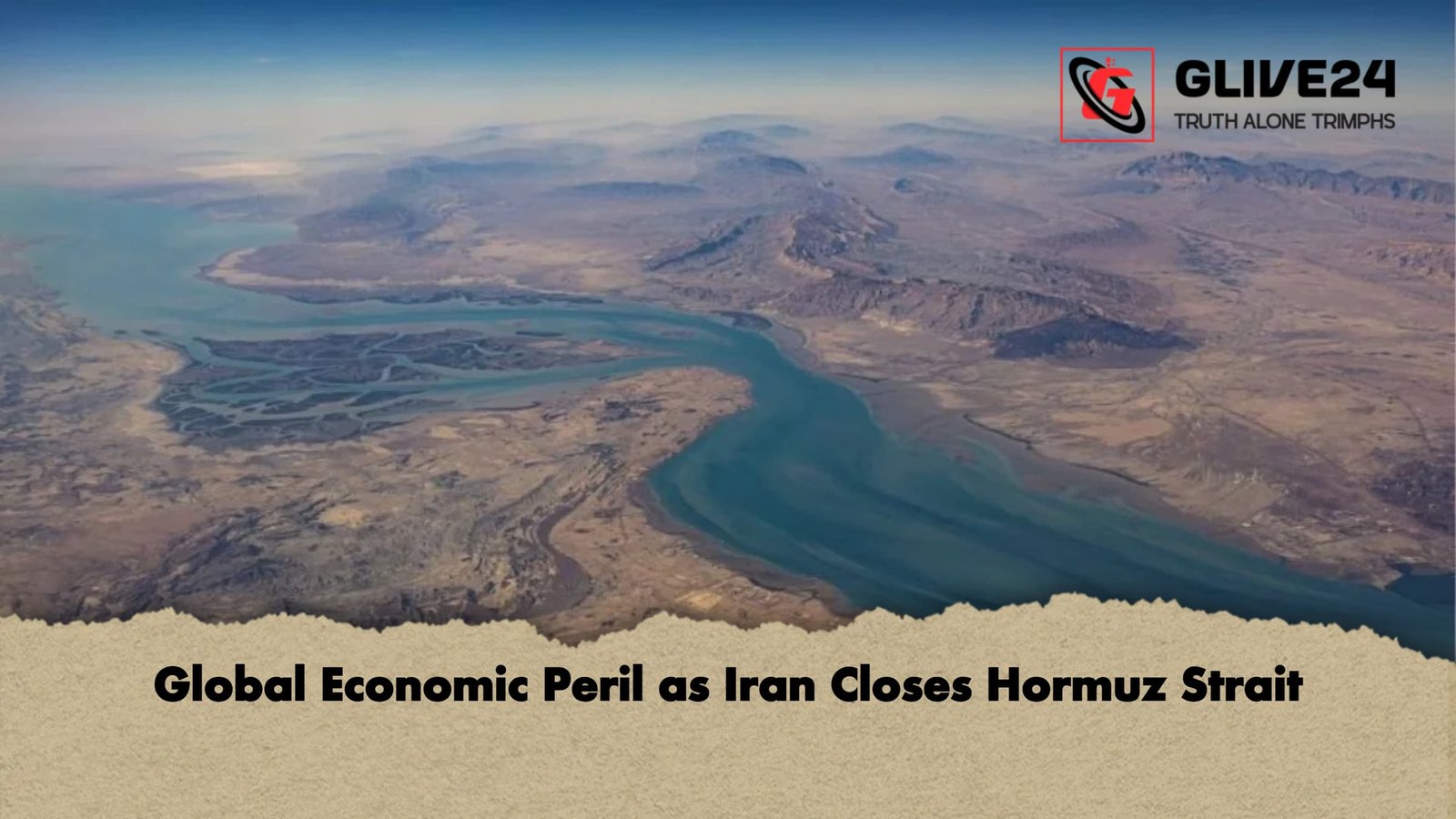
In a move that has sent shockwaves through global financial centres, the Islamic Republic of Iran has reportedly enforced a strategic blockade of the Strait of Hormuz. Following a combined military offensive by the United States and Israel, Tehran’s semi-official Tasnim News Agency confirmed on Saturday night that the Islamic Revolutionary Guard Corps (IRGC) has begun issuing warnings via Very High Frequency (VHF) radio to all maritime traffic. The directive is unambiguous: no vessel is permitted to transit the world’s most vital energy artery.
The World’s Most Critical Chokepoint
The Strait of Hormuz is a narrow, hook-shaped waterway separating Iran from Oman and the United Arab Emirates. As the sole maritime egress from the Persian Gulf to the open ocean, it serves as the jugular vein of the global energy trade. Measuring only 21 miles wide at its narrowest point, the shipping lanes are a mere two miles wide in each direction, making it exceptionally vulnerable to asymmetric military interdiction.
The Economic Fallout: A $100 Barrel?
The immediate reaction from the energy markets has been one of controlled panic. According to the U.S. Energy Information Administration (EIA), approximately 21 million barrels of oil per day (bpd)—roughly 21% of global liquid petroleum consumption—transit this passage. Furthermore, one-fifth of the world’s Liquefied Natural Gas (LNG) supplies, primarily from Qatar, pass through these waters.
Table: Projected Impact of Hormuz Closure on Oil Prices
| Financial Institution | Projected Price (Per Barrel) | Economic Sentiment |
| Current Market Rate | $73.00 – $80.00 | Volatile/Ascending |
| Goldman Sachs | $100.00+ | High Risk of Global Recession |
| Equirus Securities | $95.00 – $110.00 | Supply Chain Contagion |
| Rystad Energy | $120.00 (Extreme Scenario) | Total Market Paralysis |
Geopolitical Standoff and Global Consequences
While European Union naval mission officials have corroborated reports of IRGC warnings, Tehran has yet to issue a formal diplomatic declaration of a blockade. However, the “de facto” closure is already achieving its purpose. Shipping giants have halted movements, fearing that tankers could become targets of Iranian coastal batteries or limpet mine attacks.
The implications for the global economy are catastrophic. A sustained closure would not only spike fuel prices but would inevitably lead to a surge in inflation, affecting everything from international air travel to the cost of basic food commodities. For nations heavily reliant on Middle Eastern crude—such as China, India, and Japan—the blockade represents a direct threat to national energy security.
As the international community watches the VHF radio transcripts with bated breath, the question remains whether Western naval coalitions will attempt to break the blockade, potentially igniting a full-scale maritime war.