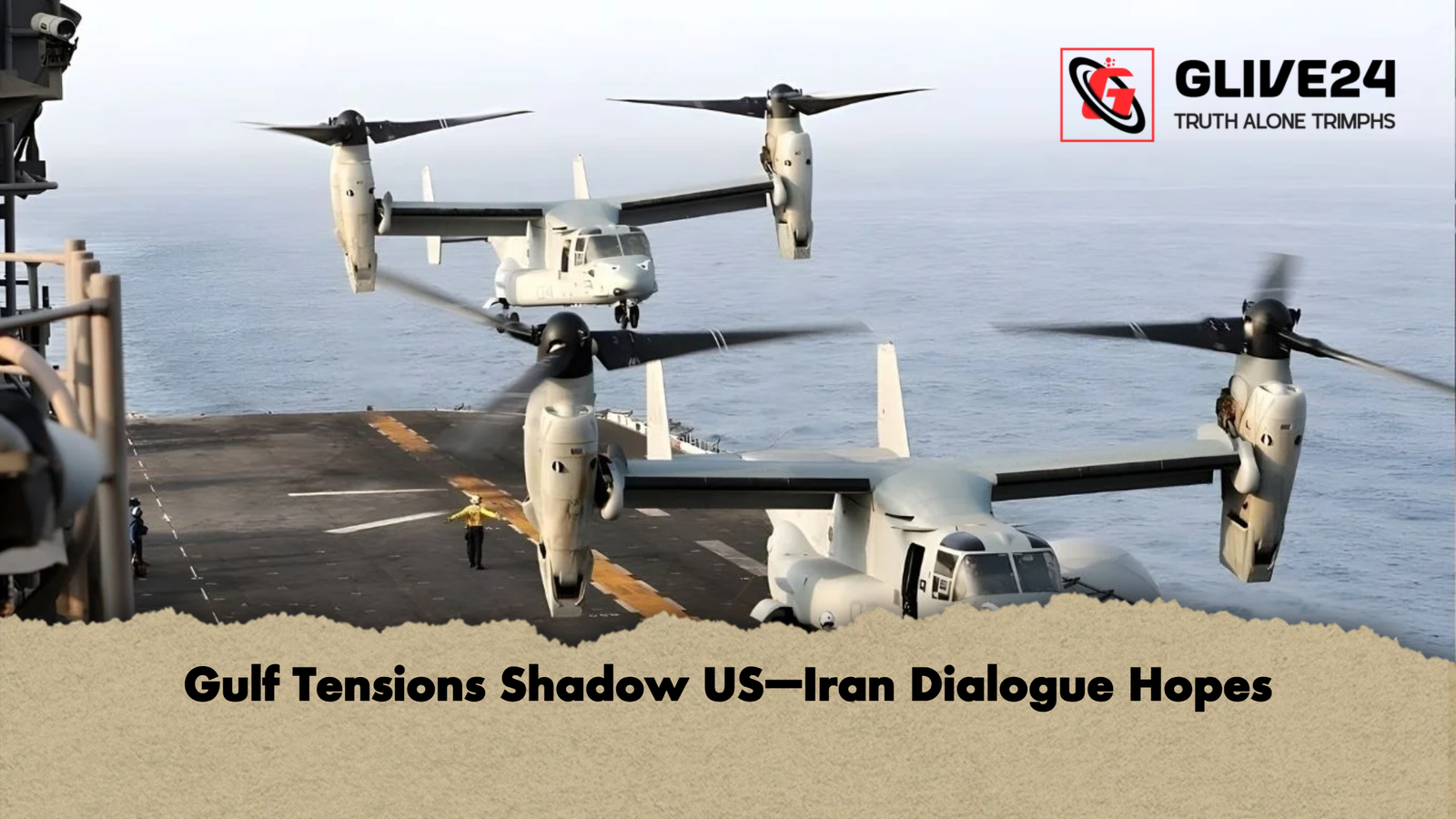
Hopes of renewed dialogue between Washington and Tehran have been overshadowed by a fresh escalation of tensions in the Persian Gulf, underscoring how fragile the regional security environment remains. Just as the United States signalled a possible willingness to re-engage Iran after years of diplomatic deadlock, two separate but closely linked incidents have reignited mistrust: the downing of an Iranian drone by US forces and allegations that Iranian security units pursued a US-flagged commercial vessel.
According to the United States Central Command (CENTCOM), American forces shot down an Iranian unmanned aerial vehicle in international waters to protect the aircraft carrier USS Abraham Lincoln. CENTCOM described the action as strictly defensive, stressing that the safety of sailors aboard the carrier was the overriding concern. A US fighter jet reportedly launched directly from the Abraham Lincoln intercepted the drone after it approached the vessel at speed.
US officials claimed the drone was a Shahed-139 model and that it had travelled from Iran’s southern coastline towards the carrier, which was positioned roughly 800 kilometres offshore. CENTCOM said the aircraft ignored repeated signals and warnings intended to de-escalate the situation, advancing in what it characterised as an “aggressive” manner. While Washington acknowledged that it could not determine the drone’s precise mission, it argued that the circumstances justified immediate defensive action.
Tehran, for its part, did not issue an immediate formal response through official government channels. However, Iran’s semi-official Tasnim news agency reported that contact had been lost with an Iranian drone operating over international waters. The report claimed the drone had successfully transmitted essential intelligence to the Islamic Revolutionary Guard Corps (IRGC) before communications were severed, adding that an investigation was under way to establish the cause.
Tensions were further heightened by a second incident involving maritime security. CENTCOM accused Iranian forces of pursuing the US-flagged commercial tanker M/V Stena Imperative. The US military alleged that two fast-attack boats operated by the IRGC, supported by a Mohajer drone, attempted to intimidate the vessel and threatened to board and seize it—an action Washington warned could undermine freedom of navigation in one of the world’s most critical shipping lanes.
Iranian officials, quoted by the Fars news agency, rejected this account. They asserted that the tanker had entered Iranian territorial waters without the necessary legal authorisation and that security forces merely issued warnings. According to Tehran, the vessel complied and left the area, framing the episode as a routine exercise of national sovereignty rather than an act of provocation.
The contrasting narratives are summarised below:
| Issue | United States’ Position | Iran’s Position |
|---|---|---|
| Drone downed | Shot down in self-defence to protect USS Abraham Lincoln | Drone lost contact; investigation ongoing |
| Drone location | International waters | International waters |
| Tanker pursuit | IRGC boats and drone threatened seizure | Vessel entered territorial waters without permission |
| Diplomatic context | Escalation amid hints of dialogue | Assertion of sovereign rights |
Analysts warn that these incidents illustrate how quickly tactical encounters can escalate into strategic complications. Beyond the immediate military risks, they may also complicate any tentative diplomatic overtures, reinforcing scepticism on both sides. In the volatile Persian Gulf, even limited confrontations can ripple far beyond the region, shaping global energy security and the broader international political calculus.