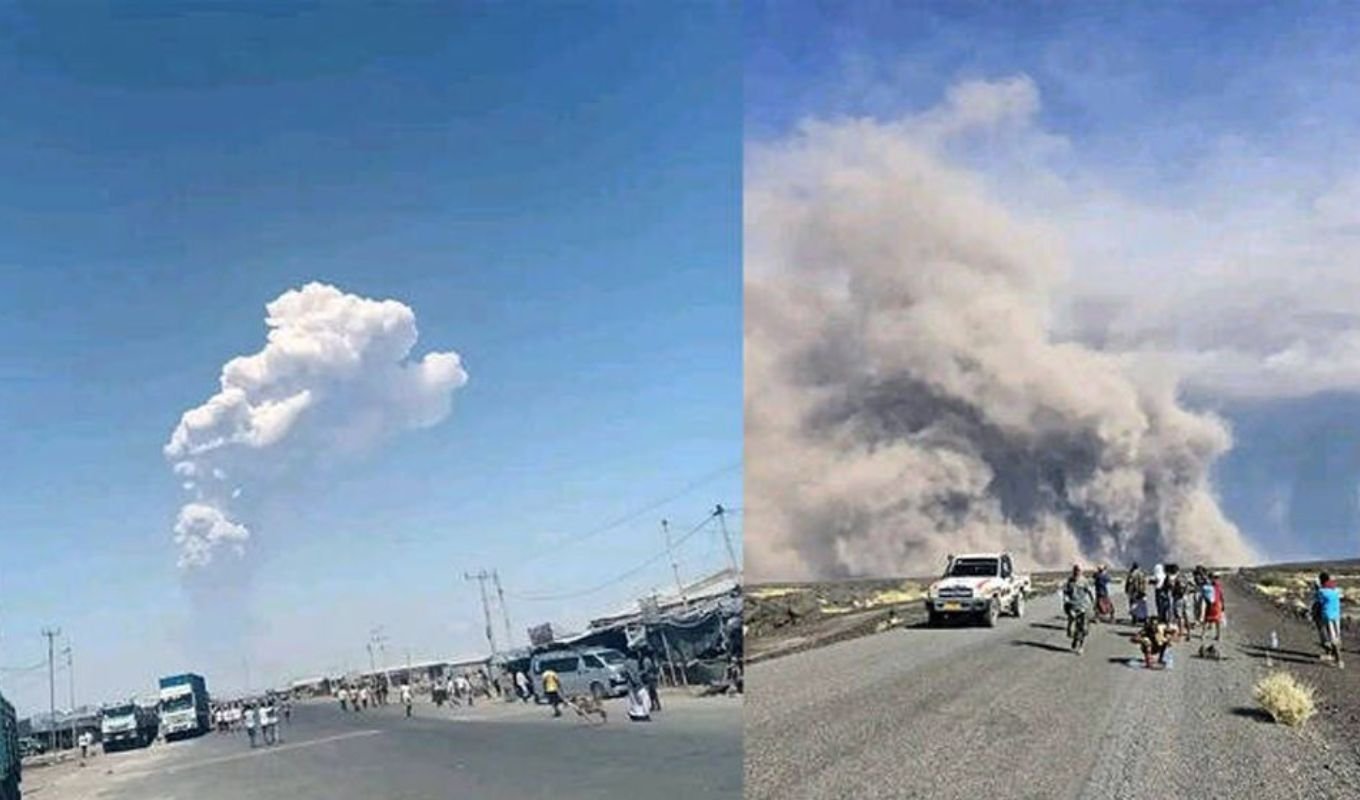
The Highly Gubbi volcano in north-eastern Ethiopia, East Africa, has erupted violently for the first time in nearly 12,000 years, sending dense ash clouds high into the atmosphere and affecting regions thousands of kilometres away. The eruption occurred on Sunday, 23 November, in the Afar region, and lasted several hours, according to reports from the Toulouse Volcanic Ash Advisory Centre (VAAC).
The volcano, approximately 500 metres tall, is located around 800 kilometres north-east of Addis Ababa, near the Eritrean border, within the Rift Valley, where the African and Arabian tectonic plates converge, creating intense geological activity. Viral videos circulating on social media captured a massive column of dense white smoke rising from the crater and drifting slowly toward the Red Sea.
The VAAC reported that the eruption propelled ash up to 14 kilometres into the sky, gradually spreading across Yemen, Oman, northern India, and Pakistan. Local meteorological departments in the affected countries have issued warnings, although no significant damage has been reported in populated areas so far.
Experts have emphasised the historic nature of the eruption. The Smithsonian Institution’s Global Volcanism Program noted that there is no record of Highly Gubbi erupting during the Holocene, i.e., the past 12,000 years. Volcano specialist Simon Carn from Michigan Technological University confirmed via BlueSky that there is no documented eruption of Highly Gubbi in the Holocene, highlighting the rarity and geological significance of the event.
A summary of the eruption’s key details is provided below:
| Detail | Information |
|---|---|
| Volcano | Highly Gubbi |
| Location | Afar region, NE Ethiopia; ~800 km from Addis Ababa |
| Height | ~500 metres |
| Date of Eruption | 23 November 2024 |
| Ash Column | Up to 14 km high |
| Areas Affected by Ash | Yemen, Oman, northern India, Pakistan |
| Historical Activity | No recorded eruption in the Holocene (~12,000 years) |
| Tectonic Setting | Rift Valley; African and Arabian plates converge |
| Casualties/Damage | No major damage reported |
Authorities continue to monitor the situation closely, and aviation agencies have been alerted to the ash clouds due to potential risks to aircraft operations. Scientists are analysing satellite images and seismic data to better understand the eruption and assess any long-term geological impact.
GLIVE/TSN