
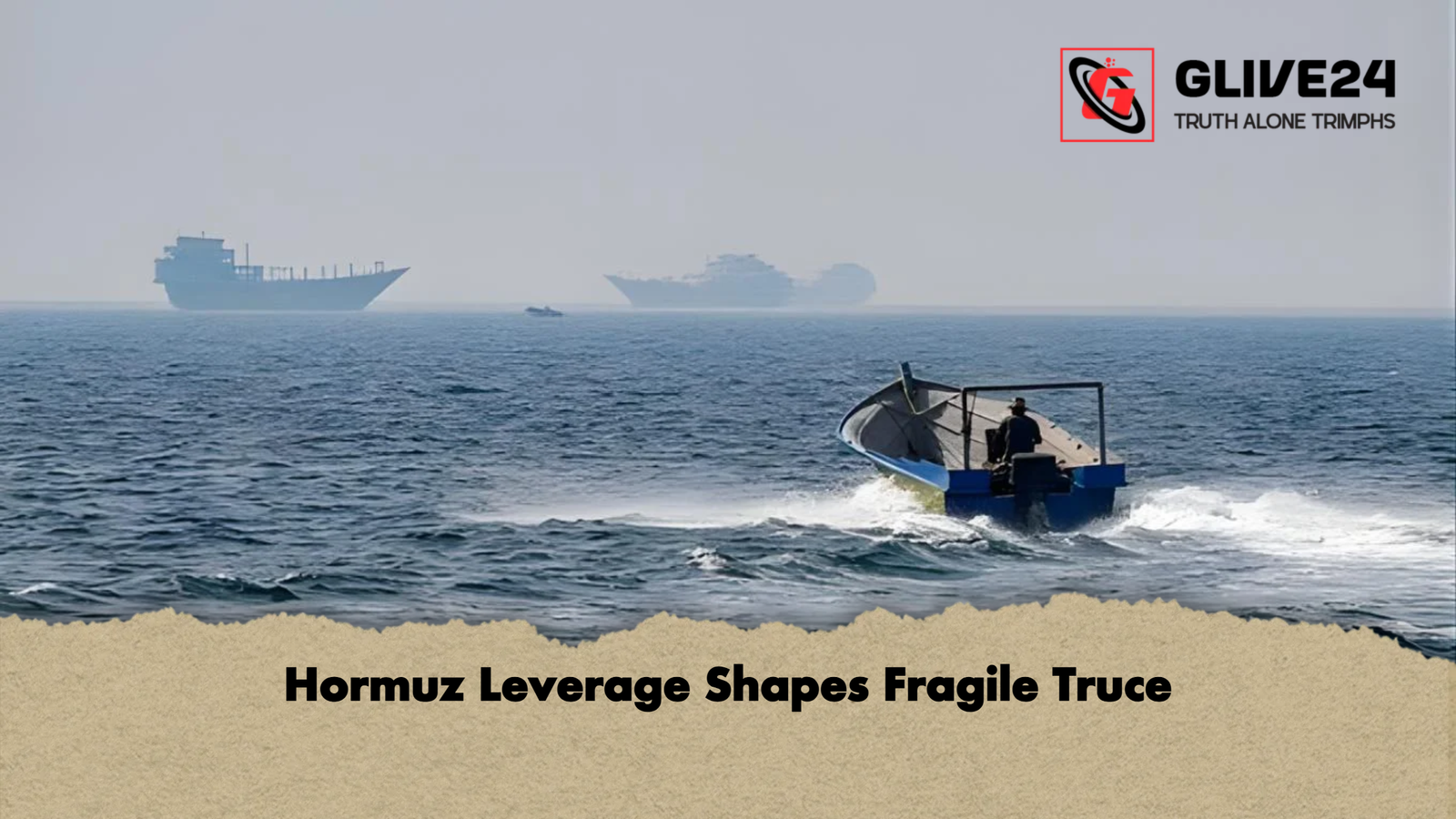
United States President Donald Trump has hailed the recently negotiated two-week ceasefire between Washington and Tehran as a “complete and unconditional victory”. Yet beneath this confident rhetoric lies a far more intricate strategic reality. By maintaining effective control over the Strait of Hormuz, Iran appears to have secured a potent lever over global energy flows and, consequently, the international economy.
The ceasefire’s durability is implicitly contingent upon whether Tehran permits the full reopening of this crucial maritime artery. Carrying roughly one-fifth of the world’s oil and natural gas supplies, the Strait occupies an unparalleled position in global trade. Its operational status has therefore become a central determinant of both market stability and geopolitical bargaining power.
Energy analysts suggest that Iran’s influence stems not from overwhelming military superiority, but from its ability to exploit geographic chokepoints. Brookings Institution energy expert Samantha Gross has argued that even limited disruption capability allows Iran to exert outsized economic pressure. Recent events appear to validate this assessment, as markets reacted sharply to both escalation and de-escalation signals.
Following the ceasefire announcement, crude oil prices fell by an estimated 15–20 per cent, while European natural gas prices also eased. However, Capital Economics Chief Economist Neil Shearing has warned that structural risks remain unresolved. Chief among these is the uncertain status of the Strait itself, which continues to loom over investor sentiment.
Key Indicators of the Crisis
| Indicator | Estimated Impact |
|---|---|
| Share of global oil & gas via Hormuz | ~20% |
| Share of global urea exports | ~33% |
| Duration of disruption | Over 6 weeks |
| Oil price movement (recent) | ↓ 15–20% |
| Iranian daily exports (March) | ~1.85 million barrels |
Despite tentative signs of resumed tanker traffic, disruptions persist. Reports indicate that Iran has intermittently restricted passage following renewed regional tensions, including Israeli military activity in Lebanon. As a result, maritime operations remain only partially normalised, with insurers and shipping firms continuing to price in elevated risk.
The scale of disruption is striking. For more than six weeks, most vessels have been unable to transit the Strait freely—an unprecedented development in modern energy markets. The consequences have rippled worldwide: the Philippines has declared a national energy emergency, European electricity generation costs have surged, and even the United States has experienced rising fuel prices despite its domestic production capacity.
According to Oxford Economics strategist Dan Alamaru, Iran has effectively used control of the Strait as a form of “economic warfare”. This approach has allowed Tehran not only to secure a ceasefire but also to stabilise its domestic political system under external pressure.
Financially, Iran appears to be benefiting as well. In an effort to ease supply constraints, Washington has reportedly relaxed restrictions on approximately 140 million barrels of Iranian oil. Data from Kpler show that Iranian exports reached about 1.85 million barrels per day in March, marking a notable increase.
Moreover, Tehran has capitalised on tighter supply conditions to command improved pricing. Whereas Iranian crude has traditionally traded at a discount of around $10 per barrel relative to Brent, it has recently achieved premiums of up to $3 per barrel in China and $7 in India—an extraordinary reversal of market norms.
Additional concerns centre on the possible formalisation of transit fees. Shipping intelligence firm Lloyd’s List has reported that at least one vessel paid approximately $2 million for passage, fuelling speculation that structured toll systems may soon emerge. There is also growing conjecture that Oman could act as a neutral intermediary, collecting fees and transferring a portion to Iran as compensation for wartime economic losses.
In sum, while the ceasefire has reduced immediate tensions, it has not fundamentally resolved the underlying balance of power. Control of the Strait of Hormuz has evolved beyond a tactical advantage into a strategic instrument—one capable of shaping negotiations, influencing global markets, and redefining geopolitical alignments for the foreseeable future.