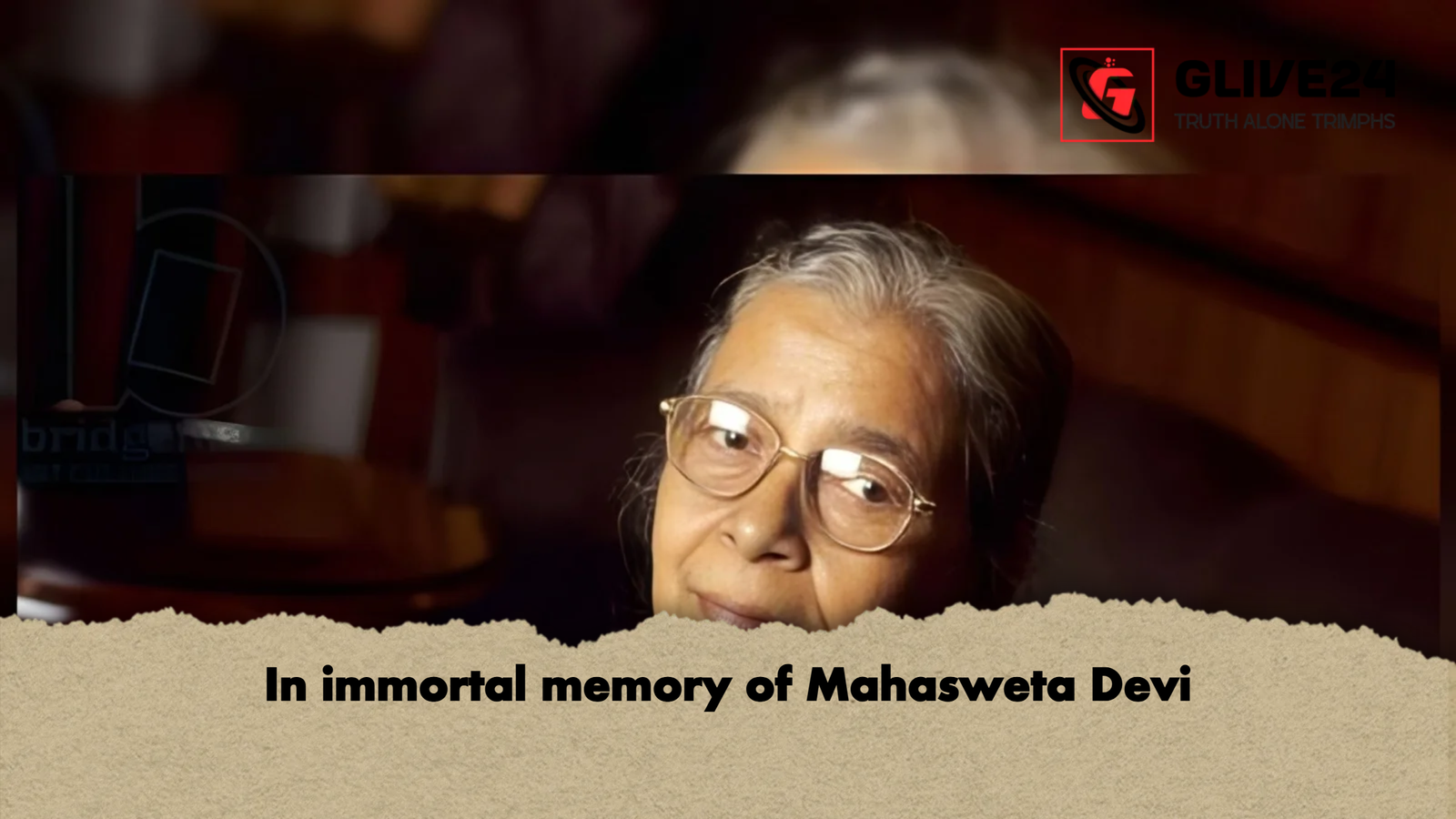
In the annals of Bengali literature and India’s human rights movement, Mahasweta Devi occupies a singular place. She was not merely a powerful writer but a relentless voice for the oppressed, particularly the tribal communities of India, such as the Santhals, and exploited women. Her literary oeuvre resounds with protest, humanity, and an unwavering sense of social justice. Among her extensive body of work, the novel Hajar Churashir Maa brought her international acclaim, portraying a mother’s grief amidst the Naxalite movement and the brutal realities of state violence—a narrative that has become a classic in Bengali literature.
Table of Contents
Early Life and Family Background
Mahasweta Devi was born on 14 January 1926 in Dhaka, then part of British India, into an educated and culturally inclined middle-class family. Her father, Manish Ghatak, was a celebrated writer of the Kallol literary movement, and her uncle was the renowned filmmaker Ritwik Ghatak, whose artistic vision profoundly influenced her own creative consciousness.
| Aspect | Details |
|---|---|
| Date of Birth | 14 January 1926 |
| Birthplace | Dhaka, British India |
| Father | Manish Ghatak, Writer |
| Uncle | Ritwik Ghatak, Filmmaker |
| Spouse | Bijon Bhattacharya, Theatre Personality |
| Child | Nabarun Bhattacharya, Writer |
Education and Career
Mahasweta Devi’s formal education began at Santiniketan, followed by graduation from University of Calcutta and a Master’s in English Literature from Visva-Bharati University. She commenced her professional career in 1964 at Vijaygarh College while actively pursuing journalism and literature. Over time, she evolved from a writer to a field-based human rights activist, advocating tirelessly for tribal communities—from remote villages to the courts.
Literature and Activism
Central to Devi’s writing were the themes of land rights, state oppression, exploitation of women’s bodies and labour, and hidden historical truths. She firmly believed that:
“Writing is not merely art; writing is responsibility.”
Her most notable works include Aranyer Adhikar, Chotti Munda and His Arrow, Streedhanini, Rudali, Titu Mir, Bandoobasti, Byadhkhondo, Shikar Parva, Ganesh Mahima, Neerite Megh, Agnigarbha, Prasthan Parva, Unnatrish Number Dharar Asami, and, of course, Hajar Churashir Maa.
Awards and Recognition
Her extraordinary contribution earned her both national and international recognition:
| Year | Award |
|---|---|
| 1997 | Ramon Magsaysay Award |
| 2006 | Padma Vibhushan |
| 2007 | SAARC Literary Award |
| — | Jnanpith Award |
These accolades celebrated not only her literary excellence but also her unflinching humanitarian and political commitment.
Personal Life and Legacy
Mahasweta Devi was married to eminent theatre personality Bijon Bhattacharya. Their only child, Nabarun Bhattacharya, became a distinctive and rebellious voice in Bengali literature.
Until her passing on 28 July 2016, Mahasweta Devi stood courageously at the forefront of social and political struggles, particularly in movements against land acquisition. She wielded both pen and action to champion the cause of the oppressed.
Her legacy endures—in the language of protest, in the literature of humanity, and in the moral conscience of history.
Tribute to a fearless writer and activist.