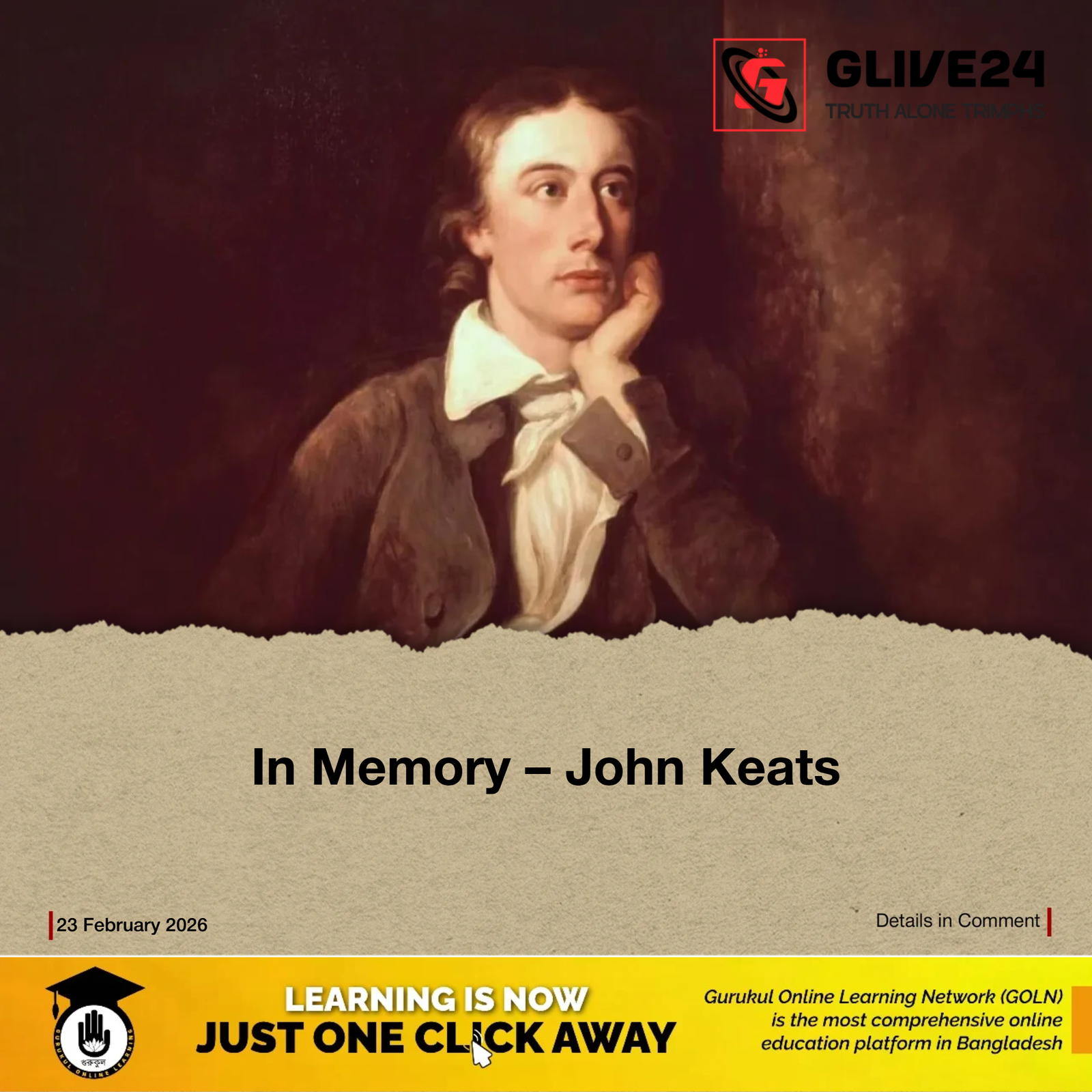
The Eternal Worshipper of Beauty
“Beauty is truth, truth beauty” — this immortal line is far more than a poetic phrase; it stands as a timeless proclamation of humanity’s pursuit of aesthetic and spiritual ideals. Its author, John Keats, a luminous star of the Romantic era, left an extraordinary legacy in world literature despite his tragically short life.
Table of Contents
Early Life and Education
John Keats was born on 31 October 1795 in London. His father, Thomas Keats, began life working in a stable but eventually married the daughter of the stable owner, acquiring ownership of the establishment. John was one of five children, including four brothers and a sister.
His schooling commenced at John Clarke’s school in Enfield, a modest institution that nonetheless offered progressive and creative teaching methods. It was here, under the guidance of Charles Cowden Clarke, that Keats’s poetic talents first began to flourish. Surrounded by literature and music, his imagination was awakened, sowing the seeds of his future literary brilliance.
Shadows of Loss and Struggle
Tragedy struck early: his father died in 1804 when Keats was just eight, and his mother succumbed to tuberculosis in 1810. Orphaned in childhood, he was raised under his grandfather’s supervision. Keats initially trained in medicine and enrolled at St Thomas’s Hospital in London, yet his true passion remained with poetry. Eventually, he abandoned medicine entirely to dedicate himself to literary pursuits.
Literary Ascendancy
| Year | Work | Significance |
|---|---|---|
| 1814 | Imitation of Spenser | First known poetic composition |
| 1817 | Poems | First published collection |
| 1818 | Endymion | Long narrative poem; opening line “A thing of beauty is a joy forever” became legendary |
| 1819 | Various Odes | Includes “Ode to a Nightingale”, “Ode on a Grecian Urn”, and “To Autumn” — celebrated masterpieces of Romantic poetry |
The year 1819 marked the pinnacle of Keats’s creative output, producing odes in which nature, love, mortality, and beauty were intertwined in vivid expression.
Love and Personal Sorrow
Keats fell deeply in love with Fanny Brawne, a young woman whose affections he returned. Yet financial insecurity and his declining health prevented the relationship from reaching full fruition. Combined with the death of his brother Tom and the onset of tuberculosis in his own body, life became a relentless struggle.
Final Years
In 1820, his last poetry collection, Lamia, Isabella, The Eve of St Agnes, and Other Poems, was published to critical acclaim. However, his health deteriorated rapidly, prompting a move to Italy on medical advice. On 23 February 1821, in Rome, John Keats passed away at the age of 25. His tombstone famously reads:
“Here lies one whose name was writ in water.”
Yet history has proven otherwise — his name is etched permanently upon the very bedrock of world literature.
The Legacy of Immortality
Though his life was brief, Keats’s profound sensitivity to beauty, human suffering, and the sublime places him among the foremost Romantic poets. Contemporary with William Wordsworth and Percy Bysshe Shelley, he carved a distinctive voice that remains unmatched.
John Keats teaches us:
Beauty is not merely external, it resides in deep perception.
Truth is not only reasoned, it shines in the heart.
A short life can yield infinite creation.
For these reasons, John Keats remains the eternal worshipper of beauty, a guiding light for poets and readers alike.