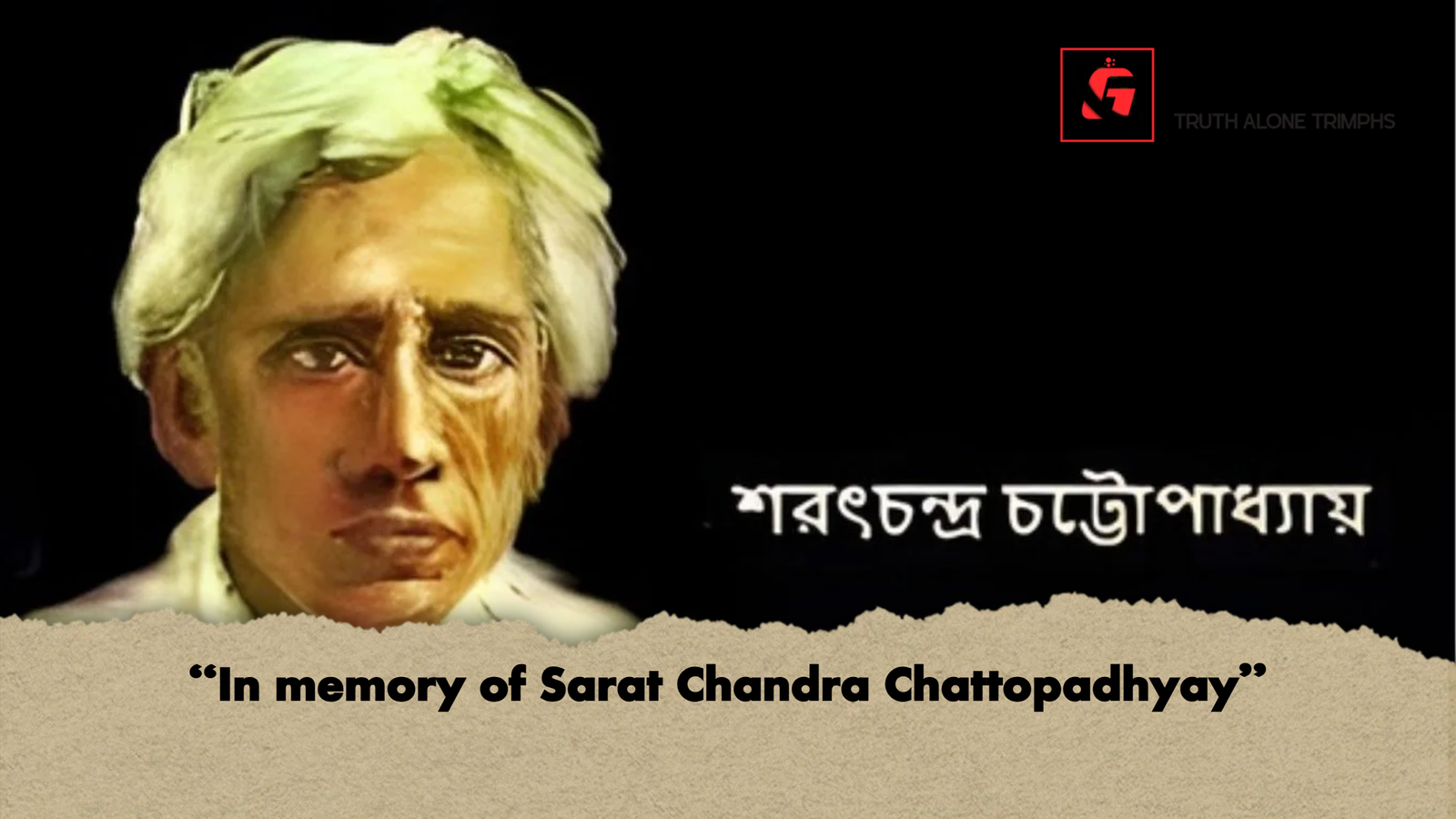
Today, 16 January, marks the death anniversary of Sarat Chandra Chattopadhyay, one of Bengali literature’s most revered and enduring novelists. His works transcend the boundaries of time, remaining as relevant and cherished today as when they were first written. Through his stories, he masterfully depicted the spectrum of human experience—joy and sorrow, love and separation, social inequality, and moral dilemmas—striking a deep chord in the hearts of readers across generations.
Sarat Chandra was born on 15 September 1876 in Debanandapur, Hooghly district. His formative years were spent in Bhagalpur, a period that profoundly shaped his literary sensibilities. It was during this time that he cultivated his empathy for humanity and his acute awareness of societal issues.
He received his early education at Debanandapur Hooghly Branch School and later at Bhagalpur Durgacharan M.E. School. He subsequently passed the entrance examination from T.N. Jubilee Collegiate School and enrolled in the F.A. class. Despite financial hardships and family difficulties truncating his formal education, these challenges never hindered his literary pursuits.
Sarat Chandra’s professional career further enriched his writing. He served as Assistant Settlement Officer in Bunelli State, a translator at Kolkata High Court, and a clerk in the Burma Railway Accounts Department. These experiences lent his work both authenticity and depth, reflecting the complexities of real life.
Notable Literary Works
| Novel / Story | Publication / Recognition | Highlights |
|---|---|---|
| Boro Didi | Bharati Magazine | First novel; created a literary sensation |
| Devdas | Widely popular | Classic tale of love; adapted into multiple films |
| Srikanta | Widely read | Explores social and moral conflicts |
| Grihadaha | Critically acclaimed | Addresses societal superstition and personal dilemmas |
| Pather Dabi | Critically acclaimed | Revolutionary spirit against British colonial rule |
Other significant works include Bindur Chhele, Parineeta, Baikunther Will, Charitraheen, Nishkriti, Dena-Paona, and Shesh Prashna. His essays, notably Narir Mulya and Swadesh O Sahitya, reflect his thoughtful literary philosophy.
Sarat Chandra also had a flair for visual arts; his oil painting “Mahashweta” is celebrated as a notable piece in Bengali art. For his unparalleled contribution to literature, he was honoured with the Kuntalin Award, Jagattarini Gold Medal, and a D.Litt from the University of Calcutta.
On 16 January 1938, Sarat Chandra Chattopadhyay passed away at Park Nursing Home, Kolkata. On this solemn day, we remember him with deep reverence, celebrating a legacy that continues to resonate in the hearts of readers and ensuring his place as an immortal figure in Bengali literature.