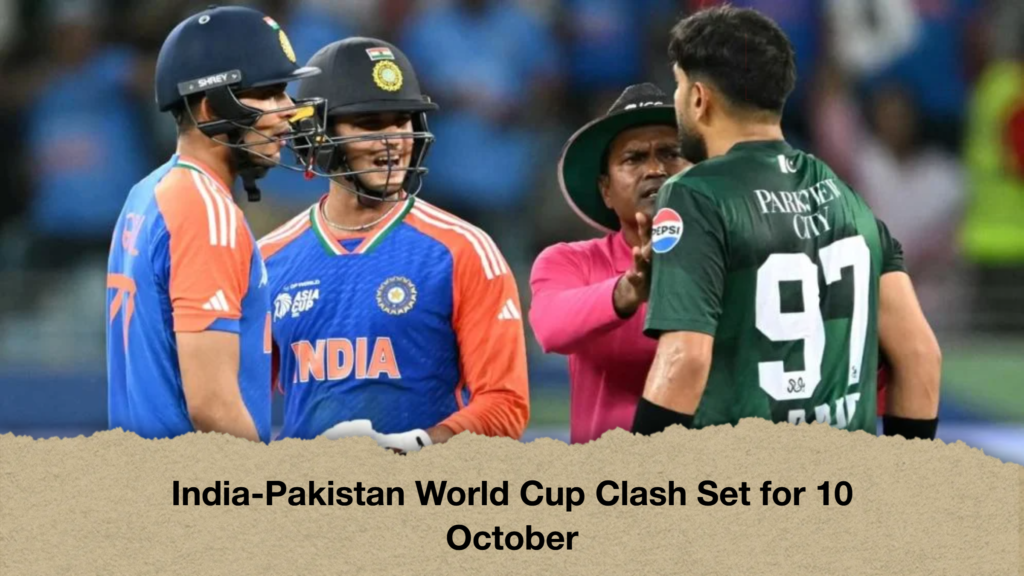
India and Pakistan will meet on 10 October in the 2027 Cricket World Cup, with the schedule for the tournament finalised about a year before the event.
The two Asian rivals rarely face each other outside tournaments organised by the International Cricket Council or the Asian Cricket Council, making their meetings among the most closely followed fixtures in international cricket. The political tensions between the two countries have limited regular bilateral cricket, increasing anticipation whenever they are drawn together in a major tournament.
The 2027 World Cup is scheduled to take place in October and November, provided the tournament proceeds according to the current plan. The schedule was announced at an ICC event in Cape Town, South Africa, on Thursday.
The tournament will begin on 7 October with a meeting between India and Australia, the two finalists from the previous World Cup. Three days later, India will face Pakistan in what is expected to be one of the most prominent fixtures of the group stage.
India have been placed alongside Pakistan, Afghanistan, Australia, Zimbabwe and one qualifier. Group B consists of Bangladesh, England, South Africa, Sri Lanka, New Zealand and a second qualifying team.
The tournament has a multi-stage qualification structure before the main contest reaches the final stages.
The opening phase will involve the three lowest-ranked teams among the 14 participating nations in the qualification process. This stage, referred to as the ‘Super Series’, will follow a round-robin format, with each team playing the other two. The team finishing at the top will advance to the next round.
The second round will feature 12 teams and 30 matches. The teams will be divided into two groups of six, with one of the 12 having advanced from the opening stage. Each team will play every other side in its group in a round-robin format.
Those matches are scheduled to run from 7 to 24 October. The top three teams from each group will progress, while the best-performing fourth-placed team across the two groups will also advance to the next phase, known as the ‘Super 7’.
The Super 7 stage will begin on 25 October and consist of 21 round-robin matches. The seven teams will each play six matches, facing every other side once. Crucially, points earned in the previous round will not be carried forward, meaning every team will begin the Super 7 stage with zero points.
The four highest-placed teams in the Super 7 standings will qualify for the semi-finals. The team finishing first will play the fourth-placed side, while the second- and third-placed teams will meet in the other semi-final.
Seven teams have already been assigned designated positions for the Super 7 stage. India are listed as A1, followed by Australia as A2, Pakistan as A3 and England as A4. New Zealand are B1, South Africa B2 and Sri Lanka B3.
If one of the designated teams fails to reach the Super 7, the team replacing it will inherit that position. For example, if Afghanistan qualify instead of Australia, Afghanistan would take the A2 position. Similarly, if Bangladesh reach the Super 7 while Sri Lanka fail to do so, Bangladesh would assume the B3 position.
The semi-finals are scheduled for 17 and 18 November, followed by the final on 21 November.
Because of their higher ranking, India will not have to participate in the opening qualification stage. The side led by Shubman Gill will enter the competition in the second round.
India are scheduled to play at least five matches in the second round. If they progress to the Super 7, they will play another six matches there, before potentially appearing in a semi-final and the final.
Should India reach the final, they would play 13 matches across their World Cup campaign. If both India and Pakistan progress to the Super 7 stage, they could have another opportunity to meet beyond their scheduled 10 October group fixture.