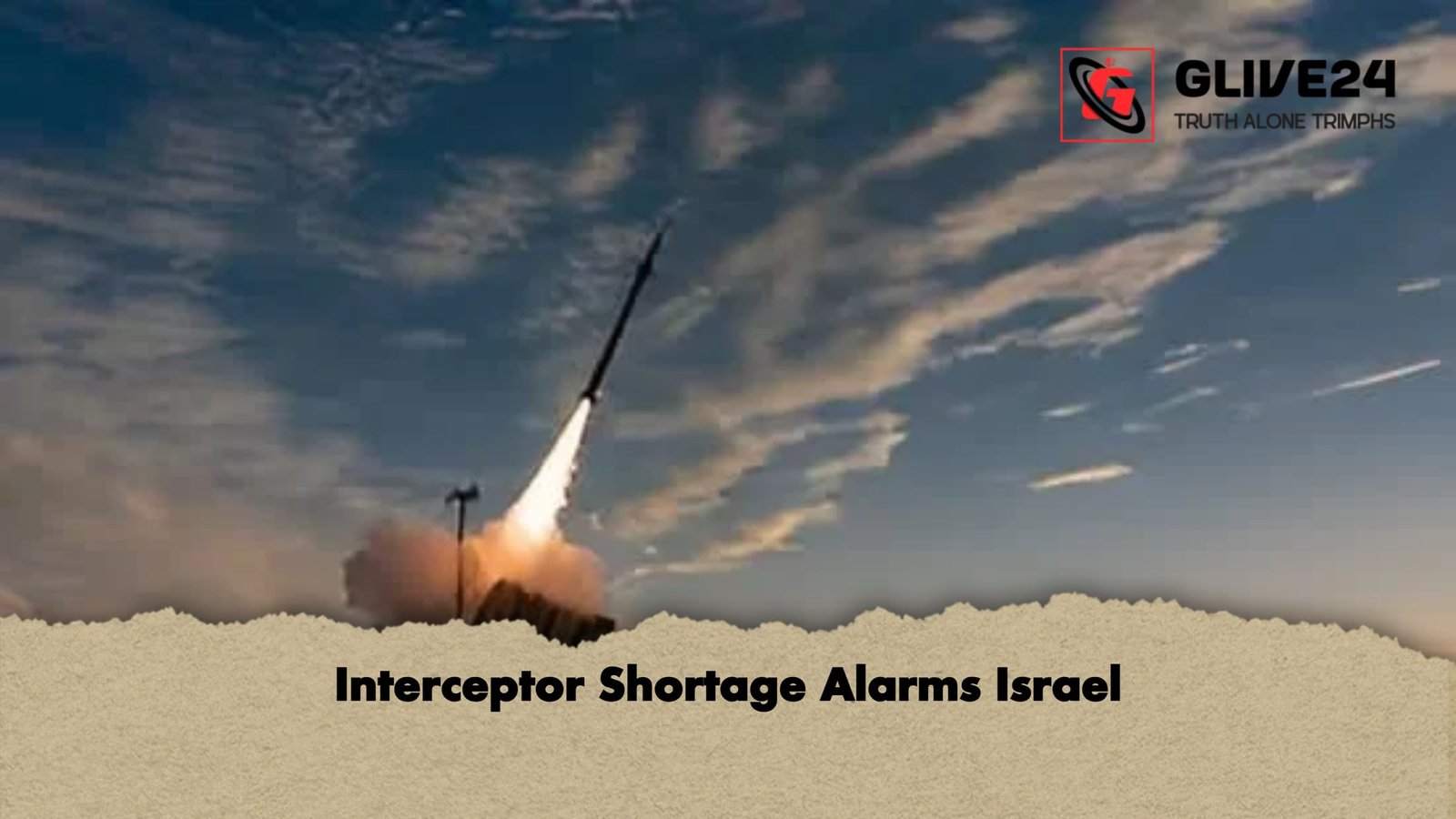
Israel is facing mounting pressure on its air defence capabilities as stocks of missile interceptors are rapidly depleting amid an intensifying conflict with Iran. Entering the third week of hostilities, Israeli officials have reportedly warned the United States that sustaining current levels of interception against waves of incoming missiles is becoming increasingly difficult.
According to defence sources, the strain on Israel’s interceptor reserves did not arise overnight. During last year’s confrontation with Iran, the country expended a substantial portion of its stockpile, leaving its missile defence systems comparatively weakened even before the present escalation began. The renewed barrage of Iranian missiles—fired in large numbers and at regular intervals—has now placed Israel’s long-range air defence network under severe and continuous stress.
Military analysts note that Iran has further complicated interception efforts by equipping some of its missiles with cluster munitions. These weapons disperse multiple submunitions mid-flight, effectively multiplying the number of targets that must be neutralised. As a result, Israel is often compelled to deploy several interceptors against a single incoming threat, accelerating the depletion of its already strained reserves.
Officials in Washington were reportedly aware of the likelihood of such a scenario months in advance. One senior American official remarked that the current shortage was “anticipated and factored into prior assessments.” Nevertheless, while the United States maintains that its own interceptor stockpiles remain sufficient, uncertainty persists over whether it will supply Israel with additional systems in the near term. Concerns are growing that, should the conflict evolve into a prolonged war, missile defence resources could be exhausted at a pace difficult to sustain.
Advanced Missile Threat Intensifies Concerns
A significant new dimension has been added to the conflict with Iran’s reported deployment of the Sejjil-2 missile, sometimes referred to as the “dancing missile.” This marks one of the first instances in which such advanced weaponry has been used against both Israel and United States military installations in West Asia.
Iran’s Revolutionary Guard has claimed responsibility for coordinated strikes involving Sejjil-2 missiles and drones targeting key American bases, including Al-Harir Air Base in Iraq, Ali Al Salem Air Base in Kuwait, and Camp Arifjan. These attacks underscore a broader regional escalation and highlight the growing sophistication of Iran’s missile arsenal.
The Sejjil-2 poses a formidable challenge to even the most advanced air defence systems. Unlike conventional ballistic missiles, it is capable of altering its trajectory during flight, making it extremely difficult for radar systems to predict its path accurately. This erratic movement is what has earned it the nickname “dancing missile.” While defence systems attempt to calculate its next position, the missile can abruptly change direction, thereby evading interception.
In addition, the missile is believed to incorporate anti-radar coatings, reducing its detectability, and may accelerate to hypersonic speeds during its terminal phase. These combined features drastically shorten the reaction time available to defence systems, rendering interception highly challenging, if not nearly impossible, under certain conditions.
Overview of the Current Situation
| Aspect | Current Status |
|---|---|
| Interceptor stockpiles | Rapidly diminishing |
| Nature of Iranian attacks | Sustained, high-volume missile barrages |
| Advanced weaponry used | Sejjil-2 missiles and drones |
| Key challenge | Multiple targets, evasive flight paths |
| US position | Adequate reserves; support under consideration |
As the conflict continues, Israel’s ability to maintain an effective missile shield will depend not only on its remaining interceptor capacity but also on the strategic decisions of its allies. The evolving nature of missile technology, coupled with sustained operational demands, suggests that the coming weeks may prove निर्णভাবে critical for the region’s security landscape.