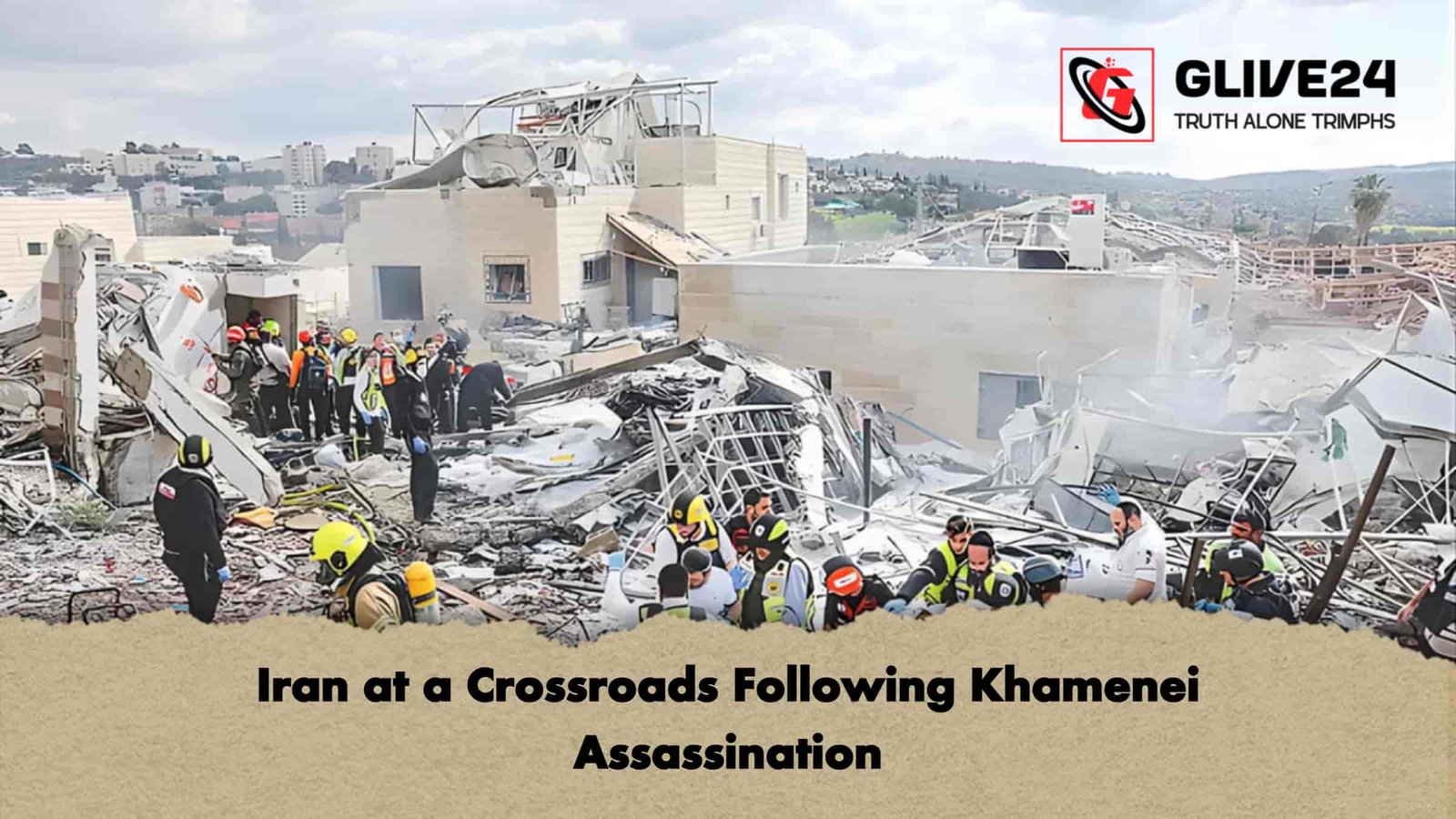
The assassination of Iran’s Supreme Leader, Ayatollah Ali Khamenei, has plunged the Middle East into an unprecedented state of uncertainty. Regional sources claim that the strike was carried out jointly by the United States and Israel, although official confirmation remains absent. Khamenei, who had led the Islamic Republic for more than three decades, was central to both the political and ideological framework of the nation. His sudden absence has destabilised the balance of power, raising profound concerns over succession, internal stability, and potential regional conflicts.
Within hours of the news breaking, Tehran reportedly responded with drone and missile strikes. Damage has been reported to civilian infrastructure in several locations, including Minab city in Hormozgan Province. Local sources indicate that even a girls’ educational institution sustained partial destruction. Although reliable casualty figures are not yet available, analysts warn that the humanitarian impact will likely deepen the suffering of a population already reeling from an ongoing economic crisis.
Signs of Power Transition
Since assuming office in 1989, Khamenei guided Iran’s security policy, regional alliances, and nuclear programme. Analysts note, however, that real power had been gradually shifting prior to his death. In recent months, the influence of the Supreme National Security Council and the Islamic Revolutionary Guard Corps (IRGC) has become increasingly visible amid heightened military tensions.
The table below outlines the likely roles of key institutions in the current transitional period:
| Institution / Faction | Potential Role | Current Position |
|---|---|---|
| Supreme National Security Council | Military and strategic coordination | Active in orchestrating state responses |
| Islamic Revolutionary Guard Corps (IRGC) | Internal security and external operations | Well-organised and powerful |
| Reformist and Opposition Groups | Mobilising public opinion | Divided leadership |
| Religious Leadership | Legitimising succession | Significant differences of opinion |
Despite Khamenei’s assassination, the state apparatus has not collapsed. The IRGC’s firm control over both the economy and security infrastructure suggests that any transition will be tightly monitored and controlled.
Domestic Unrest and International Repercussions
In December, nationwide protests erupted over economic hardship and political repression. While security forces suppressed these movements, public discontent persisted. Former US President Donald Trump expressed support for demonstrators at the time and, following the recent assassination, urged Iranians to “reclaim their country.”
However, political reality remains complex. Exiled royal heir Reza Pahlavi has been discussed as a potential alternative, but no unified domestic leadership has yet emerged. Historian Arash Azizi cautions that such transitional periods are often the most perilous, with mismanagement risking civil conflict.
Regional Strategic Calculations
Israeli Prime Minister Benjamin Netanyahu has called for Iranians to take to the streets. Yet the question now dominating regional discourse is whether a stable, reformist Iran would advance the interests of neighbouring powers—or whether a weakened, divided Iran might be strategically advantageous.
In sum, Iran stands at a precarious juncture. External military pressure can topple regimes, but sustainable political structures depend on institutional resilience, leadership cohesion, and civic engagement. The path forward will be determined by the decisions and capacities of the country’s institutions, leaders, and citizens alike.