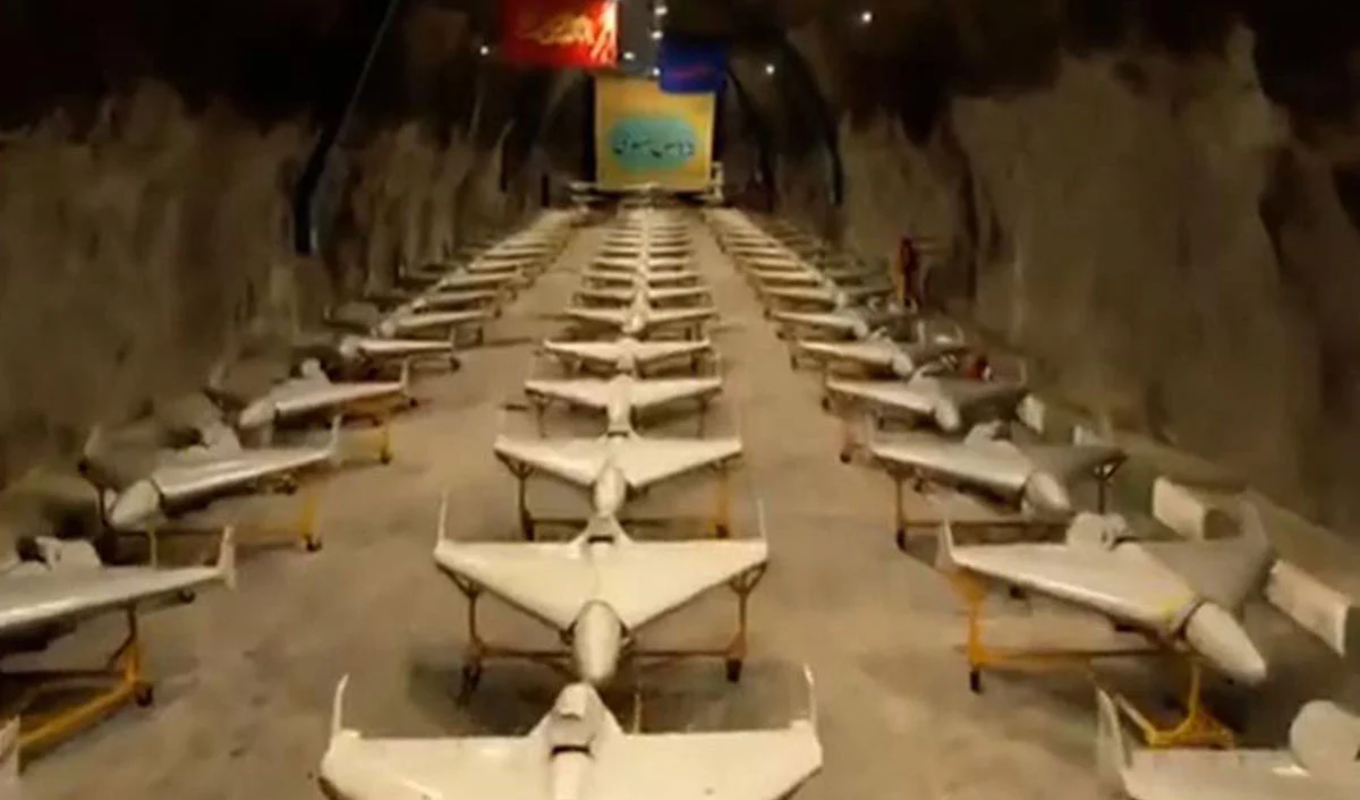
Iran has released unprecedented footage revealing thousands of drones stored in a subterranean facility, signalling its growing aerial capabilities amid escalating tensions in the Middle East. The video, released by the state-run Fars News Agency, depicts rows of drones meticulously aligned, with several positioned atop rocket launchers. The tunnel’s walls are adorned with the Iranian flag and large portraits of the late Supreme Leader, Ayatollah Ali Khamenei.
No concrete information regarding the location, date, or specific drone models was provided. Analysts suggest the timing of the release is likely strategic, serving as both a domestic morale booster and a deterrent message to regional adversaries.
International Reactions
CNN and other international outlets reported on the footage, noting that similar drones have previously been used by Iran in strikes against U.S. bases and Israeli targets across the region. While the media reports did not detail the drones’ technical specifications, the footage has prompted renewed attention to Iran’s unmanned aerial capabilities.
Experts suggest the release has multiple objectives: to display military strength, demonstrate domestic drone production, and reinforce internal messaging about Iran’s defence readiness.
Visual Features of the Facility
The footage provides a rare insight into a highly secure underground complex. Key features observed include:
| Feature | Observation |
|---|---|
| Number of Drones | Thousands, neatly arranged |
| Drone Placement | Some mounted on rocket launchers |
| Facility Type | Underground tunnel/bunker |
| Symbolism | Iranian flag and portraits of Ayatollah Ali Khamenei |
| Source | Fars News Agency |
Strategic and Security Implications
Military analysts emphasise that storing drones underground increases their survivability against pre-emptive attacks, allowing Iran to maintain operational readiness even under the threat of airstrikes. Such a public display may also function as a deterrent, signalling to rivals that Iran can deploy unmanned aerial vehicles effectively despite regional tensions.
Despite the visual impact, the lack of technical data—such as range, payload capacity, or launch mechanisms—limits precise evaluation of operational capabilities. Nevertheless, the footage is likely to raise security concerns in Israel, the United States, and allied countries in the region, all of which have been targets of Iran’s drone operations in past conflicts.
This revelation underscores the increasing role of unmanned aerial vehicles in modern warfare and highlights the strategic significance of drone technology in Iran’s military doctrine. Analysts continue to monitor developments closely, anticipating potential regional countermeasures and further demonstrations of unmanned aerial capabilities.