Iran has warned that renewed military attacks by the United States and Israel could provoke retaliatory strikes against critical oil and technological infrastructure across seven Gulf countries, raising concerns that another confrontation could spread throughout the Middle East and disrupt global energy markets.
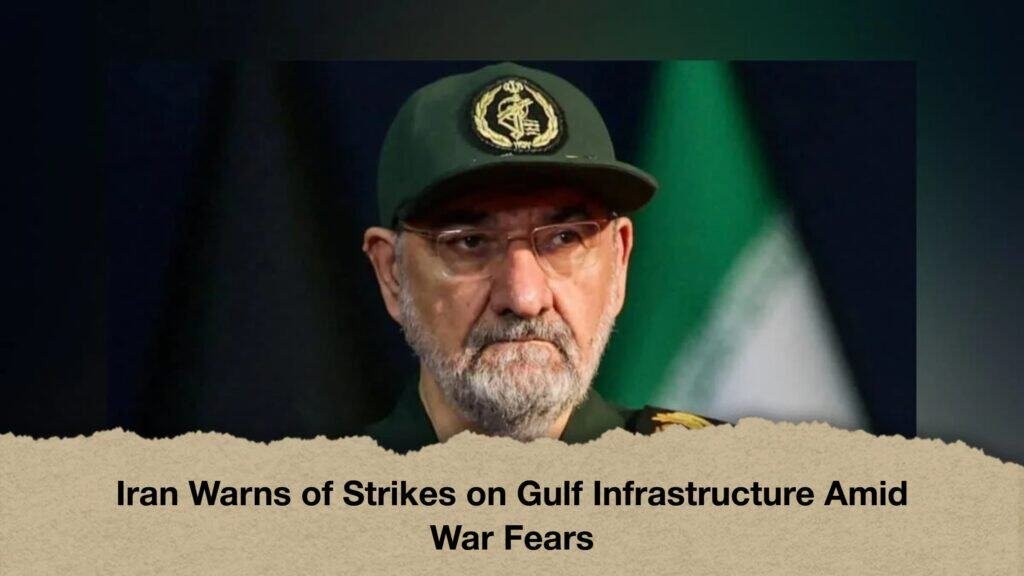
According to Iranian media reports, Mohsen Rezaei, identified as the secretary of Iran’s National Security Council, said Tehran could target oil installations, undersea communications cables, data centres and artificial intelligence (AI) infrastructure if Washington and Tel Aviv launched another offensive.
The warning comes amid reports of growing American and Israeli military preparations, diplomatic uncertainty and renewed tensions over commercial shipping through the strategically important Strait of Hormuz.
Rezaei reportedly warned that countries assisting attacks against Iran should not expect their economic infrastructure to remain secure. He indicated that any attempt to damage Iran’s economic lifelines could trigger retaliation against facilities supporting the economies of those involved.
The seven Gulf countries referred to in the warning were not individually identified in the supplied reports.
Tehran Signals Broader Military Response
Mehdi Mohammadi, an adviser to Iranian Parliament Speaker Mohammad Bagher Ghalibaf, has claimed that US President Donald Trump and Israeli Prime Minister Benjamin Netanyahu have reached an agreement in principle on launching another attack against Iran.
Mohammadi, who has been involved in discussions concerning tensions between Tehran and Washington, acknowledged that uncertainty remains over whether such an operation could achieve its intended objectives.
He said Iranian authorities regard another potential conflict as an existential threat rather than a limited military confrontation.
According to Mohammadi, a third war within two years could have particularly serious consequences, prompting Tehran to prepare a response that would not necessarily observe conventional geographical or operational boundaries.
His remarks suggest that Iran could expand retaliatory operations beyond the immediate territory of countries directly involved in an attack.
Iranian media reports indicate that Tehran is considering a wider range of potential targets, including digital communications infrastructure, major computing facilities and installations associated with artificial intelligence.
Such infrastructure has become increasingly important to Gulf economies as countries across the region invest in technological development, financial services and advanced digital systems.
Damage to undersea communications cables or major data centres could disrupt telecommunications, financial transactions and other essential services across several countries.
US Election Raises Questions Over Possible Strikes
Reports of a potential American military operation have intensified ahead of the United States midterm elections scheduled for 3 November.
Several US media outlets have claimed that military advisers have prepared detailed lists of Iranian targets for possible operations after the elections.
The reported targets include missile installations, oil infrastructure and facilities associated with Iran’s nuclear programme.
According to the accounts, President Trump has stepped back from decisions to launch renewed attacks against Iran on seven occasions over the past four months.
However, with diplomatic negotiations reportedly reaching an impasse, American officials are said to be reviewing several military options.
The reports do not establish that a final decision to launch another offensive has been taken.
Meanwhile, the United States and Israel have reportedly continued joint military exercises involving aircraft movements and preparations for possible operations through Iraqi airspace.
US news outlet Axios reported that dozens of Israeli fighter aircraft flew near Iran’s border earlier this week, adding to speculation about the possibility of renewed hostilities.
The reported activity has increased concerns that military preparations on either side could heighten the risk of confrontation.
Netanyahu and Hegseth Discuss Military Options
Israeli Prime Minister Benjamin Netanyahu met US Defence Secretary Pete Hegseth in Israel on Monday amid speculation about a possible coordinated military operation against Iran.
According to the reports, their discussions covered the potential timing and objectives of a joint offensive.
The political implications of such an operation, including its possible effect on Netanyahu’s re-election prospects, were also reportedly considered.
One account claimed that Netanyahu would prefer Iran to initiate military action before Israel and the United States launched a broader response.
However, the reported details of the private discussions have not been independently confirmed.
The Trump administration is also said to be considering a substantial reinforcement of American forces in the Middle East by November.
The proposed deployment could include three aircraft carriers, several thousand Marines, fighter aircraft and specialised military units capable of conducting complex operations.
If implemented, the deployment would significantly increase American military capabilities in the region at a time when relations with Tehran remain strained.
Strait of Hormuz Shipping Incidents Heighten Tensions
Fresh claims of attacks against commercial vessels in the Strait of Hormuz have added another dimension to the escalating crisis.
On Wednesday, the naval branch of Iran’s Islamic Revolutionary Guard Corps (IRGC) claimed to have launched simultaneous attacks against four commercial ships attempting to navigate the strategic waterway.
The IRGC alleged that the vessels had been involved in transferring oil to other ships.
It also claimed that three additional vessels had sustained damage following mine explosions in the strait.
The circumstances surrounding the alleged incidents, including the identities of the vessels and the extent of any damage, could not be independently verified.
The Strait of Hormuz is one of the world’s most important maritime passages, connecting the Persian Gulf with the Gulf of Oman and international shipping routes.
Large volumes of crude oil, petroleum products and liquefied natural gas pass through the waterway on their way to international markets.
Any prolonged disruption to commercial shipping could have serious consequences for energy-importing countries, particularly those in Asia and Europe.
Even limited attacks or threats against merchant vessels can increase insurance premiums, transport costs and uncertainty surrounding global supply chains.
Oil Prices Rise Amid Supply Concerns
Growing fears of renewed military confrontation have reportedly contributed to instability in international energy markets.
According to the supplied report, Brent crude reached $113.40 per barrel, placing it among the higher price levels recorded in the recent period.
The possibility of disruption to Gulf oil exports has raised concerns about the availability and cost of energy supplies.
A prolonged interruption to shipments through the Strait of Hormuz could force importing countries to seek alternative sources, potentially increasing transport costs and placing further pressure on international oil prices.
Higher energy prices can affect manufacturing, agriculture, transportation and household expenditure.
For countries heavily dependent on imported fuel, sustained price increases could worsen inflationary pressures and place additional strain on foreign currency reserves.
The consequences would not necessarily remain confined to the energy sector. Rising production and distribution costs could eventually be reflected in the prices of food, industrial goods and essential services.
Fire at Iranian Aluminium Plant Raises Questions
Against the backdrop of growing military tensions, a major fire has also been reported at an aluminium factory in Arak, a city in central Iran.
The incident has prompted speculation about possible sabotage or other hostile activities inside the country.
However, the cause of the fire has not been established, and there is no independently confirmed evidence linking the incident to foreign involvement.
The development comes as Iranian authorities face heightened concerns about the security of industrial and strategic facilities.
Although the circumstances remain unclear, the incident has contributed to uncertainty surrounding the country’s internal security situation.
Experts Warn of Water and Electricity Shortages
Reza Nasri, an international law specialist described as close to Iran’s Foreign Ministry, has warned that another war could spread far beyond the countries directly involved.
He expressed concern that a regional conflict could expose electricity grids, desalination facilities, oil refineries and major ports to military attacks.
Such infrastructure plays a crucial role in sustaining daily life across the Gulf.
Several countries in the region rely heavily on desalination plants to convert seawater into drinking water. Serious damage to these facilities could therefore disrupt access to safe water for large populations.
Attacks against electricity networks could have equally severe consequences, affecting hospitals, communications systems, transport services and industrial production.
Nasri warned that widespread infrastructure damage could create humanitarian emergencies and force people to leave affected areas.
He also raised the possibility that a major regional conflict could increase migration pressures towards Europe as displaced populations seek safety outside the Middle East.
According to Nasri, a complete closure of the Strait of Hormuz could cause a dramatic rise in global oil prices and potentially contribute to an international economic recession.
He argued that a prolonged conflict would also impose significant economic costs on Israel while creating political difficulties for the Trump administration.
His assessment reflects concerns that a war involving several regional powers could become increasingly difficult to contain once critical civilian infrastructure was affected.
Iranian Military Units Reportedly Ordered to Prepare
Iran’s Fars News Agency, which is regarded as close to the IRGC, has reported that military and operational units have received instructions to prepare for the possibility of a major conflict.
According to the agency, Iranian authorities are considering a wider retaliatory strategy in the event of renewed attacks.
The report suggested that the killing of senior Iranian officials or civilian casualties during another confrontation could prompt Tehran to expand its response beyond military installations.
Political targets could also be considered, according to the reported warning.
Such threats have added to fears that any renewed hostilities could develop into a sustained confrontation involving military, political and economic targets across the region.
The reported preparations come amid uncertainty over whether diplomatic negotiations can produce an agreement before tensions escalate further.
Istanbul Meeting Seeks Diplomatic Breakthrough
Despite the increasingly confrontational rhetoric, diplomatic efforts to prevent another war remain under way.
Representatives from several countries are expected to meet in Istanbul on Friday to discuss developments involving Iran, Yemen and Palestine.
The meeting is expected to bring together foreign ministers from three European countries alongside representatives from Turkey, Saudi Arabia, Pakistan and Egypt.
The discussions are intended to explore a coordinated approach to regional security challenges and examine possible ways of reducing tensions.
The gathering comes as reports of military preparations by both Washington and Tehran have raised concerns about the risk of renewed hostilities.
The participation of regional and European representatives reflects the wider international implications of the crisis, particularly its potential effects on energy security, maritime trade and humanitarian conditions.
Pakistan-Linked Mediation Revives Ceasefire Proposals
Separate diplomatic discussions involving Iranian and Pakistani intermediaries have also reportedly resumed this week in an attempt to identify a possible path towards a ceasefire.
The negotiations are said to involve several proposals previously considered by the parties.
Among them is the possibility of lifting restrictions on shipping through the Strait of Hormuz.
Another proposal would allow United Nations nuclear inspectors to visit Iranian nuclear facilities damaged by bombing.
The discussions also reportedly include arrangements under which Iran’s stockpile of highly enriched uranium could be transferred to a third country.
In exchange, Tehran could receive access to several billion dollars in Iranian assets currently frozen overseas.
Such an arrangement could potentially address some of the immediate security concerns surrounding Iran’s nuclear programme while providing economic incentives for de-escalation.
However, no final agreement has been reported, and it remains unclear whether the parties can overcome the differences that have prevented previous diplomatic efforts from succeeding.
Regional Stability and Global Economy Face Uncertainty
The latest warnings from Tehran underline the increasingly complex nature of the confrontation between Iran, Israel and the United States.
Iran’s stated willingness to target oil facilities, undersea communications cables, data centres and AI infrastructure suggests that another war could threaten sectors extending far beyond traditional military operations.
The economic implications could be substantial. Gulf energy exports remain vital to international markets, while the region’s expanding digital infrastructure supports financial services, communications and other essential economic activities.
Damage to such facilities could disrupt business operations and civilian services even in countries not directly participating in military action.
At the same time, reports of American and Israeli military preparations have reinforced fears that diplomatic efforts may struggle to prevent further escalation.
The outcome of the proposed Istanbul meeting and the ongoing mediation discussions could therefore prove significant.
For now, the situation remains marked by competing military threats, reports of operational preparations that have not been independently verified and efforts to secure a negotiated settlement.
Whether those diplomatic initiatives succeed will help determine if the current confrontation can be contained or develops into a broader conflict with serious consequences for regional stability and the global economy.