
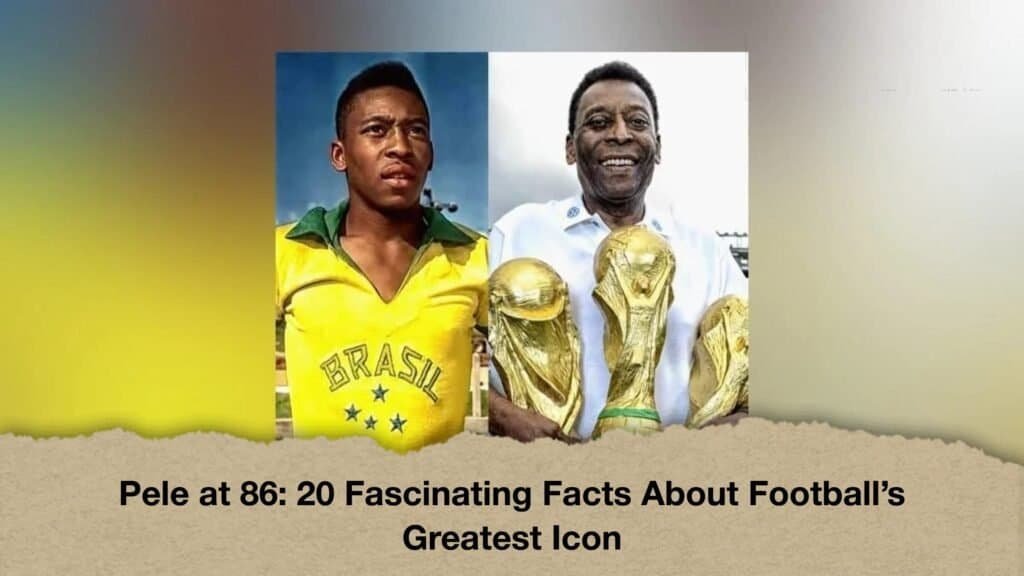
Born on 23 October 1940 in Três Corações, in Brazil’s Minas Gerais state, Pelé rose from humble beginnings to become a global sporting phenomenon. His journey from a young boy playing football with limited equipment to lifting the World Cup three times is one of the most remarkable stories in sporting history.
Pelé’s achievements extended well beyond the pitch. His life was filled with intriguing stories, remarkable records and moments that demonstrated the extraordinary reach of his fame. From the origins of his famous nickname to his historic 1,000th goal, many aspects of his career continue to fascinate football supporters.
On the anniversary of his birth, here are 20 fascinating facts about the Brazilian legend.
20 Remarkable Facts About Pelé
1. His name was inspired by Thomas Edison
Pelé’s full name was Edson Arantes do Nascimento. His parents named him Edson in honour of the American inventor Thomas Edison, although the spelling differed slightly. Pelé grew up in a modest household, where financial limitations did little to diminish his passion for football. He eventually became one of the most recognisable athletes in the world.
2. The curious origins of the name ‘Pelé’
As a child, he was known within his family as ‘Dico’. The story commonly associated with his famous nickname dates back to his schooldays, when he reportedly mispronounced the name of a goalkeeper known as Bilé, who played for a local team. His classmates began calling him ‘Pelé’, and the nickname gradually stuck. It would eventually become one of the most celebrated names in sporting history.
3. He reportedly disliked his own nickname
Despite the worldwide fame associated with the name Pelé, the footballer reportedly disliked it during his childhood. He considered it childish and preferred his given name, Edson. Over time, however, the nickname became inseparable from his identity and developed into a symbol of his extraordinary achievements.
4. His first football team had an unusual name
Pelé grew up in circumstances in which buying proper football boots was not always possible. Like many children from less affluent backgrounds, he and his friends improvised when playing the game they loved. The group formed a team known as ‘The Shoeless Ones’, a name that reflected their limited resources and determination to play football regardless of the obstacles.
5. His father reportedly achieved a remarkable heading record
Pelé’s father, João Ramos do Nascimento, better known as Dondinho, was also a footballer. According to a widely repeated story, Dondinho once scored five headed goals in a single match. Pelé himself scored an extraordinary number of goals throughout his career, but reportedly never managed to equal his father’s feat. The story remains one of the more unusual anecdotes associated with the family.
6. He became a World Cup winner at just 17
Pelé announced himself to the world at the 1958 FIFA World Cup in Sweden. At just 17, he became the youngest player to win the tournament. In the final against Sweden, he scored twice as Brazil secured a convincing 5–2 victory. His performances established him as one of football’s brightest young talents and marked the beginning of an extraordinary international career.
7. He remains the only player to win three men’s World Cups
Pelé was part of Brazil’s World Cup-winning squads in 1958, 1962 and 1970. No other player has won the men’s FIFA World Cup three times as a member of the victorious squad.
Although an injury restricted his participation during the 1962 tournament, he was part of the Brazilian team that retained the trophy. His contribution was particularly influential in 1970, when Brazil produced one of the most celebrated campaigns in World Cup history, defeating Italy 4–1 in the final.
8. His career goal tally remains a subject of debate
Pelé is widely credited with scoring 1,283 goals across his career, including exhibition and other matches outside the modern definition of official competitive football. The figure has become one of the most frequently cited statistics associated with his legacy.
However, career totals vary according to the matches included in each calculation. Modern statistical records distinguish between official competitive fixtures and friendlies or exhibition games. Pelé scored 77 goals for Brazil in recognised senior international matches, a record for the country’s men’s team that stood until Neymar surpassed it in 2023.
9. He once scored eight goals in a single match
One of the most extraordinary performances attributed to Pelé came on 21 November 1964, when he reportedly scored eight goals for Santos against Botafogo in an 11–0 victory. Scoring even three goals in a match is considered a significant achievement, making an eight-goal performance particularly remarkable.
The feat illustrated his ability to exploit defensive weaknesses, find space in crowded penalty areas and finish chances with exceptional precision. His prolific scoring helped establish Santos as one of the most formidable clubs of the era.
10. He was credited with 92 career hat-tricks
Pelé is widely credited with scoring 92 hat-tricks during his playing career. A hat-trick occurs when a player scores at least three goals in a single match, and his reported total reflects an extraordinary level of consistency in front of goal.
His record included several performances in which he scored four or five times in one game. Such achievements were not merely the result of playing in attacking teams; they also reflected his positioning, movement, technique and ability to make decisive contributions in front of goal.
11. His 1,000th goal became a historic occasion
On 19 November 1969, Pelé reached the celebrated milestone of 1,000 career goals by scoring a penalty for Santos against Vasco da Gama at the Maracanã Stadium in Rio de Janeiro.
The occasion sparked enormous excitement among supporters, with fans reportedly rushing on to the pitch and interrupting the match for around 30 minutes. The goal became one of the defining moments of his career.
The date is also associated with ‘Pelé Day’ in Santos, where the occasion serves as a reminder of his extraordinary contribution to the club and Brazilian football.
12. He had a controversial view of penalty kicks
Despite scoring his 1,000th goal from the penalty spot, Pelé was associated with a provocative opinion about penalty-taking. A remark frequently attributed to him describes scoring from a penalty as a cowardly way to score.
The comment has often been interpreted as a reflection of his preference for goals created through open play, technical skill and individual initiative. Whatever the precise context of the quotation, Pelé’s reputation rested largely on his ability to score in a wide variety of situations rather than relying on penalties alone.
13. Brazil never lost when Pelé and Garrincha played together
Pelé formed a formidable partnership with another Brazilian legend, Garrincha, whose dribbling and ability to beat defenders made him one of the most exciting wingers of his generation.
According to widely cited historical records, Brazil did not lose any match in which the two played together for the national team. Their contrasting styles complemented each other: Garrincha could destabilise defences on the wings, while Pelé exploited the spaces created by his movement and supplied the finishing touch.
Their partnership became an important part of Brazil’s rise to dominance in international football.
14. His final international appearance came in 1971
Pelé played his final match for Brazil on 18 July 1971, in a 2–2 draw against Yugoslavia. His international retirement brought an end to a career that had transformed the national team’s standing in world football.
During his time with Brazil, he became a symbol of the country’s footballing identity. His performances in three World Cup campaigns helped shape the image of Brazil as a team capable of combining technical excellence, creativity and attacking flair.
15. He played for two clubs in his farewell match
Pelé brought his professional playing career to an end on 1 October 1977 in a match between Santos and the New York Cosmos in the United States.
In an unusual farewell, he played for the Cosmos in the first half and Santos in the second. The occasion brought together the two clubs most closely associated with his professional career and provided a fitting conclusion to his time as an active player.
His move to the Cosmos in the 1970s had also helped raise the profile of football in the United States, where the sport was still seeking a wider audience.
16. Brazil declared him a national treasure
Pelé’s talent attracted considerable interest from wealthy European clubs, particularly during the 1960s. According to widely circulated historical accounts, the Brazilian government declared him an official national treasure in 1961, a move intended to help prevent his departure abroad.
The episode illustrates how important Pelé had become to Brazil. His value extended beyond his performances on the pitch, as he was increasingly seen as a national symbol whose success enhanced the country’s international reputation.
17. He received major recognition as an athlete of the century
In 1999, the International Olympic Committee recognised Pelé as its Athlete of the Century. The same year, he received other significant distinctions celebrating his contribution to football.
Such recognition reflected his standing not only as a successful player but also as an athlete whose influence extended across generations. His career helped shape how football was played, watched and understood around the world.
18. He served as Brazil’s sports minister
Pelé also entered public life after retiring from professional football. From 1995 to 1998, he served as Brazil’s Minister of Sport, becoming the country’s first minister to hold that specific portfolio.
During his time in government, he became associated with efforts to improve sports administration and address corruption in Brazilian football. His appointment demonstrated how his public profile could be used beyond the playing field, although his political and administrative legacy was distinct from his achievements as a footballer.
19. A reported ceasefire in Nigeria was linked to his visit
One of the most famous stories about Pelé’s international popularity concerns a visit to Nigeria in 1967, when Santos toured parts of Africa.
According to a widely repeated account, the Nigerian Civil War saw a temporary ceasefire associated with the opportunity for people to watch Pelé play. Some versions of the story describe the pause in hostilities as lasting 48 hours.
The precise circumstances and duration of the reported ceasefire require careful historical qualification, and the details are not uniformly documented. Nevertheless, the anecdote has endured as a powerful illustration of the extraordinary public interest surrounding Pelé and his ability to attract crowds far beyond Brazil.
20. The offside rule existed throughout his career
A common misconception is that football did not have an offside rule during Pelé’s playing days. In fact, the rule had existed long before his birth, and a major change introduced in 1925 helped make attacking play more productive.
The interpretation and application of offside have evolved over the decades. Under modern rules, a player in an offside position is not automatically penalised; officials consider whether that player becomes involved in active play, interferes with an opponent or gains an advantage.
During Pelé’s era, the interpretation was different in some respects, and officials could flag players in circumstances that might not result in an offence under today’s interpretation. Some football observers have speculated that modern interpretations could have affected his career statistics, but it is impossible to establish how many additional goals he might have scored.
Pelé’s Enduring Legacy in World Football
Pelé’s significance goes far beyond his three World Cup victories or the remarkable number of goals credited to him. He played during a period when international television coverage and global sports marketing were far less developed than they are today, yet his reputation spread across continents.
His success with Santos, his performances for Brazil and his later spell with the New York Cosmos helped bring football to new audiences. He became a global ambassador for the sport at a time when few athletes enjoyed comparable international recognition.
Pelé died on 29 December 2022, aged 82. His death prompted tributes from footballers, sporting organisations and supporters around the world, reflecting the breadth of his influence.
His legacy lives on in the records he established, the generations of players he inspired and the millions of supporters who continue to regard him as one of football’s greatest figures. For those who watched him play, he represented a rare combination of skill, imagination and competitive instinct. For younger generations, his career remains an essential chapter in the history of the game.
On the anniversary of his birth, Pelé’s story serves as a reminder that football’s greatest icons are remembered not simply for the trophies they win, but also for the lasting impact they leave on the sport and its supporters.