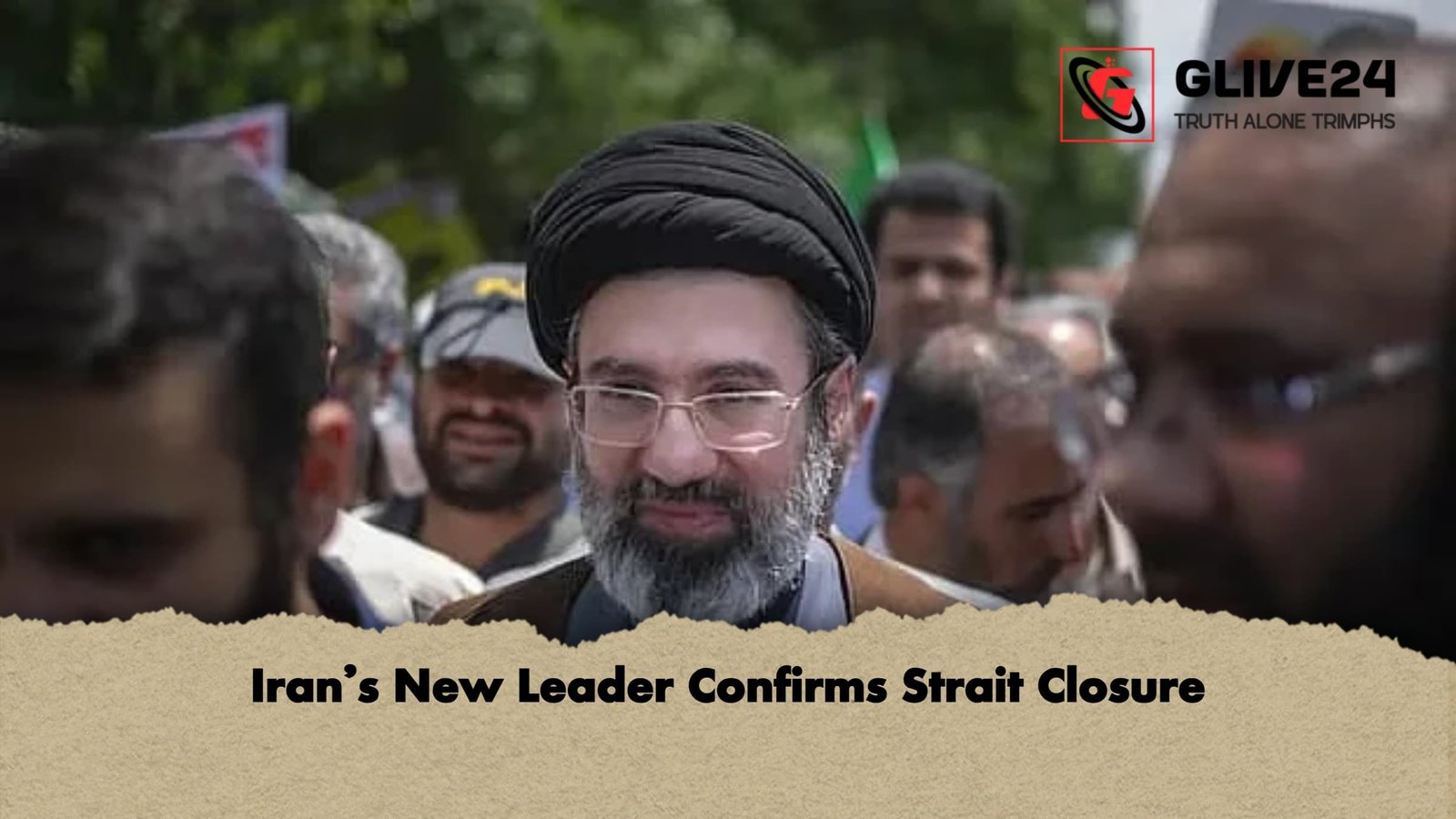
Iran’s newly appointed Supreme Leader, Ayatollah Mojtaba Khamenei, has declared that the Strait of Hormuz, one of the world’s most strategic maritime routes for oil transportation, will remain closed under Iranian control. Speaking publicly for the first time since his appointment, Khamenei emphasised that the measure is intended to maintain pressure on hostile powers while safeguarding Iran’s national interests.
The Strait of Hormuz is a critical chokepoint in global energy supply, with roughly one-fifth of the world’s oil shipments passing through its waters. Analysts warn that disruptions to this route have already contributed to surging global oil prices, which have now exceeded $100 per barrel.
In his address, Khamenei called for national unity, stressing the importance of solidarity in facing external pressures. “The closure of the Strait of Hormuz will continue as a strategic measure to assert our sovereignty and challenge those who threaten our nation,” he stated.
Strategic Significance of the Strait of Hormuz
| Factor | Details |
|---|---|
| Global oil transported | Approximately 20% of world supply |
| Current market impact | Oil price exceeds $100 per barrel |
| Countries most affected | United States, China, India, Japan, South Korea |
| Iran’s position | Maintains closure to assert leverage over adversaries |
Khamenei further highlighted the support Iran receives from regional allies, stating that Yemen’s Houthi rebels will “fulfil their responsibilities” in backing Tehran’s stance. He also mentioned that armed groups in Iraq are willing to assist Iran strategically, underscoring Tehran’s influence across the region.
Paying tribute to Iran’s military, Khamenei expressed his gratitude for the armed forces’ role in preventing the country from succumbing to external attacks or internal fragmentation. “In times of immense pressure and threat, our courageous soldiers have performed exceptionally. I extend my heartfelt thanks to them,” he said.
He also issued a stern warning regarding the nation’s martyrs: “We will avenge the blood of our martyrs.”
Despite these security-focused measures, Khamenei stressed Iran’s commitment to maintaining friendly relations with neighbouring countries. However, he clarified that attacks on American military bases will continue as part of Iran’s strategic operations.
The new leader’s appointment follows a significant escalation in regional tensions. On 28 February, forces from the United States and Israel launched attacks on Iranian territory, resulting in the death of Iran’s former Supreme Leader, Ayatollah Ali Khamenei. Subsequently, on 8 March, his son, Mojtaba Khamenei, was elected as the new Supreme Leader of Iran.
Experts caution that Iran’s decision to maintain the closure of the Strait of Hormuz could have far-reaching implications, not only for Middle Eastern geopolitics but also for global energy markets. The move reinforces Tehran’s leverage in ongoing regional disputes and signals a period of heightened strategic assertiveness.