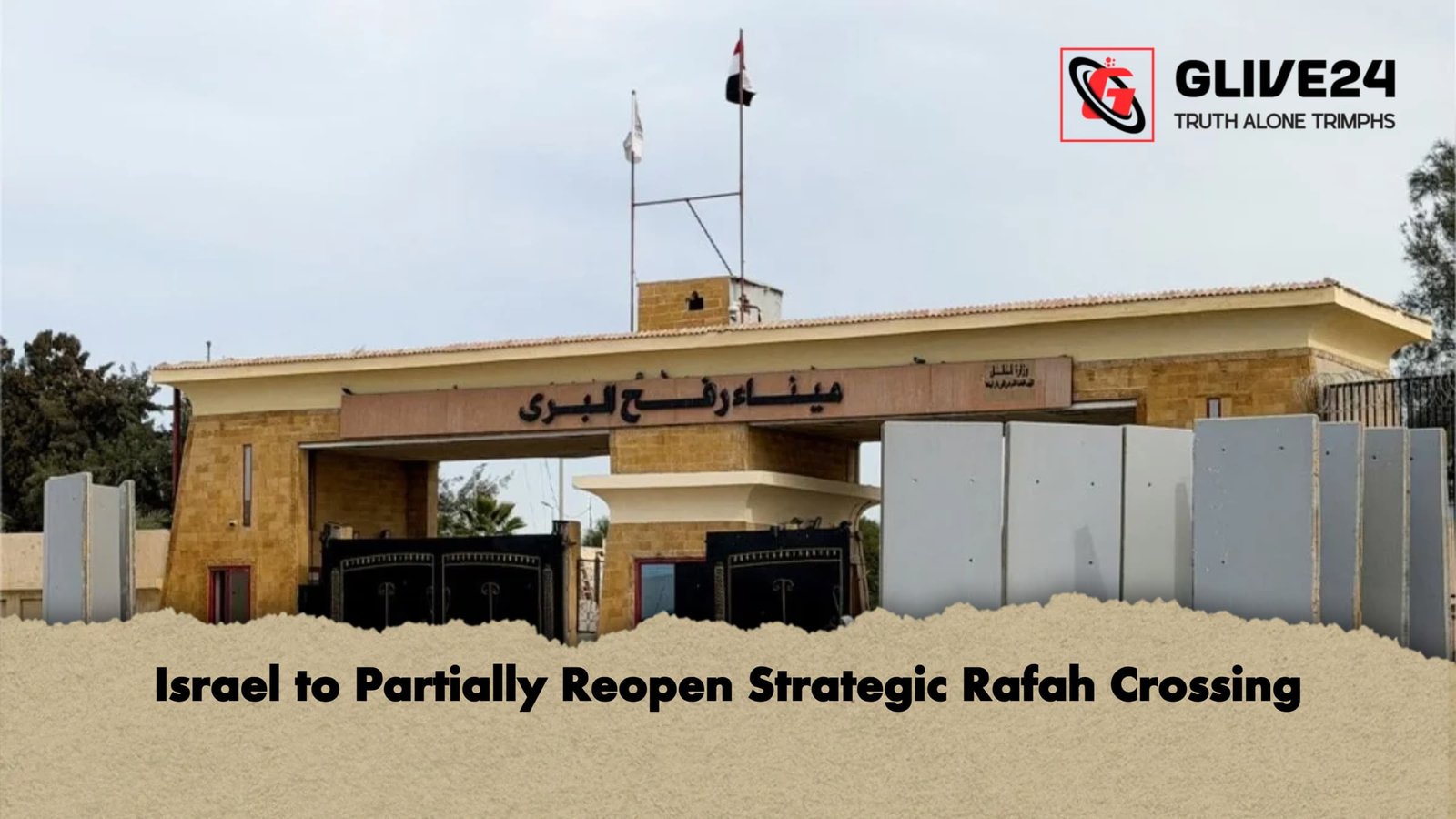
Following relentless pressure from the United Nations, international humanitarian organisations, and the Palestinian populace, Israel has officially announced that the Rafah Border Crossing—the critical artery between the Gaza Strip and Egypt—will partially reopen this Sunday. However, the Israeli authorities have underscored that the facility will strictly cater to the “limited movement of persons” rather than a full restoration of commercial or logistical flow.
The Diplomatic Impasse and Breakthrough
The announcement follows a significant plea from Hamas on Friday, urging an immediate transition to the “second phase” of a United States-brokered ceasefire agreement. A central pillar of this phase includes the reopening of the Rafah gate and the introduction of a technocratic Palestinian committee to oversee the administration of the territory.
Previously, Israel had maintained a steadfast refusal to reopen the crossing, conditioning any movement on the repatriation of the remains of Ran Gvili, an Israeli hostage held in Gaza. Following the recovery of his body earlier this week and his subsequent funeral in Israel on Wednesday, the primary diplomatic obstacle appears to have been removed.
Oversight and Operational Constraints
COGAT (the Israeli Ministry of Defence body overseeing civilian affairs in the Palestinian territories) clarified in a statement on Friday that while the crossing would be operational in both directions, it remains subject to rigorous security protocols.
| Operational Detail | Description of Conditions |
| Direction of Flow | Open for both entry and exit |
| Eligibility | Restricted to persons with prior Israeli security clearance |
| Supervision | Monitored by a European Union Border Assistance Mission (EUBAM) |
| Coordination | Managed in direct conjunction with Egyptian authorities |
| Purpose | Limited humanitarian and individual transit |
A Symbolic but Limited Step
The Rafah crossing holds immense strategic value as it is the only point of entry and exit for Gazans that does not transit directly through Israeli territory. Since Israeli forces seized control of the Philadelphi Corridor in May 2024, the crossing has remained largely dormant, exacerbating a dire humanitarian crisis within the enclave.
Despite the withdrawal of Israeli forces behind the so-called “Yellow Line” as stipulated by recent ceasefire terms, the area remains under the effective military shadow of the Israel Defence Forces (IDF), who continue to control more than half of the Gaza Strip. While the reopening is a vital step for medical evacuations and the movement of displaced persons, humanitarian agencies warn that without a full resumption of aid truck convoys, the gesture may offer only marginal relief to a population on the brink of famine.