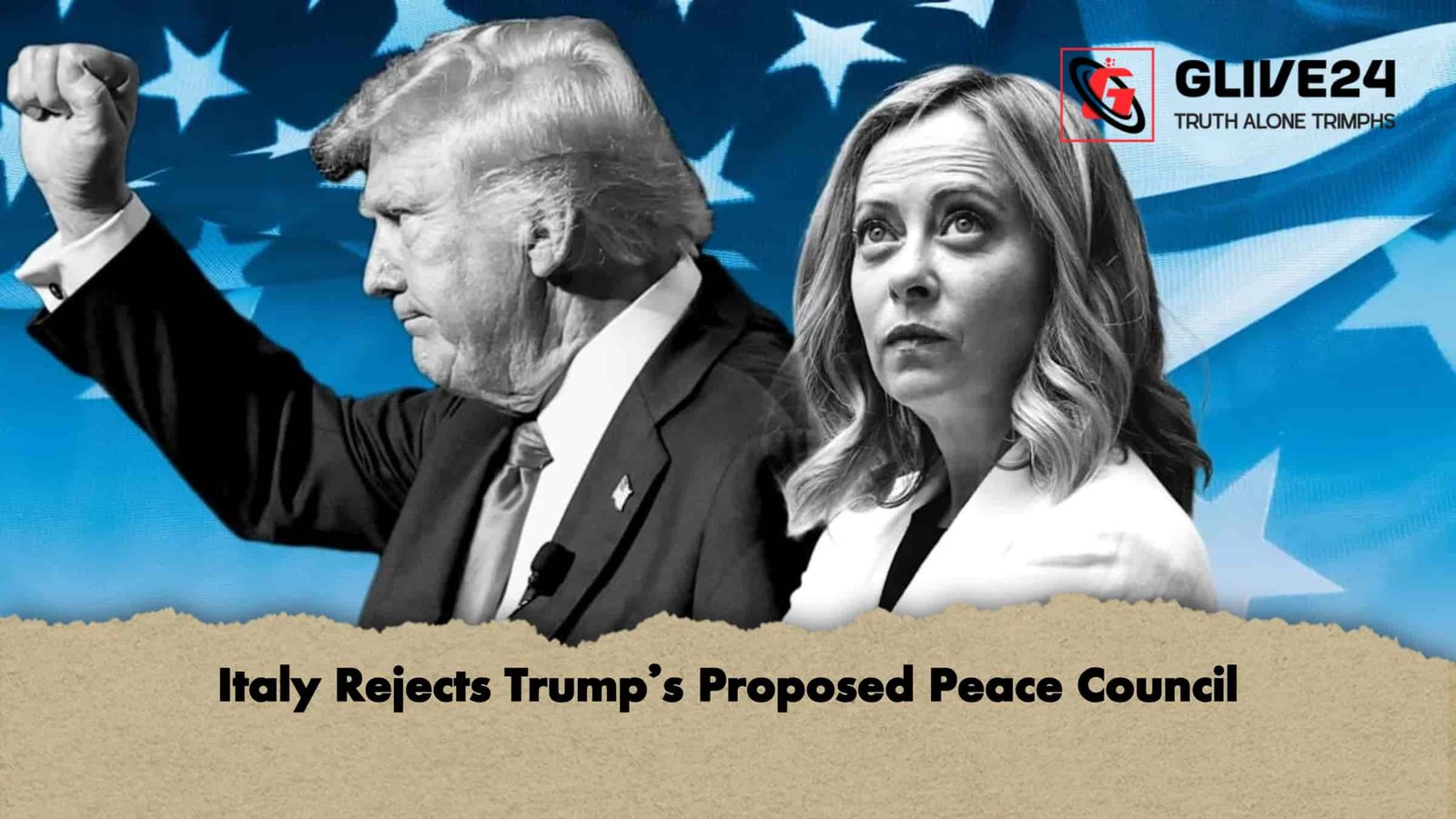
Italy has formally declined to join the proposed “Peace Council” initiated by former United States president Donald Trump, citing constitutional and legal constraints that Rome says it cannot overlook. The council, envisaged as a body to oversee a post-war interim administration in Gaza, has been presented by its architects as an alternative framework for stabilisation after the conflict. However, Italy’s refusal has added fresh momentum to a growing European scepticism surrounding the initiative’s legitimacy, governance structure and international credibility.
Speaking in interviews with leading Italian and international media, Foreign Minister Antonio Tajani explained that participation would be incompatible with Article 11 of the Italian Constitution. That provision allows Italy to take part in international organisations only when they are based on equality among member states and involve shared decision-making. According to Tajani, the draft charter of the proposed Peace Council vests excessive authority in a single office: the chairmanship held by Donald Trump. The document reportedly grants the chair veto power over decisions and sole authority to interpret the council’s resolutions, provisions that Italy considers inconsistent with the principles of equal sovereignty and collective governance.
Tajani stressed that Italy’s decision should not be interpreted as opposition to peace efforts in the Middle East. On the contrary, Rome has reiterated its readiness to contribute constructively to any initiative grounded in international law and multilateral norms. Italian officials have pointed to areas where the country could play a tangible role, including police training, civilian protection, humanitarian assistance and post-conflict reconstruction in Gaza, provided these efforts are coordinated through recognised international mechanisms.
Italy’s stance aligns it with several other major European powers. France, Germany, the United Kingdom and Spain have also chosen not to participate, raising concerns about transparency, legal legitimacy and the risk of bypassing established multilateral institutions such as the United Nations. As a result, a substantial portion of the European Union will remain outside the council, casting doubt on its ability to claim broad international support.
The refusal is particularly notable given the reportedly cordial political relationship between Trump and Italian Prime Minister Giorgia Meloni. Analysts argue that this episode underscores a clear boundary between political affinity and constitutional obligation, with Rome signalling that domestic legal frameworks take precedence over personal or ideological alignments.
Many observers view the proposed Peace Council as an attempt to create a parallel platform that could rival or dilute the role of the United Nations. Critics warn that such initiatives may fragment international diplomacy rather than strengthen collective responses to complex crises. The council was formally launched in January 2026 in Davos, with around 20 national leaders signing its charter. Although invitations were extended to roughly 60 countries, European participation has so far been limited. A first meeting is tentatively scheduled for February 2026 in Washington, yet details regarding its agenda and decision-making procedures remain unclear.
Proposed Peace Council: Key Facts
| Item | Details |
|---|---|
| Formal launch | January 2026, Davos |
| Chair | Donald Trump |
| Charter signatories | Around 20 countries |
| European states declining | Italy, France, Germany, UK, Spain |
| Planned first meeting | February 2026, Washington |
| Stated objective | Support ceasefire and oversee Gaza’s interim administration |
Taken together, Italy’s refusal has sharpened the debate over the Peace Council’s legal foundation, governance model and practical effectiveness. With Europe’s leading powers staying out, questions persist over whether the initiative can meaningfully contribute to resolving the Gaza crisis or fostering long-term regional stability.