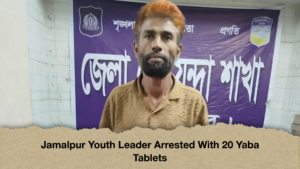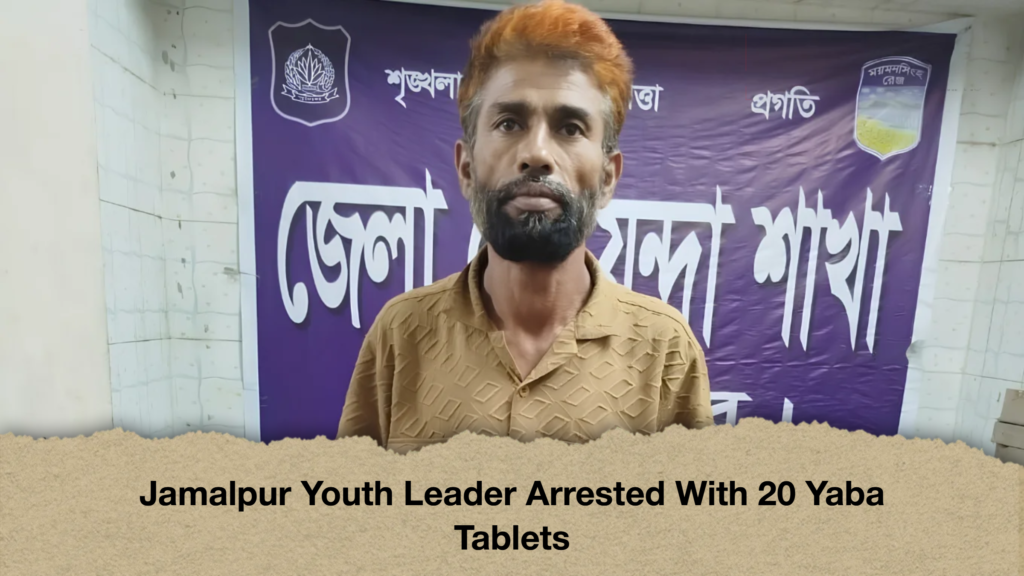
A local youth political leader was arrested in Sarishabari, Jamalpur, after police allegedly recovered 20 yaba tablets from his possession.
The detainee was identified as Shah Alam, 42, general secretary of the Bhatara Union unit of Jubo Dal. He was produced before a court on Thursday, 17 September, and sent to jail custody.
According to the District Detective Branch (DB-1), officers conducted a raid in the Purba Para area of Bhatara Union on Wednesday night following a tip-off about suspected drug activity. The operation was led by Sub-Inspector Atikur Rahman.
Police said they arrested Shah Alam from the courtyard of his home during the operation and recovered 20 yaba tablets from him. He is the son of the late Gias Uddin of the same village.
The DB alleged that Shah Alam had been involved in drug consumption and dealing in the area for a considerable period. Police also claimed that several cases had previously been filed against him. Details of those cases were not immediately available.
Following the arrest, Shah Alam was taken to Sarishabari Police Station and a fresh case was filed against him under the Narcotics Control Act. He was subsequently produced before the court under police escort.
The court ordered that he be sent to jail custody.
The arrest has also drawn a response from the local Jubo Dal organisation. Anisur Rahman, president of the Bhatara Union Jubo Dal, said the organisation would not accept responsibility for any wrongdoing allegedly committed by an individual member.
He said an application had been submitted to the upazila-level Jubo Dal seeking Shah Alam’s expulsion from the organisation.
The arrest came as law-enforcement authorities continue operations against narcotics in the area. Yaba, a form of methamphetamine-based stimulant, is classified as a controlled narcotic in Bangladesh, and possession or trafficking can lead to criminal proceedings under the country’s narcotics laws.
Police said legal proceedings against Shah Alam would continue in accordance with the case. The allegations against him will ultimately be subject to the judicial process.