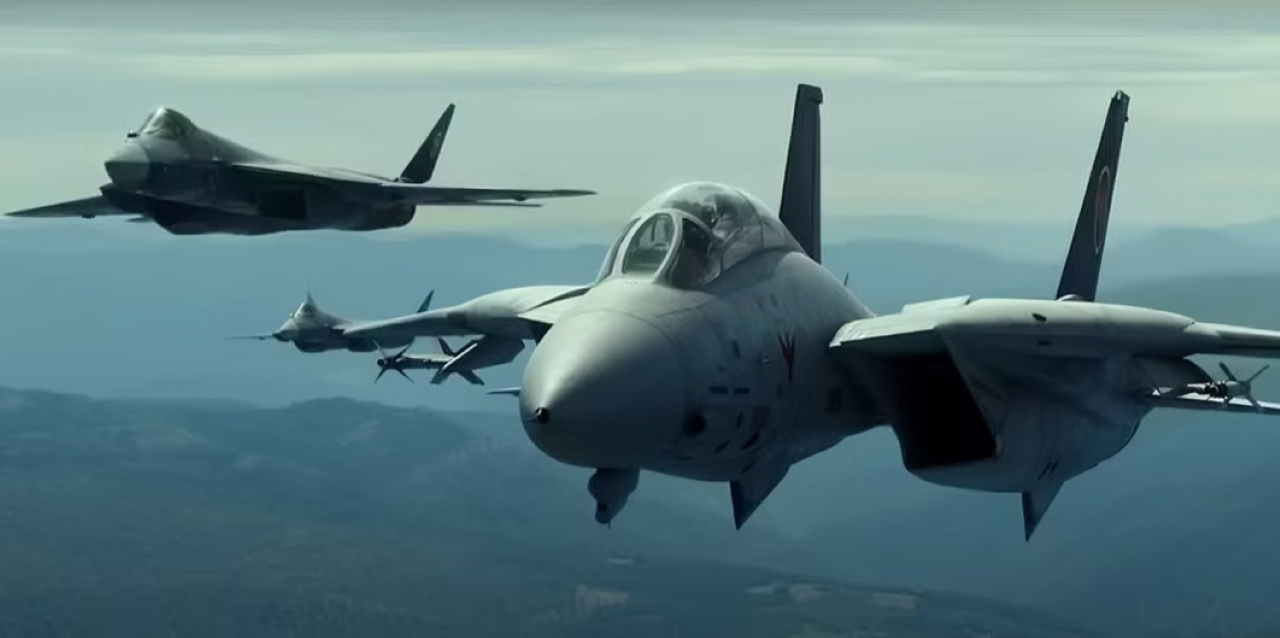
Thirty-six years after the original cinematic masterpiece redefined the action genre, Captain Pete ‘Maverick’ Mitchell made his long-awaited return to the silver screen. Whilst Tom Cruise’s performance received significant acclaim following the film’s release on 27 May, it was the mechanical co-stars—the cutting-edge and classic fighter aeroplanes—that truly stole the show. Top Gun: Maverick is not merely a sequel; it is a meticulously crafted love letter to aviation, showcasing a range of aircraft from the dawn of the jet age to the hypothetical future of hypersonic flight.
Table of Contents
The Modern Workhorse: Boeing F/A-18 Super Hornet
Taking centre stage as the primary vessel for the film’s high-stakes mission is the Boeing F/A-18 Super Hornet. A direct and more formidable descendant of the original F/A-18 Hornet, this multirole combat jet is the backbone of the U.S. Navy’s carrier air wings. Capable of reaching speeds of approximately 1,915 km/h (roughly Mach 1.6), its versatility and agility were displayed in breathtaking detail through the film’s low-level canyon sequences.
The Nostalgic Legend: Grumman F-14 Tomcat
For many, the Grumman F-14 Tomcat remains the definitive Top Gun icon. Maverick’s original “steed” from the 1986 film makes a dramatic and pivotal return in the sequel. Known for its distinctive variable-sweep wings and a blistering top speed of 2,485 km/h, the Tomcat was the ultimate interceptor of the Cold War era. Its inclusion in the film’s climax served as a poignant bridge between the past and the present, satisfying the cravings of long-term enthusiasts.
The Stealth Adversary: Sukhoi Su-57 Felon
To represent the “fifth-generation fighters” of the unnamed adversary, the filmmakers utilised the Sukhoi Su-57, known by its NATO reporting name, ‘Felon’. Manufactured by the Russian aerospace giant Sukhoi, this stealth-capable, twin-engine fighter represents the pinnacle of modern aerial combat technology. In the film, its superior manoeuvrability and thrust-vectoring capabilities provided a terrifying challenge for Maverick’s aging F-14.
The Hypersonic Enigma: Darkstar
One of the most enigmatic additions to the franchise is the ‘Darkstar’. Although a fictional creation for the film, it was developed with assistance from Lockheed Martin’s Skunk Works—the same division responsible for the legendary SR-71 Blackbird. Based conceptually on the proposed SR-72, the Darkstar is a hypersonic experimental jet. While actual hypersonic testing aims for speeds exceeding 6,170 km/h (Mach 5), Maverick is depicted pushing the airframe to a staggering Mach 10 during the film’s opening sequence.
Technical Specification and Performance Comparison
The following table provides a comparative glance at the diverse fleet featured within the film:
| Aircraft Model | Origin | Role | Approx. Top Speed | Notable Feature |
| F/A-18 Super Hornet | USA | Multirole Fighter | 1,915 km/h | Primary mission aircraft |
| F-14 Tomcat | USA | Interceptor | 2,485 km/h | Variable-sweep wing design |
| Su-57 Felon | Russia | Stealth Fighter | 2,600 km/h | Fifth-generation capability |
| F-35C Lightning II | USA | Stealth Fighter | 1,960 km/h | Single-pilot carrier variant |
| Darkstar (SR-72) | USA | Hypersonic Test | 7,400 km/h+ | Experimental “Scramjet” |
| P-51 Mustang | USA | WWII Fighter | 710 km/h | Tom Cruise’s personal craft |
The Soul of the Film: North American P-51 Mustang
Finally, the film finds its emotional anchor in the North American P-51 Mustang. This World War II-era propeller-driven fighter represents the “analogue” soul of aviation. Capable of a modest 710 km/h, the aircraft featured in the film actually belongs to Tom Cruise himself. Its presence underscores the film’s recurring theme: that while technology may evolve, the spirit and “instinct” of the pilot remain paramount.