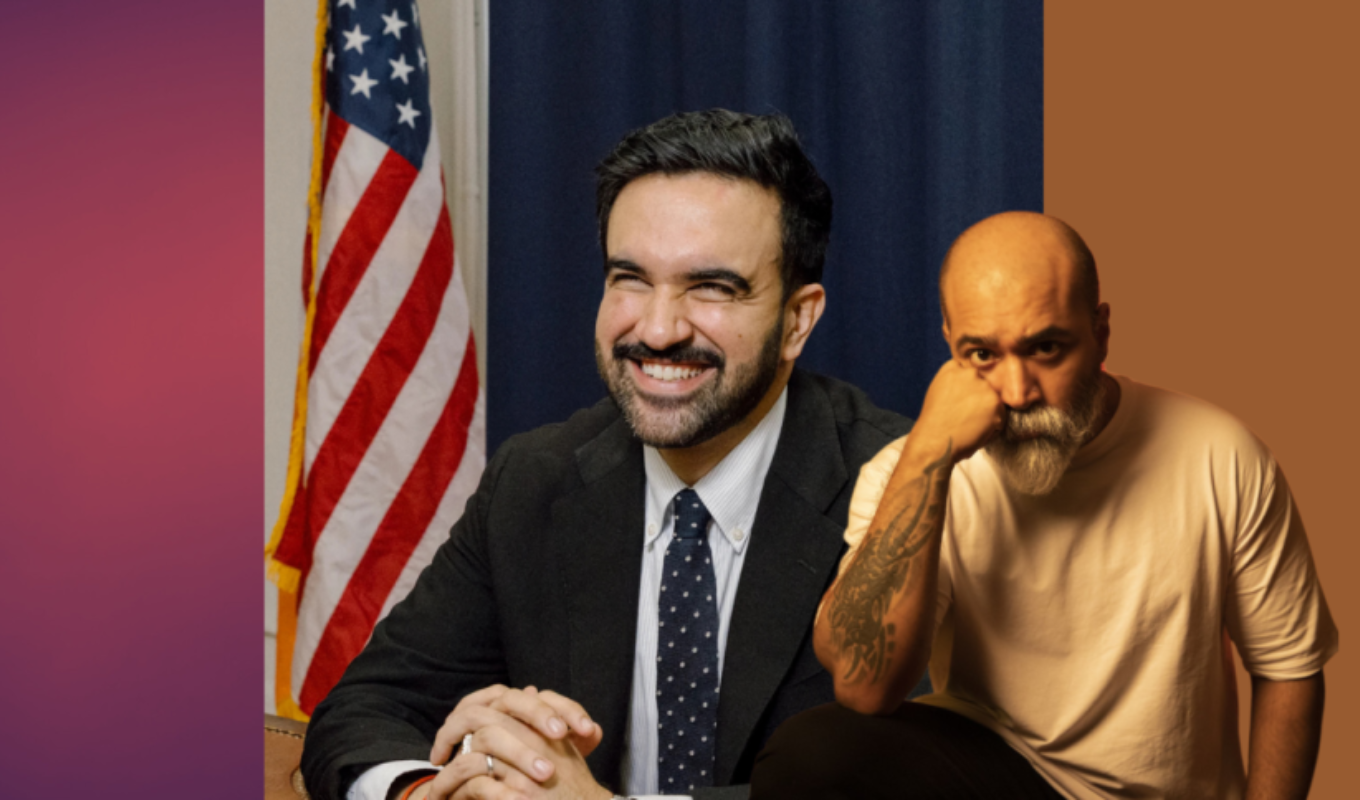
A fundraising event in Queens this week illustrated how cultural leadership and political ambition are becoming closely intertwined within New York’s immigrant communities. Bangladeshi singer and composer Jon Kabir took to the stage at the Thikana Community Hub to perform in support of mayoral candidate Zohran Mamdani, turning a political gathering into a high-energy cultural showcase.
The highlight of the evening came when Kabir, joined by vocalist Ruhin Hossain, performed “High Hopes,” a song widely associated with aspiration and perseverance. As the performance unfolded, the audience joined in, transforming the fundraiser into a participatory experience rather than a one-directional campaign event. Mamdani, watching from within the crowd, responded enthusiastically, reinforcing the sense of closeness between candidate and supporters.
Visual messaging played a strategic role throughout the evening. A projected backdrop declaring “Zohran, a new era, New York” aligned the emotional momentum of the music with the campaign’s political message. The pairing of popular culture with electoral ambition reflected a broader trend in progressive politics, where symbolism and shared experiences are increasingly used to build loyalty and enthusiasm.
Jon Kabir’s involvement carried additional significance given his recent appointment as Head of Programmes, Events and Music at Thikana. In this role, he is expected to shape the organisation’s cultural and civic initiatives, positioning music and art as tools for engagement rather than mere entertainment. Kabir described his connection with Mamdani as rooted in shared cultural understanding, emphasising that personal trust often precedes political endorsement within diaspora communities.
The fundraiser was organised by Thikana as part of Mamdani’s transition effort and was introduced by Thikana Group Chairman M M Shaheen. Group CEO Mushrath Shaheen coordinated the programme, while Rivertel CEO Ruhin Hossain provided organisational support. Senior figures from Thikana’s media operations, including Thikana TV CEO Khaled Muhiuddin, were also present.
According to organisers, the event attracted over 200 attendees and raised more than $150,000. While the financial contribution was substantial, its political implications may prove even more significant. Organisers noted that this was the only Bangladeshi Muslim-led fundraising event of its kind in Queens, underscoring the community’s increasing confidence in asserting its political voice.
The Thikana Community Hub itself symbolised this shift. Designed as a space for education, organising and cultural exchange, the 6,000-square-foot venue reflects a deliberate effort to create infrastructure that supports long-term civic participation. Rather than functioning solely as a media or business office, Thikana has positioned the hub as a meeting point for ideas, activism and cultural expression.
Zohran Mamdani’s rise has been closely watched within New York’s political circles. At 34, he represents a younger generation of progressive Democrats who emphasise grassroots organising over traditional party hierarchies. His campaign has focused on issues such as housing affordability, social equity and public investment, resonating strongly with voters who feel excluded from existing power structures.
The Queens fundraiser demonstrated how such campaigns can benefit from partnerships with cultural institutions and figures. By incorporating music and community identity into a political setting, the event offered a model for inclusive campaigning that goes beyond speeches and policy papers.
As New York’s electorate continues to diversify, events like this suggest that future political success may depend not only on policy platforms, but also on the ability to engage communities through shared cultural experiences.