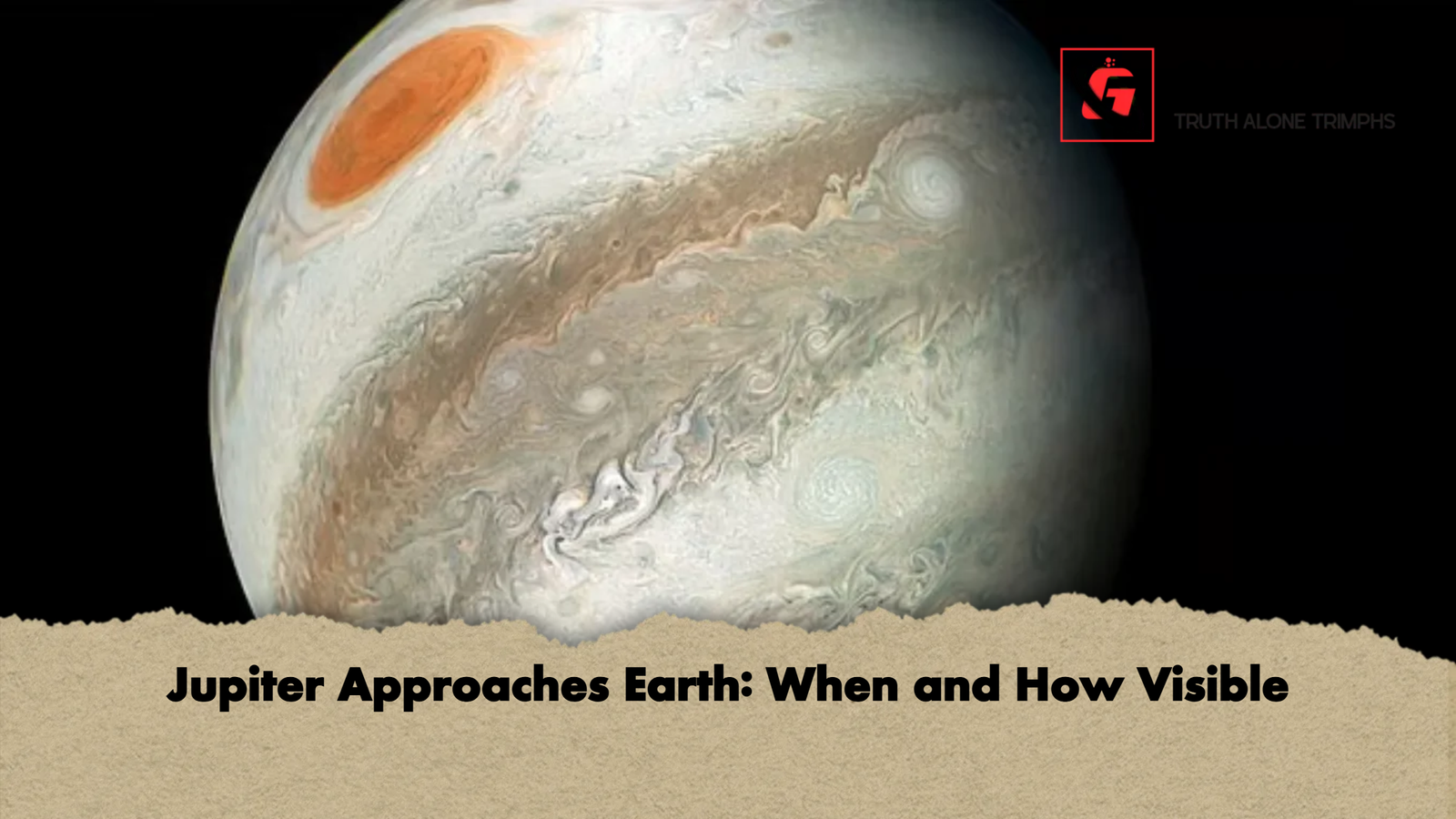
Jupiter, the largest planet in our Solar System, is currently positioned within the Gemini constellation and is set to make its closest approach to Earth in just two days. This rare astronomical event will allow skywatchers and astronomy enthusiasts to observe the gas giant with exceptional clarity. Due to its proximity, Jupiter will appear particularly bright in the night sky, providing a spectacular viewing opportunity.
According to astronomers, the planet will be at its closest distance from Earth on the night of 10 January (Bangladesh Standard Time) at approximately 2:00 am. At this time, Jupiter will form an irregular triangle with two bright stars, Castor and Pollux, making it easier for observers to locate the planet. The planet will be roughly 633 million kilometres away from Earth during this event.
The light reflected from Jupiter takes approximately 35 minutes to reach Earth, while sunlight requires around 43 minutes to travel from the Sun’s surface to Jupiter. Even with the naked eye, the planet will be clearly visible. Observers equipped with standard binoculars will also be able to discern Jupiter’s four largest moons: Io, Europa, Ganymede, and Callisto.
Despite being much farther from Earth than Venus, Jupiter appears brighter because its dense cloud layers efficiently reflect sunlight. With a diameter eleven times that of Earth, the gas giant can be observed from both the Northern and Southern Hemispheres. Using a small telescope or 10× binoculars, viewers may even catch glimpses of Jupiter’s famous coloured cloud bands, a striking feature of the planet.
Key Observational Data for Jupiter (10 January 2026)
| Parameter | Details |
|---|---|
| Constellation | Gemini |
| Closest Approach to Earth | 633 million km |
| Best Viewing Time | 2:00 am BST |
| Apparent Magnitude | -2.0 (extremely bright) |
| Visible Moons | Io, Europa, Ganymede, Callisto |
| Distance Sun → Jupiter | ~778 million km |
| Light Travel Time Sun → Jupiter | ~43 minutes |
| Light Travel Time Jupiter → Earth | ~35 minutes |
| Telescope Recommendation | Small telescope or 10× binoculars |
Astronomers emphasise that this is a rare chance for amateur stargazers to enjoy a vivid and relatively close view of Jupiter. Observers are encouraged to choose locations with minimal light pollution to fully appreciate the planet’s brightness and the alignment with Gemini’s stars. This event also offers an educational opportunity for students and enthusiasts to explore planetary motion and the dynamics of the Solar System.