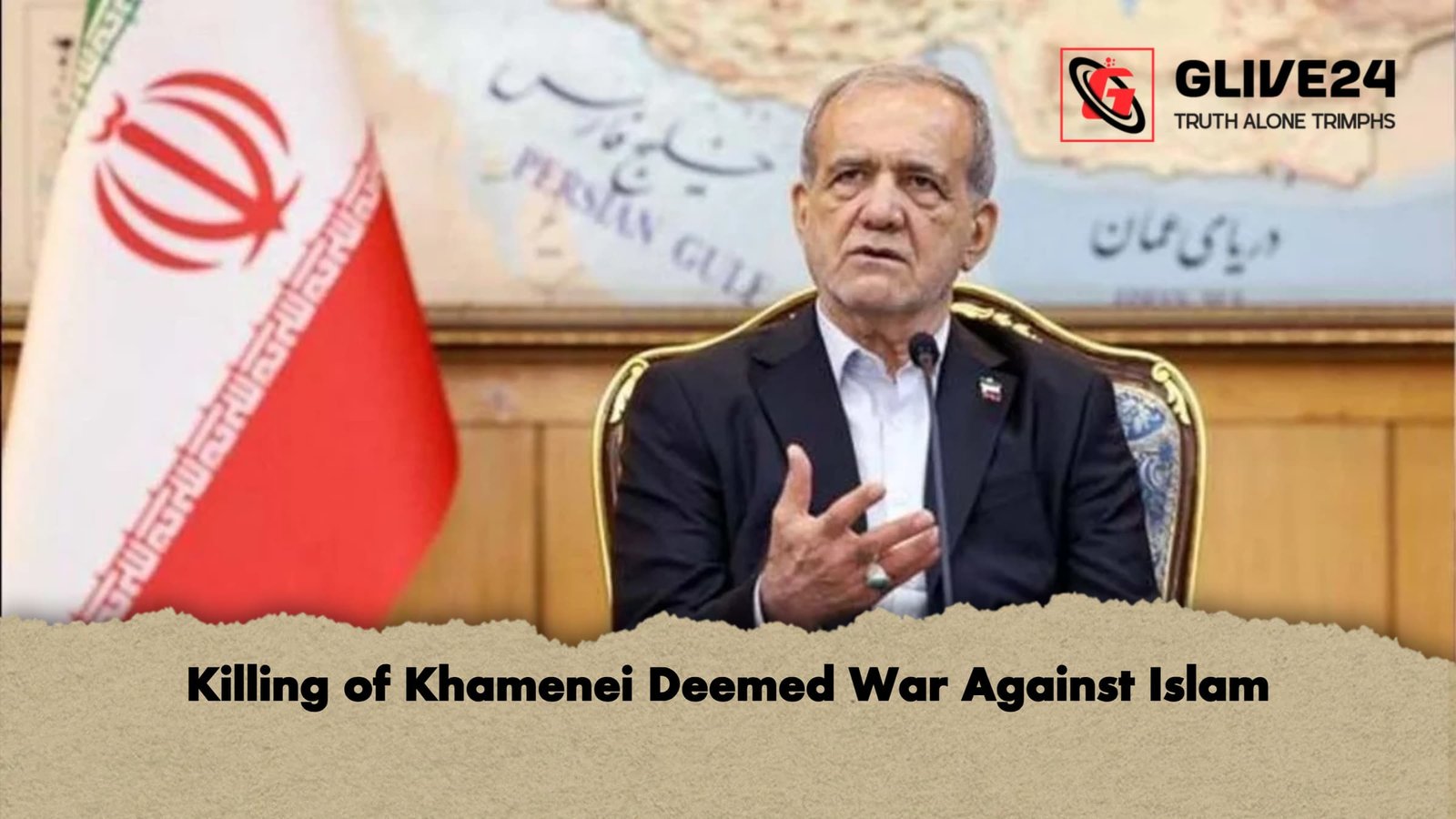
The Islamic Republic of Iran has officially characterised the assassination of its Supreme Leader, Ayatollah Ali Khamenei, as a definitive “declaration of war” against the entire Muslim world. Following the joint American and Israeli military strikes on Saturday that resulted in the leader’s death, the Iranian presidency has issued a chilling mandate for “crushing retaliation,” signalling a potential shift from regional skirmishes to a global ideological confrontation.
Table of Contents
A Proclamation of Universal Conflict
In a televised address broadcast on state media on Sunday, 1 March, President Masoud Pezeshkian articulated a stance that transcends national borders. He asserted that the targeted killing of the Supreme Leader—who served as the ultimate political authority in Iran and a pre-eminent spiritual figure for millions of Shia Muslims worldwide—constitutes an assault on the religious identity of the global Ummah.
“The martyrdom of the Supreme Leader at the hands of American and Israeli forces is not merely an attack on a sovereign state,” Pezeshkian declared. “It is an overt declaration of war against Muslims in every corner of the globe, and specifically a provocation against the Shia faith.”
The Mandate for Retaliation
The Iranian executive leadership has framed the impending response not as a choice, but as a “sacred obligation.” The President emphasised that the Islamic Republic views the extraction of vengeance as both a legal right under international self-defence norms and a moral duty to the Iranian people.
Tehran’s strategic rhetoric suggests that the “Axis of Resistance”—comprising Hezbollah in Lebanon, the Houthis in Yemen, and various militias in Iraq—will be mobilised to execute a multi-front response. The objective, according to senior officials, is to ensure that the “architects and perpetrators of this historic crime” face unprecedented consequences.
Key Declarations from the Iranian Presidency
| Subject | Official Stance / Statement |
| Categorisation of Act | A “Declaration of War” against the Global Muslim Community. |
| Legal Justification | Inherent right to self-defence and sovereign retribution. |
| Targeted Actors | The United States (as the planner) and Israel (as the executor). |
| Religious Context | An assault on the spiritual leadership of the Shia world. |
| Future Action | Mandatory “Crushing Retaliation” across all strategic theatres. |
Global Repercussions
The international community remains on high alert as the definition of “retaliation” begins to take shape. Analysts suggest that by framing the assassination as a war on Islam, Iran is attempting to galvanise support across the broader Middle East and beyond, potentially triggering civil unrest in Western nations with significant Muslim populations.
The Pentagon and the Israeli Defence Forces (IDF) have reportedly bolstered their defensive postures, anticipating a wave of asymmetric attacks, cyber warfare, and long-range ballistic strikes. As the mourning period for Khamenei begins, the world watches to see if this “declaration of war” will manifest as a conventional military campaign or a sustained global insurgency.