
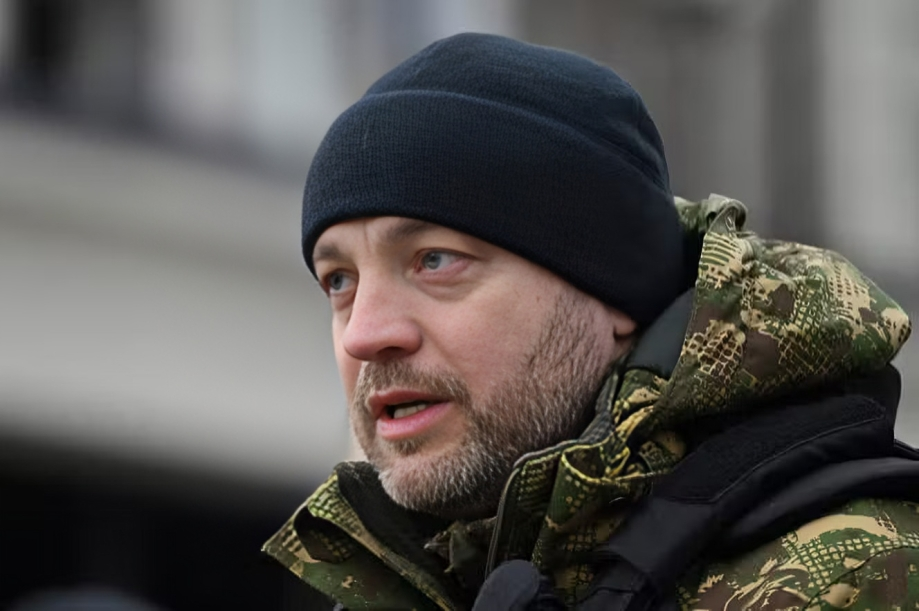
More than one hundred days into the relentless Russian invasion of Ukraine, the nation’s capital finds itself in a state of watchful peace. On Thursday, Ukraine’s Interior Minister, Denys Monastyrsky, offered a measured assessment of the city’s security, asserting that while there is no imminent risk of a renewed ground march on Kyiv, the capital will not be lowering its guard.
Table of Contents
A Strategic Lull, Not a Permanent Peace
Speaking to reporters while clad in a black military sweater adorned with the Ukrainian flag, Monastyrsky was clear about the current tactical reality. “There is no danger of an attack on Kyiv today,” he stated. He noted that there is currently no significant concentration of Russian or allied troops stationed near the Belarusian border—the route used by Moscow in the early, chaotic weeks of the conflict to strike at the heart of the government.
However, the Minister was quick to temper this optimism with the realism of a wartime commander. “We understand that any scenarios are possible tomorrow,” he warned, explaining that the military is currently engaged in “serious training” and the meticulous preparation of defensive lines to ensure that if the tide turns, the city remains an impenetrable fortress.
Security Assessment and Judicial Progress
The following table summarises the current security situation in the capital as detailed by the Ministry of Internal Affairs:
| Category | Current Status | Key Concerns |
| Ground Threat | Low / No Imminent Risk | Possible re-deployment via Belarus |
| Aerial Risk | High | Targeted strikes on historic/government quarters |
| Border Activity | Stable (Monitoring) | Absence of troop concentrations currently |
| War Crime Inquiries | 288 Active Suspects | Ensuring no statute of limitations on “monsters” |
| POW Negotiations | Ongoing | Prioritising the return of wounded soldiers |
The Persistent Threat from the Skies
While the physical “siege” of Kyiv ended months ago when Russian forces retreated to focus on the east and south, the threat of aerial bombardment remains a daily reality. Monastyrsky highlighted that “any place in Ukraine can be a target for rocket fire,” specifically mentioning that Russia’s sights remain fixed on the historic centre and the government quarter—the symbolic soul of the nation.
The Minister’s comments reflect a city that has been through the fire. In February and March, several suburbs were occupied and subsequently devastated; the retreat of Russian forces revealed a “trail of death” that has shaped the government’s approach to justice.
Justice and the Return of the Fallen
Beyond immediate defence, the Ministry is spearheading a massive judicial undertaking. Monastyrsky confirmed that 288 individuals are currently suspected of war crimes. He vowed that these atrocities have “no statute of limitations,” and that those responsible will be held accountable whenever they are found.
Simultaneously, the government is navigating delicate negotiations to bring home Ukrainian prisoners of war (POWs) held by Russia or its proxies. The Minister described this as a race against time, particularly for the wounded. “It is vital to bring them back here today, to save the boys from imminent death,” he concluded.