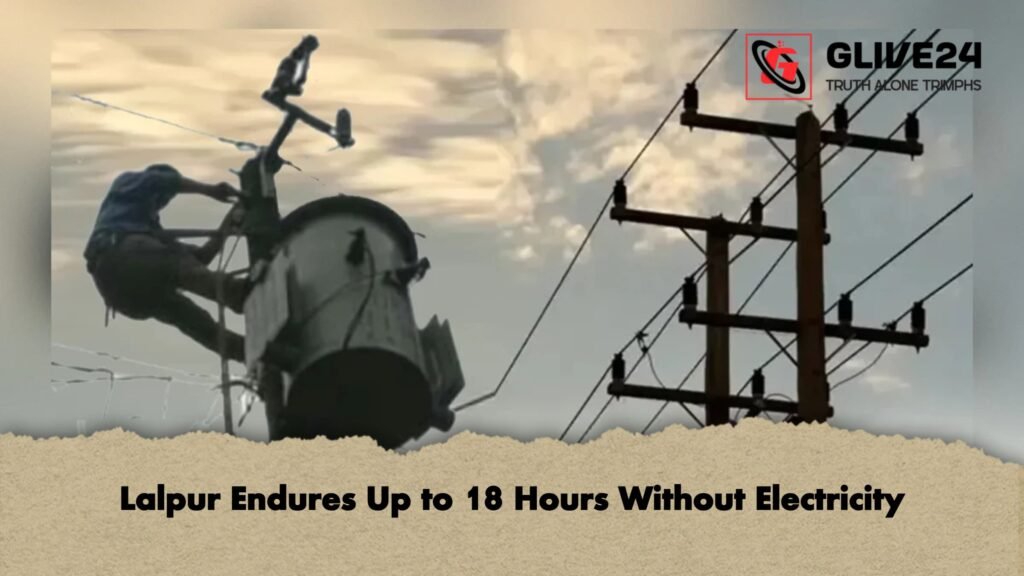
Residents of Lalpur in Natore are facing severe disruption as prolonged load-shedding has intensified amid oppressive heat, with electricity reportedly unavailable for as many as 18 hours in a 24-hour period.
The frequent power cuts have disrupted everyday life across the area and are affecting households, education, transport, workshops and other businesses. Residents say the situation has become particularly difficult during the hot weather, when electricity is needed not only for lighting and household appliances but also for fans, water pumps and battery charging.
Data from the local rural electricity office show a significant gap between demand and supply. On Monday during the daytime, electricity demand in Lalpur stood at 19 megawatts, while only 9.42 megawatts was available. The previous night, on Sunday, demand reached 25 megawatts against a supply of 15 megawatts.
The shortfall has forced the authorities to impose repeated load-shedding across the area’s nine feeders. According to the local electricity office, outages are lasting between one hour and one and a half hours at a time, adding to the difficulties faced by residents.
For people whose livelihoods depend directly on electricity, the disruption has immediate financial consequences.
Sohel Ali, an auto-rickshaw driver from Walia village, said he depends on driving his vehicle to support his family. However, prolonged power cuts have made it difficult to charge the vehicle’s battery.
“Electricity is unavailable for around 18 hours within 24 hours. I cannot charge the battery properly, so I often cannot take the auto-rickshaw onto the road. It has become difficult to run my household,” he said.
Households are also struggling with basic domestic activities. Aliza Parvin, a homemaker from Lalpur village, said repeated outages had made life particularly difficult for families with young children.
“We cannot sleep properly at night with small children because of the heat. We also cannot pump water into the tank when there is no electricity. We are in serious trouble,” she said.
Students are facing their own difficulties. Sumaiya Khatun, an HSC examinee from Walia village, said the frequent outages were preventing her from studying properly. The lack of electricity, particularly during study hours, is making it harder for students to maintain regular preparation for examinations.
The situation is also disrupting workshops and small industrial establishments. Mohammad Gani, owner of Gani Engineering Workshop, said his business has a heavy workload but cannot operate normally during power cuts.
“There is plenty of work at the workshop, but we cannot continue working when there is no electricity. The workers have to sit idle,” he said.
The disruption extends beyond individual households and businesses. Electricity-dependent activities in agriculture, small-scale industry and trade are also being affected, according to local residents. For businesses that rely on electrically powered machinery, repeated outages can interrupt production and delay work.
Rezual Karim, deputy general manager of the Lalpur zonal office of Natore Palli Bidyut Samity-2, said the main problem was the substantial gap between electricity demand and supply.
“We are receiving less than half of the electricity required against demand. As a result, load-shedding has to be carried out across the nine feeders, sometimes for one hour and sometimes for one and a half hours,” he said.
The figures provided by the electricity office illustrate the scale of the supply shortage. During the daytime on Monday, available supply was roughly half of the 19-megawatt demand, while Sunday night’s supply was also significantly below the 25-megawatt requirement.
For residents of Lalpur, the prolonged outages have become an issue affecting nearly every part of daily life, from household chores and children’s sleep to education, transport and commercial activity. With the area experiencing persistent heat, residents are seeking a reduction in load-shedding and more reliable electricity supply.