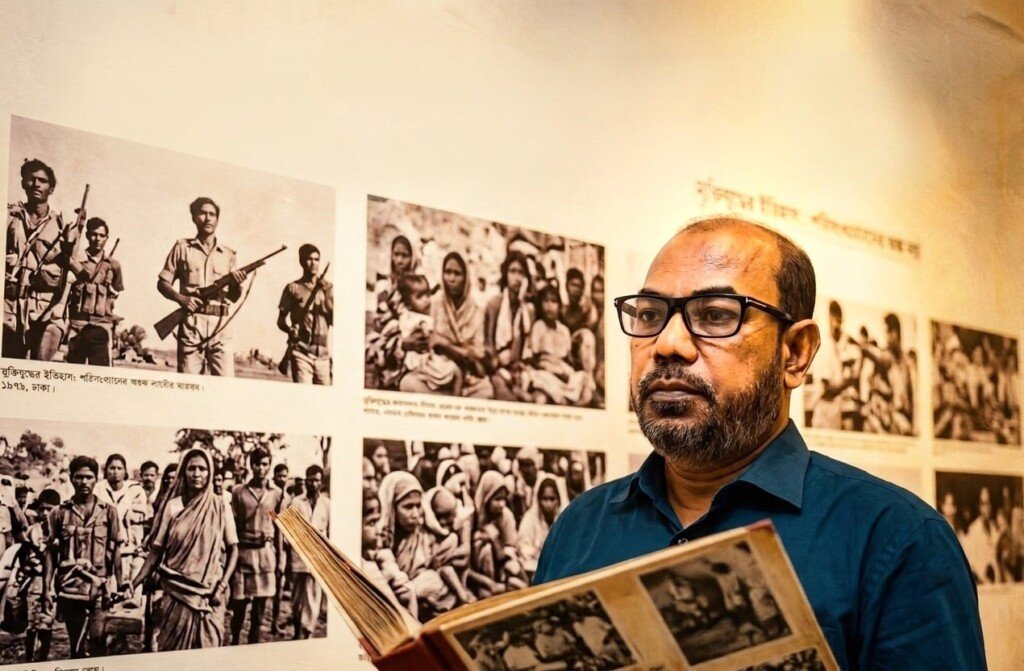
The history of Bangladesh’s Liberation War is far more than the story of those who fought with weapons on the battlefield. It is the collective story of a nation’s sacrifice, resistance and determination to secure its very existence. For that reason, historians and researchers argue that the legacy of 1971 cannot be measured solely by the number of officially recognised freedom fighters or administrative records. The war’s true significance lies in the countless acts of courage, suffering and resilience that unfolded across the country.
A recent opinion piece by controversial writer Mohiuddin Ahmed in the Bangla daily Prothom Alo has reignited debate over the number of freedom fighters and collaborators, as well as their respective roles during the Liberation War. The article has prompted concern among many readers and commentators, particularly over fears that its interpretation could leave the impression that a significant proportion of recognised freedom fighters were not genuine combatants or that the crimes committed by collaborators with the Pakistani military were less severe than established historical accounts suggest.
Many observers argue that such an interpretation conflicts with the widely accepted narrative of Bangladesh’s War of Independence. They maintain that the Liberation War should be understood through the broader context of national resistance rather than being reduced to numerical comparisons or administrative classifications.
Those who fought directly against the Pakistani military undoubtedly occupy a central place in the country’s history. Yet the struggle also relied heavily on thousands of others who never carried a rifle into battle. Young men waiting in refugee camps for military training, civilians who gathered and passed on intelligence, families who sheltered and fed guerrilla fighters, and ordinary people who risked their lives to support the resistance all played indispensable roles in the liberation movement. Many were arrested, tortured or killed because of that support.
The humanitarian catastrophe created by the conflict also forms an inseparable part of the Liberation War’s history. More than ten million Bangladeshis fled to neighbouring India to escape widespread violence and military operations. They did not leave to avoid the war; they were forced from their homes by killings, persecution and destruction. Refugee camps were plagued by disease, malnutrition and overcrowding, and many people died despite international relief efforts. Their suffering remains one of the defining human costs of the conflict.
Across Bangladesh, numerous villages were destroyed, and civilians were executed for allegedly assisting the Mukti Bahini. Mass graves discovered in different parts of the country continue to stand as grim reminders of those atrocities. Various historical studies have also estimated that around 300,000 women were subjected to wartime sexual violence. Students, farmers, labourers, teachers, cultural activists and countless ordinary citizens contributed to the struggle in different ways, whether through armed resistance or civilian support.
The sacrifices made by individuals such as martyred freedom fighter Shafi Imam Rumi symbolise the commitment shown by many young Bangladeshis who abandoned secure futures to join the war. Alongside well-known figures were thousands of unnamed villagers, workers and teenagers whose contributions were never formally documented but were no less significant.
The role of the Razakar, Al-Badr, Al-Shams and Peace Committee organisations has also been extensively examined through historical research, eyewitness testimony and judicial proceedings. Established historical accounts hold that elements within these auxiliary forces actively assisted the Pakistani military in identifying civilians, carrying out killings, committing acts of torture and participating in looting and other wartime crimes.
Scholars agree that history should remain open to re-examination as new evidence emerges. Debate and academic inquiry are essential to historical understanding. However, critics argue that reassessment must be grounded in credible evidence, documented records and reliable testimony. Any interpretation that creates a moral equivalence between those who fought for Bangladesh’s independence and those who collaborated with the occupying forces risks generating confusion about one of the country’s defining historical events.
The Liberation War does not belong to any political party or ideological group. It remains the shared heritage of the Bangladeshi nation. Differences of opinion over historical interpretation are inevitable, but such debates carry a responsibility to uphold factual accuracy and respect the evidence accumulated over decades of research.
The birth of Bangladesh came at an immense human cost. The widely recognised sacrifice of three million martyrs, the suffering of countless women subjected to wartime atrocities, the displacement of millions of refugees and the contributions of innumerable unnamed freedom supporters cannot be reduced to statistics alone. The history of the Liberation War is, above all, the story of a nation’s identity and its struggle for freedom. Preserving that history with accuracy, integrity and respect remains a responsibility owed to future generations.