
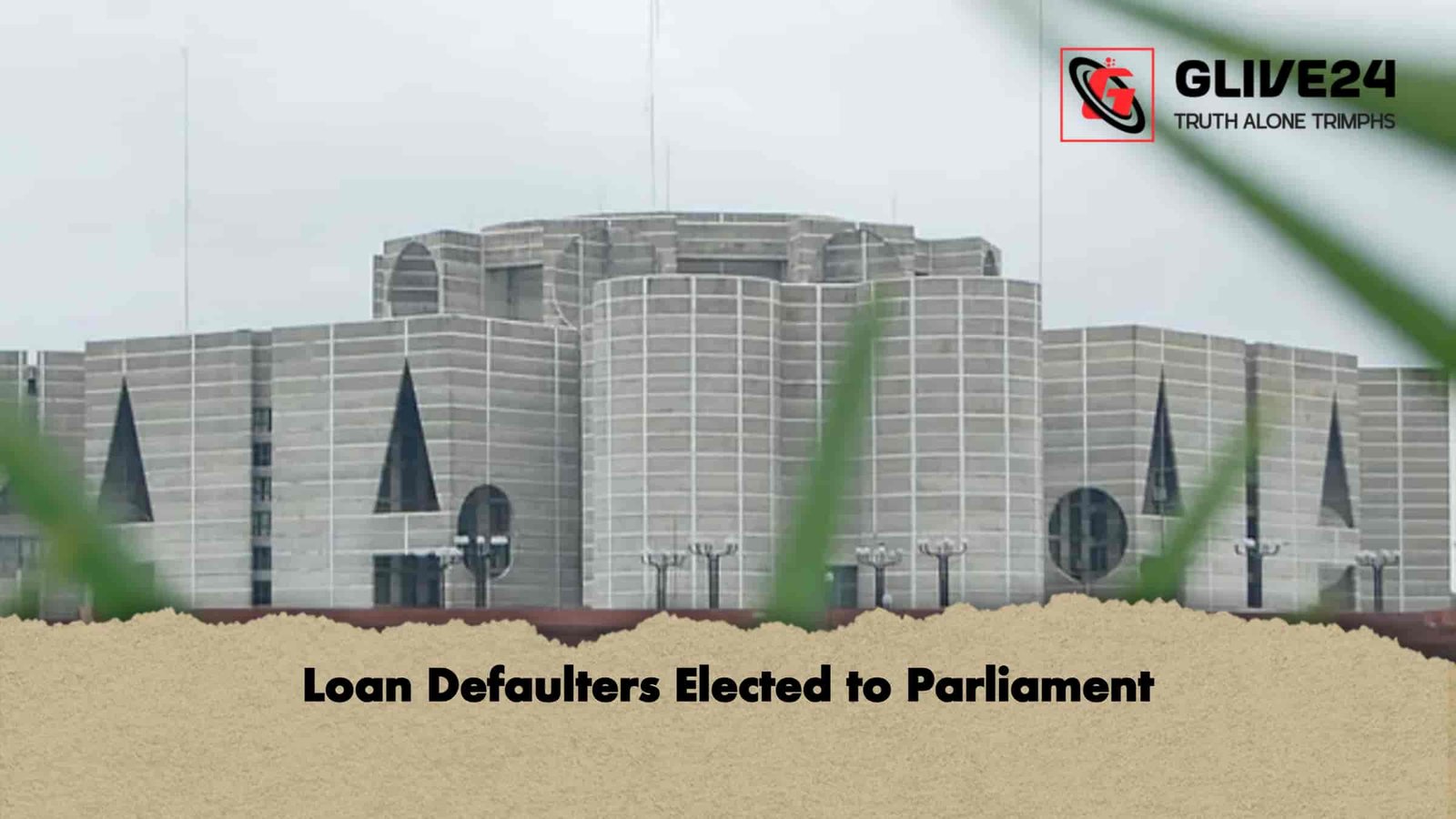
In a development raising questions about financial governance, multiple candidates listed as bank loan defaulters successfully contested the 13th parliamentary elections and have taken their seats in the legislature. Among the most prominent is Khondkar Abdul Muktadir, elected from Sylhet-1, comprising Sylhet City Corporation and Sylhet Sadar Upazila. He now serves as the Minister of Commerce, Industries, and Textiles & Jute.
Ahead of the elections, the Bangladesh Bank’s Centralised Information Bureau (CIB) submitted two lists of defaulters to the Election Commission. The first list identified 82 individuals with unpaid loans, while the second contained 31 names of candidates who had secured court stays, temporarily preventing their default status from being officially recorded. Muktadir was included on the latter list, allowing him to contest, win, and assume ministerial office despite pending loan cases.
According to December data from Bangladesh Bank, total bank loan defaults stood at BDT 5,57,216 crore, equivalent to 30.60% of the total banking sector loan portfolio.
Legal Loopholes and Election Participation
The Representation of the People Order (1972), Section 12, explicitly prohibits loan defaulters from running for office. Nevertheless, many potential candidates regularise a portion of their debt before elections and obtain court injunctions, enabling them to stand for election. Once elected, MPs rarely face consequences for unresolved defaults, creating a persistent legal loophole.
Economist Moinul Islam criticised the practice: “Allowing defaulters into Parliament is a dangerous precedent. The law fails to prevent individuals with unresolved bank debts from becoming legislators, undermining governance and financial accountability.”
Prominent Defaulter MPs
| Name | Constituency | Total Loan (BDT) | Banks / Companies | Court Stay Expiry |
|---|---|---|---|---|
| Khondkar Abdul Muktadir | Sylhet-1 | 185.36 crore | National Bank, Trust Bank, Prime Bank, Islami Bank, Al-Arafah Islami Bank | Jan 10 & Jan 26 (companies) |
| Giasuddin Qader Chowdhury | Chattogram-6 | 679.38 crore | Agrani, Sonali, Dutch-Bangla, Dhaka Bank, Peoples Leasing | Feb 23 |
| Kazi Rafiqul Islam | Bogura-1 | 765 crore | Two private banks | Jan 25, Mar 7, Apr 22 |
| Mohammad Aslam Chowdhury | Chattogram-4 | 1,700 crore | Five banks (personal, director & guarantor loans) | Jan 19 & Jan 31; renewed |
| Mohammad Zakir Hossain | Mymensingh-5 | 97 crore | NRB Bank, Premier Bank | Jun 6 |
| Sarwar Alamgir | Chattogram-2 | 201 crore | Standard Bank | Stay until appeal resolved |
Other BNP MPs elected under similar circumstances include Abul Kalam (Comilla-9), Lutfur Rahman Matin (Tangail-4), and Mujibur Rahman Chowdhury (Moulvibazar-4). In each case, court stays prevented their default status from being recorded in the CIB prior to elections.
Systemic Concerns
Supreme Court advocate Shahdeen Malik noted that while some defaulters are deliberate, others arise from genuine business difficulties or acting as guarantors. Courts grant stays to prevent unfair disqualification, yet the process has created a loophole where candidates with substantial unpaid loans can influence legislation and economic policy. Malik warned: “Allowing individuals unable to repay large bank loans into Parliament risks conflicts of interest, reduced investment, fewer jobs, and an overall negative impact on the economy.”
The 2014 and 2018 elections reflect a similar pattern, with court stays enabling candidates like Mohiuddin Khan Alamgir, Aslam Chowdhury, and Giasuddin Qader Chowdhury to contest and win despite unresolved loan issues. Economists argue that this practice undermines both public trust and financial sector integrity.
As loan defaults in Bangladesh remain substantial, the presence of defaulter MPs in Parliament highlights a critical governance challenge, exposing the need for stricter enforcement of election eligibility rules to safeguard economic and democratic integrity.