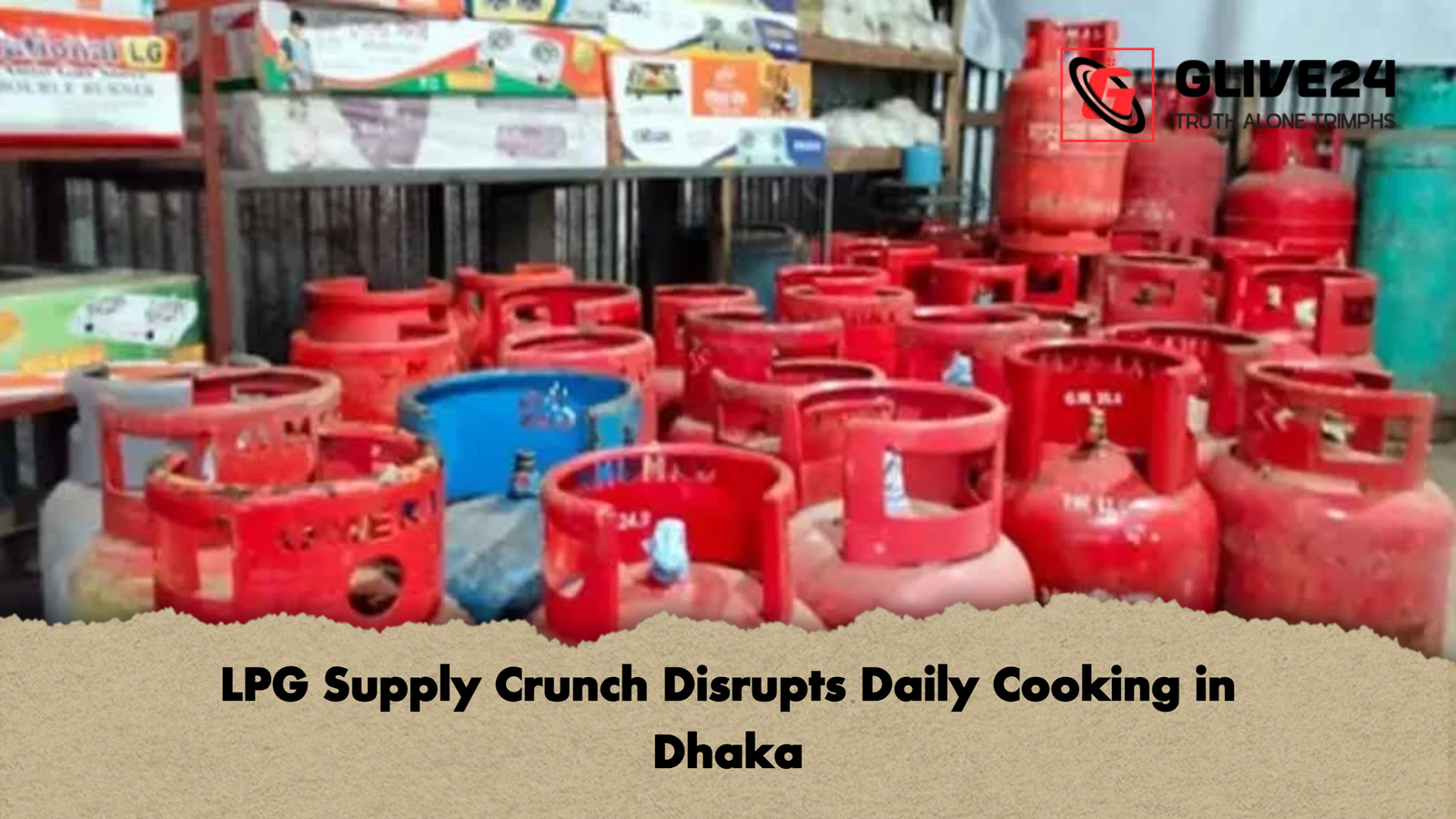
For more than a week, residents of Bangladesh’s capital, Dhaka, have been grappling with an acute shortage of liquefied petroleum gas (LPG) cylinders, the primary cooking fuel for thousands of urban households. Despite strong consumer demand, the most commonly used domestic cylinders are largely unavailable at neighbourhood retail shops. As a result, many families are forced to roam from shop to shop in search of gas, while those who do manage to find a cylinder are paying exorbitant prices—often Tk 700 to Tk 800 above the government-set rate.
The crisis has left daily life in disarray. In several households, normal cooking has come to a halt, compelling residents to rely on hotels and takeaway food, adding to both financial strain and inconvenience. On Saturday, visits to various localities in Mirpur and Mohammadpur revealed widespread frustration among consumers facing the same predicament.
At around 10am, Monir Mia, a caretaker of a residential building in the Kalshi area of Mirpur, described a familiar ordeal. One of the tenants on the seventh floor ran out of LPG gas early in the morning. Monir contacted three shops that usually supply cylinders to the building, only to be told by each that there was no stock available. The tenant was informed, and breakfast had to be arranged from a nearby hotel instead.
“When there is no cylinder at all, what difference does paying more make?” Monir remarked wryly, reflecting the helplessness felt by many consumers.
Retailers, too, say they are caught in the middle. Hasan Mahmud, owner of Binimoy Traders, which supplies LPG to homes in Mirpur’s Section 11 and 12, said he sells brands including Bashundhara, Unigas, Petro and Sena LPG. However, for nearly ten days, none of the distributors has delivered cylinders to his shop. “I used to sell 15 to 20 cylinders a day. Now I don’t have a single one,” he said. On one occasion, he managed to procure three cylinders from larger traders and sold them at Tk 2,000 each, only after informing customers of the higher price. He has since stopped selling at inflated rates, citing the lack of official receipts and customer dissatisfaction.
Wholesale suppliers echo similar concerns. A sales representative of Spark Energy Solution, which supplies LPG to small retailers in Mirpur Sections 10, 11 and 12, said normal supply has been disrupted for almost two weeks. Previously, consignments of 150 to 200 cylinders (12kg and 35kg) were common. Now, even with the same demand, suppliers are releasing only 15 to 20 cylinders, citing depleted gas reserves. The few cylinders that are released are reportedly priced higher at the manufacturing stage.
The same scenario is unfolding in Shewrapara and Mohammadpur. Residents complain of empty shops and soaring prices. Ahmed Sajib of Shewrapara said a cylinder officially priced at around Tk 1,250 is now being sold for Tk 2,000. “There is no market monitoring,” he alleged. “Earlier, sellers charged Tk 200 to Tk 300 extra. Now it has jumped to Tk 700 or Tk 800.”
Others, like Nirab Khan and Siam Hossain, said they have had to borrow cylinders from relatives or buy food from outside after failing to cook at home on time.
Under government regulations, the retail price of a 12kg LPG cylinder—the most widely used for household cooking—is fixed at Tk 1,253, with no provision for charging even a single taka extra. Yet consumers allege that weak enforcement has allowed opportunistic price hikes amid the shortage.
The National Consumer Rights Protection Directorate has urged affected consumers to lodge complaints via its 24/7 hotline, 16121, or through its official website.
Snapshot of the Current LPG Situation
| Item | Details |
|---|---|
| Most-used household cylinder | 12 kg LPG |
| Government-fixed price | Tk 1,253 |
| Current market price | Tk 1,950–2,100 |
| Extra amount charged | Tk 700–800 |
| Duration of shortage | 7–10 days |
| Worst-affected areas | Mirpur, Shewrapara, Mohammadpur |
As the shortage drags on, consumers and retailers alike are calling for urgent intervention to restore supply chains and ensure strict enforcement of regulated prices before the crisis deepens further.