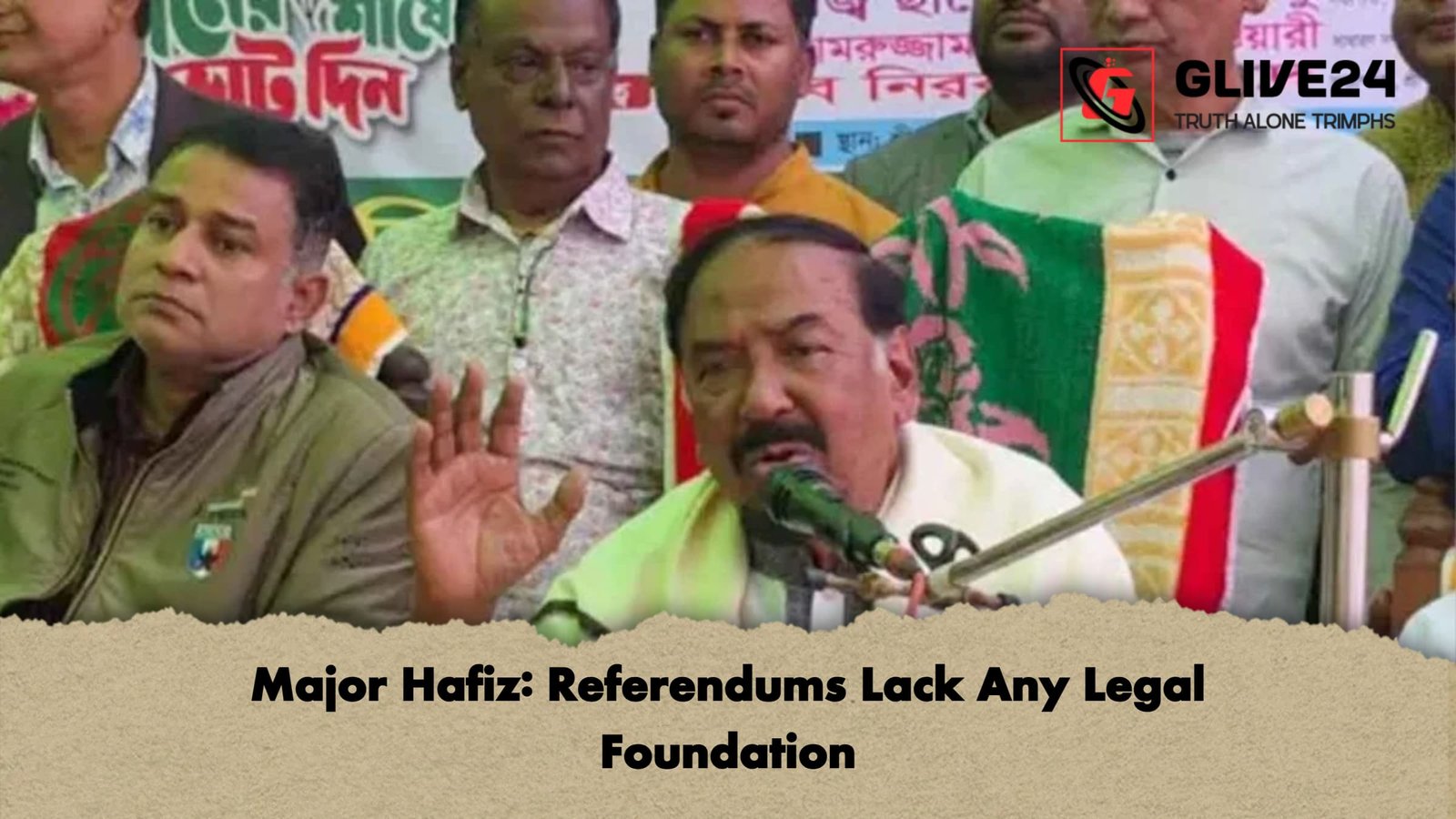
Major (Retd) Hafiz Uddin Ahmed, a prominent member of the Bangladesh Nationalist Party (BNP) Standing Committee, has sparked a fresh wave of political discourse by categorically stating that referendums possess no legal standing in the current constitutional framework. His remarks suggest a growing friction between grassroots political aspirations and the agendas of urban technocrats.
Addressing a consultative meeting with members of the Hindu community at the Madan Mohan Temple premises in Lalmohan, Bhola, Major Hafiz pulled no punches. He described the move toward a referendum as an imposition by a “special elite group” based in Dhaka, rather than a demand rising from the common populace.
A Reluctant Endorsement under Duress
In a candid revelation, the veteran politician admitted that the BNP was initially opposed to the idea of a referendum. However, the party reached a pragmatic, if uncomfortable, conclusion: without agreeing to this process, the environment required for a general election might never materialise.
“We feared that if we did not concede to the referendum, the path to a national election would be permanently obstructed,” Major Hafiz explained. “It was under these coercive circumstances that the BNP felt compelled to sign the July Charter.”
He argued that fundamental changes to the nation’s governance, specifically constitutional amendments, should remain the exclusive preserve of representatives directly elected by the people. According to Hafiz, bypassing the parliamentary process in favour of a direct plebiscite risks undermining the very democracy it claims to uphold.
Comparative Perspectives on the Referendum Dispute
| Feature | The “Elite Group” Proposal | Major Hafiz / BNP Position |
| Source of Authority | Direct popular mandate via plebiscite. | Elected parliamentary representatives. |
| Legal Basis | Proposed as a new democratic tool. | Currently lacks constitutional validity. |
| Motivation | Rapid institutional reform. | Ensuring a timely general election. |
| Societal Readiness | Deemed necessary for progress. | Public is unprepared; process is confusing. |
Critique of the Constitutional Amendment Process
Major Hafiz expressed deep reservations regarding the maturity of the Bangladeshi electorate for such a sophisticated voting mechanism. He noted that the campaign strategies used to promote the referendum have been riddled with inconsistencies, leading to widespread public confusion.
The Major’s critique highlights a significant philosophical divide. While some reformists argue that a referendum is the purest form of democracy, the BNP leadership appears to view it as a distraction—or worse, a hurdle—to the restoration of a traditional parliamentary system. By labelling the proponents as a “Dhaka elite,” Hafiz is positioning the BNP as the defender of constitutional orthodoxy against top-down experimentalism.
As the political climate intensifies, these comments underscore the fragility of the consensus surrounding the “July Charter” and the looming challenges in the transition toward a stable electoral roadmap.