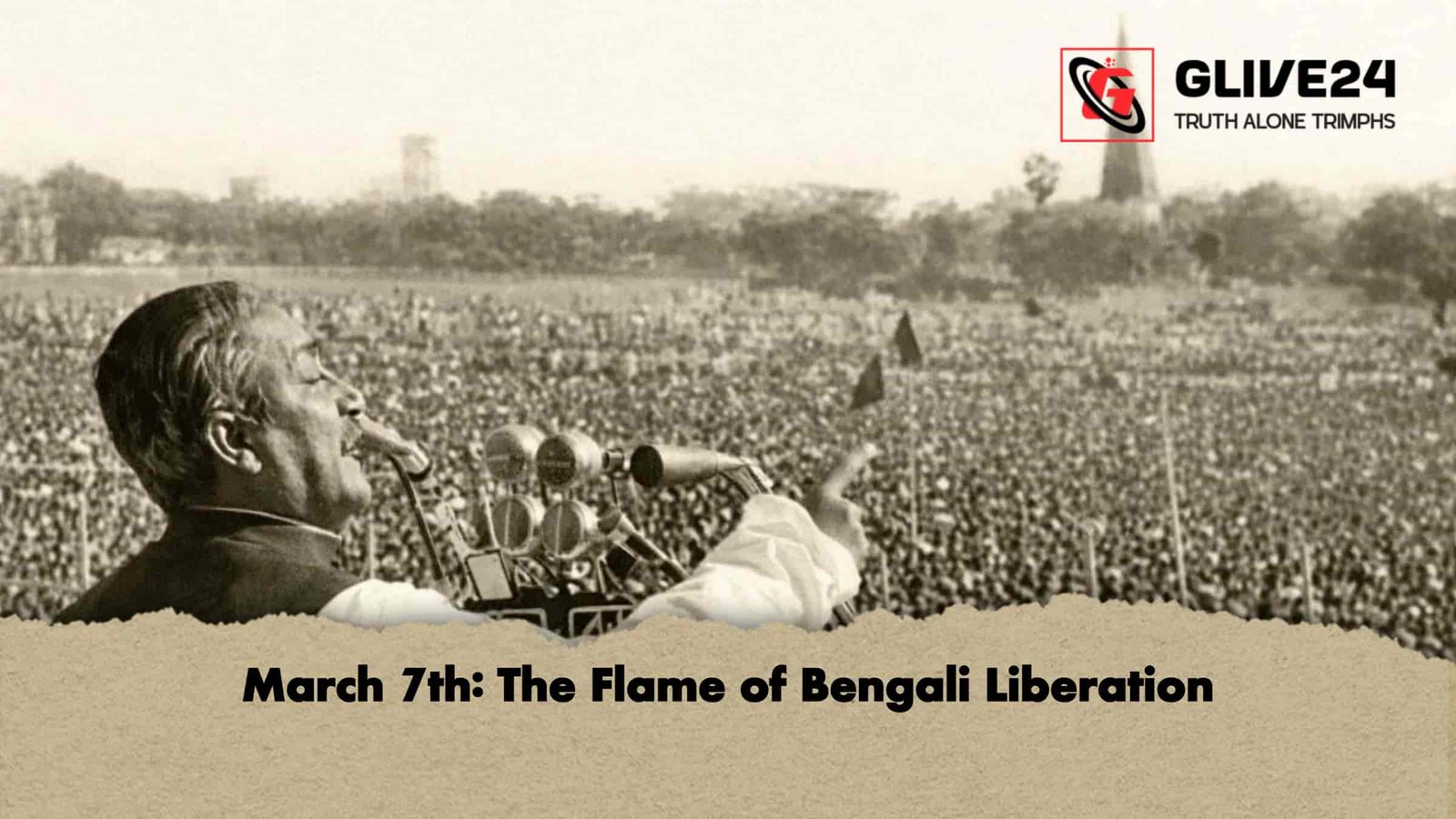
The seventh of March remains one of the most significant and unforgettable days in the history of the Bengali nation’s struggle for freedom and self-determination. On this day in nineteen seventy one, the undisputed leader of the people, Bangabandhu Sheikh Mujibur Rahman, delivered a historic speech at the Ramna Racecourse Ground in Dhaka. That address would later become the defining inspiration for the independence movement and a turning point in the political destiny of the region.
The atmosphere in Dhaka on that day was extraordinary. Vast crowds gathered in anticipation of hearing their leader speak at a moment of profound political uncertainty. People travelled from distant districts, towns, and rural communities to reach the capital. Some arrived on foot after long journeys, while others travelled by river routes, trains, or buses. By the afternoon, the Ramna Racecourse Ground had become a sea of humanity. Men and women, young people, labourers, farmers, and students assembled together, united by a shared hope for political justice and national dignity.
At approximately three twenty in the afternoon, Bangabandhu Sheikh Mujibur Rahman stepped onto the stage. Dressed in a white traditional outfit with a black sleeveless coat, he began speaking in a firm and commanding voice. The crowd responded with thunderous applause and chants. His speech lasted about eighteen minutes, yet its influence has endured for generations.
During the address, he described the long history of political deprivation, economic exploitation, and discrimination faced by the people of the eastern region. He outlined a path of resistance and unity while urging the population to remain prepared for a decisive struggle. His most powerful declaration came near the conclusion of the speech when he proclaimed:
“The struggle this time is the struggle for our emancipation; the struggle this time is the struggle for independence.”
These words electrified the audience and quickly spread across the country, inspiring millions with a renewed sense of determination and national purpose.
In the same speech, he also presented four crucial political demands directed at the authorities of the time. These demands reflected the urgent aspirations of the people for democratic governance and justice.
| Subject | Information |
|---|---|
| Date | Seventh March nineteen seventy one |
| Location | Ramna Racecourse Ground, Dhaka |
| Speaker | Bangabandhu Sheikh Mujibur Rahman |
| Duration of Speech | Approximately eighteen minutes |
| Core Message | Call for emancipation and independence |
| Historical Impact | Inspired national unity and resistance |
Efforts were initially made to broadcast the speech live across the country. However, military authorities temporarily halted the transmission. In response, Bengali employees of the national broadcasting service protested by suspending operations. Later that night, permission was granted to broadcast the full speech, and recordings quickly spread throughout the country, strengthening public resolve.
The historical importance of the address soon became evident. Within weeks, political tensions escalated dramatically. After the brutal military crackdown that began on the night of twenty fifth March nineteen seventy one, the declaration of independence followed in the early hours of twenty sixth March. This marked the beginning of a nine month war of liberation that ultimately resulted in the emergence of an independent state on sixteen December nineteen seventy one.
The international significance of the speech has also been widely recognised. On thirty October two thousand seventeen, the United Nations Educational, Scientific and Cultural Organization formally included the speech in the Memory of the World Register, acknowledging it as an important documentary heritage of global history.
In recent commemorations, although the central leadership of the Awami League did not organise a nationwide programme, various local groups and activists held rallies, poster campaigns, and public broadcasts of the historic speech in Dhaka and other districts. Volunteers installed loudspeakers in different parts of the capital so that citizens could once again hear the powerful words that once awakened a nation and inspired the dream of freedom.