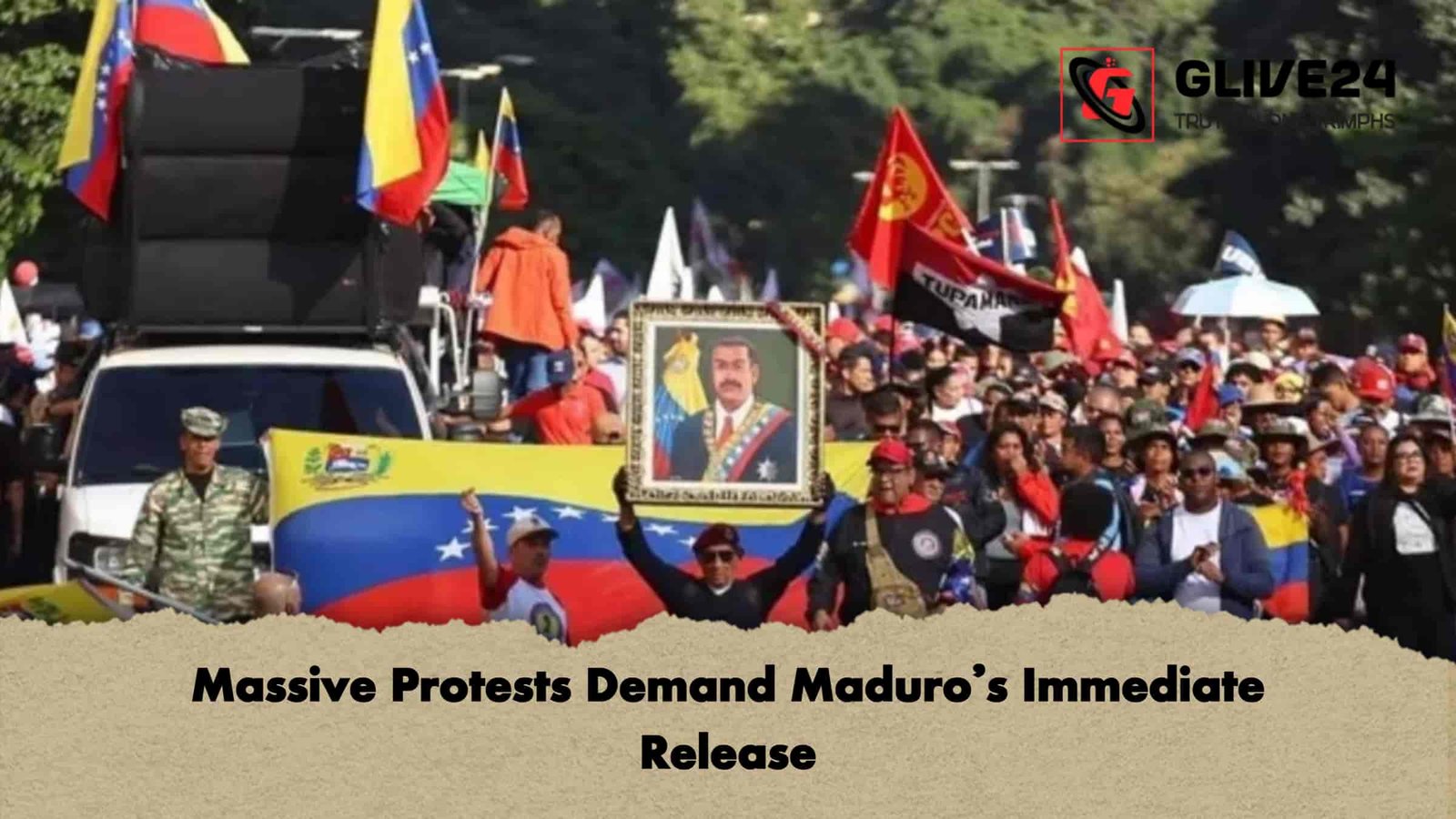
Caracas, Venezuela — On Tuesday, 4 February 2026, millions of Venezuelans took to the streets in a wave of unprecedented protests across Caracas and other major cities, demanding the immediate release of President Nicolás Maduro and his wife, Cilia Flores. Reports indicate that nearly 20 million people participated in what has been described as one of the largest demonstrations in the country’s recent history.
The protests mark exactly one month since a U.S. military operation resulted in the capture of Maduro and Flores, who were subsequently transported to a Western court in New York. Demonstrators denounced the operation as both a violation of international law and an act of neo-colonial interference, asserting that foreign intervention undermines Venezuela’s sovereignty.
Maduro and Flores are currently facing allegations of corruption, drug trafficking, and other international crimes in New York. Despite these charges, the majority of Venezuelans perceive foreign military involvement as unacceptable and insist that “Maduro is the democratically elected leader of the people” and must be returned immediately.
The main protest, organised by the government under the banner of the “Gran Marcha” (Great March), brought together government employees, students, labour unions, and ordinary citizens. Participants carried banners, flags, and portraits of the presidential couple, chanting slogans demanding respect for Venezuela’s constitutional rights. Many voiced concerns that external intervention had destabilised the country’s political equilibrium. Popular chants included: “Venezuela cannot function without Maduro.”
Parallel demonstrations have also been reported by groups from opposing political currents, calling for the release of ordinary political prisoners and the rapid passage of a general amnesty law. Activists anticipate that the legislation would free numerous detainees currently held under politically motivated charges.
International reactions have been swift. The United Nations Secretary-General emphasised the importance of careful diplomacy to maintain peace and stability, while Russia and China strongly condemned the U.S. military action.
Key Political Developments in Venezuela
| Issue | Details |
|---|---|
| President | Nicolás Maduro (detained in the U.S.) |
| First Lady | Cilia Flores (detained alongside Maduro) |
| Detention Location | New York, United States |
| Interim Government | Delcy Rodríguez |
| Principal Demand | Immediate release of Maduro and Flores |
| Local Sentiment | Support for government and protection of sovereignty |
| International Reaction | UN concern; Russia and China condemn U.S. intervention |
In Caracas, Maduro’s son and National Assembly member Nicolás Maduro Guerra addressed the rally, describing the operation as a “deep scar in Venezuela’s history” and condemning the foreign incursion into Venezuelan territory. Tens of thousands of government employees joined the march, underscoring the widespread public support for the president despite his absence.
The current interim leader, Delcy Rodríguez, has sought to maintain political stability amid escalating unrest. Reports indicate that she has already released hundreds of political prisoners and opened avenues for private investment in nationalised energy sectors, while the U.S. has conditioned further cooperation on securing control over Venezuela’s oil reserves.
Venezuela’s Current Political Snapshot (February 2026)
| Aspect | Details |
|---|---|
| President | Nicolás Maduro (abducted) |
| First Lady | Cilia Flores (abducted) |
| Interim Leader | Delcy Rodríguez |
| Key Event | 3 January 2026 – Presidential couple abducted |
| International Response | Global protests with “Hands Off Venezuela” slogan |
| U.S. Position | Cooperation contingent on oil sector control |
As tensions escalate, Venezuela remains at a crossroads. Street protests, political uncertainty, and international scrutiny highlight the country’s deep divisions, leaving its future precarious and dependent on both domestic consensus and global diplomacy.