
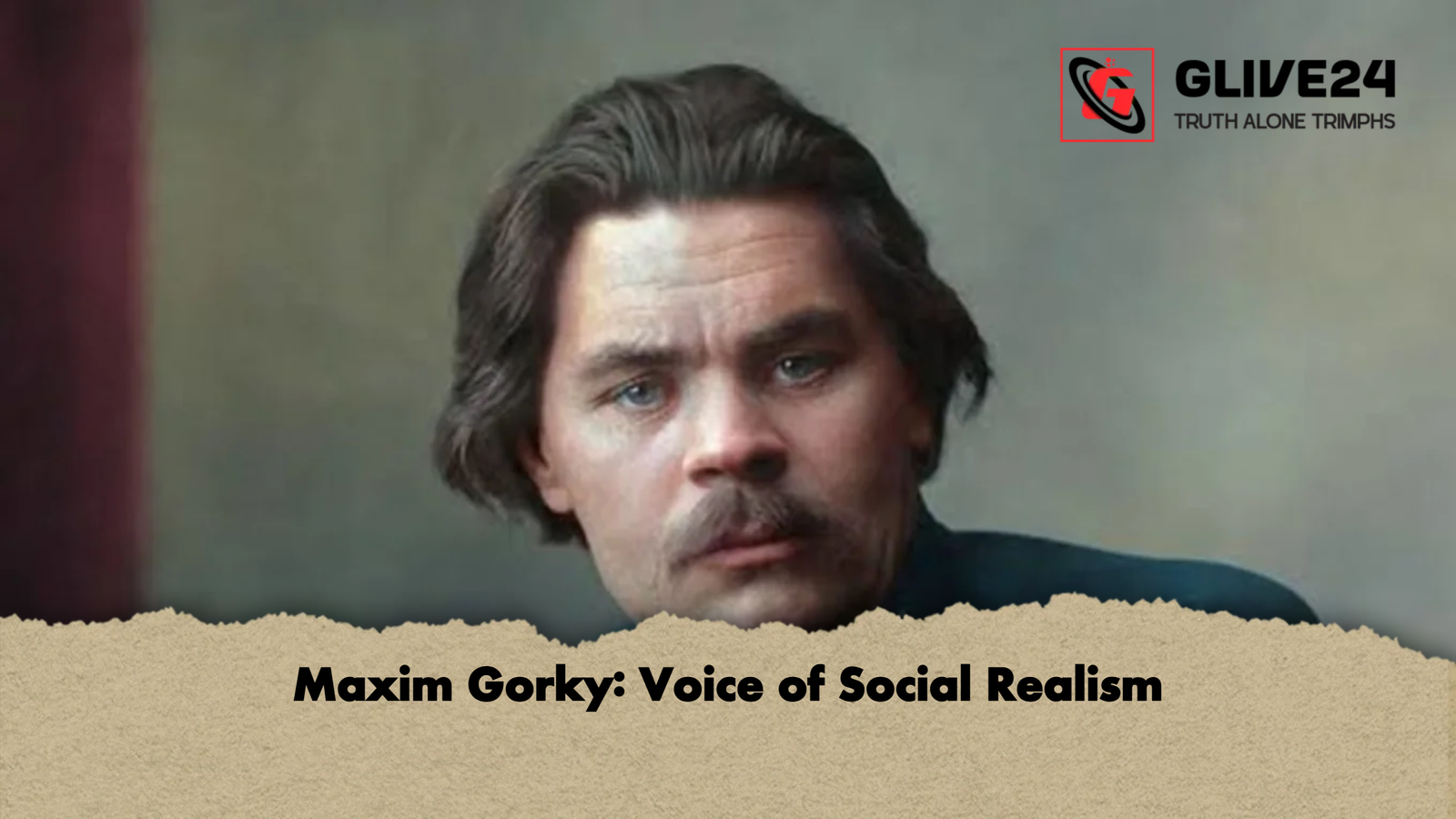
Maxim Gorky remains one of the most influential figures in Russian and world literature, remembered not merely as a writer but as a powerful voice for the oppressed and marginalised. Born Alexei Maximovich Peshkov, he adopted the pen name “Gorky”, meaning “bitter”, a poignant reflection of the hardship, suffering, and harsh realities that shaped his life and literary vision.
Table of Contents
Early Life and Formative Years
Gorky was born on 28 March 1868 in Nizhny Novgorod, within the Russian Empire. Orphaned at a young age, he endured extreme poverty, instability, and neglect throughout his childhood. Deprived of formal education, he instead absorbed life as his greatest classroom, developing an acute awareness of human struggle and social injustice.
A Life of Hard Labour and Experience
From adolescence, Gorky was compelled to survive through various forms of manual labour and itinerant work. He worked as a cook’s assistant, a dock labourer, a ship worker, and a wanderer traversing vast regions of Russia. These experiences exposed him to the harsh realities faced by ordinary people, particularly the working class and the destitute, shaping the thematic foundation of his literary output.
Literary Contribution
Gorky began his literary journey in the early 1880s, gradually developing a distinctive narrative voice marked by realism and emotional depth. His works predominantly focus on the struggles of workers, vagrants, and the socially excluded, portraying their resilience amid oppression.
He is widely regarded as a foundational figure of Socialist Realism, a literary approach that later became central to Soviet literature. His writing combined artistic expression with a strong socio-political message, advocating for dignity, equality, and social transformation.
Selected Works
| Title | Year | Form | Theme |
|---|---|---|---|
| Mother | 1906 | Novel | Revolutionary consciousness and workers’ struggle |
| Foma Gordeyev | 1900 | Novel | Moral decay and the burden of wealth |
| Sketches and Stories | 1898 | Short stories | Life of the poor and dispossessed |
| Various early tales | 1880s–1890s | Fiction | Social realism and human suffering |
Political Engagement and Exile
Gorky was deeply engaged in the progressive political currents of his time and maintained close associations with revolutionary movements during the Russian Revolution. However, his independent views and occasional criticism of political developments led to tensions with authorities, resulting in periods of exile from Russia and later the Soviet Union.
Humanitarian Role
During the devastating famine of 1921–1922, Gorky issued urgent appeals to the international community for humanitarian assistance. His efforts helped draw global attention to the crisis, which claimed millions of lives across famine-stricken regions of Russia, and contributed to relief initiatives.
Personal Tragedy and Death
The death of his only son, Maxim Peshkov, in 1934 deeply affected him, marking a profound personal tragedy in his later years. Gorky himself died on 18 June 1936 from pneumonia. His death has been surrounded by historical debate, with scholars continuing to examine the political and medical circumstances of his final days.
Legacy
Although nominated five times for the Nobel Prize in Literature, Gorky never received the award. Nevertheless, his literary legacy remains monumental. He gave enduring voice to the voiceless and redefined literature as an instrument of social critique and transformation.
Maxim Gorky’s life and work continue to remind the world that literature is not merely a form of artistic expression, but also a powerful medium of resistance, empathy, and human liberation.