
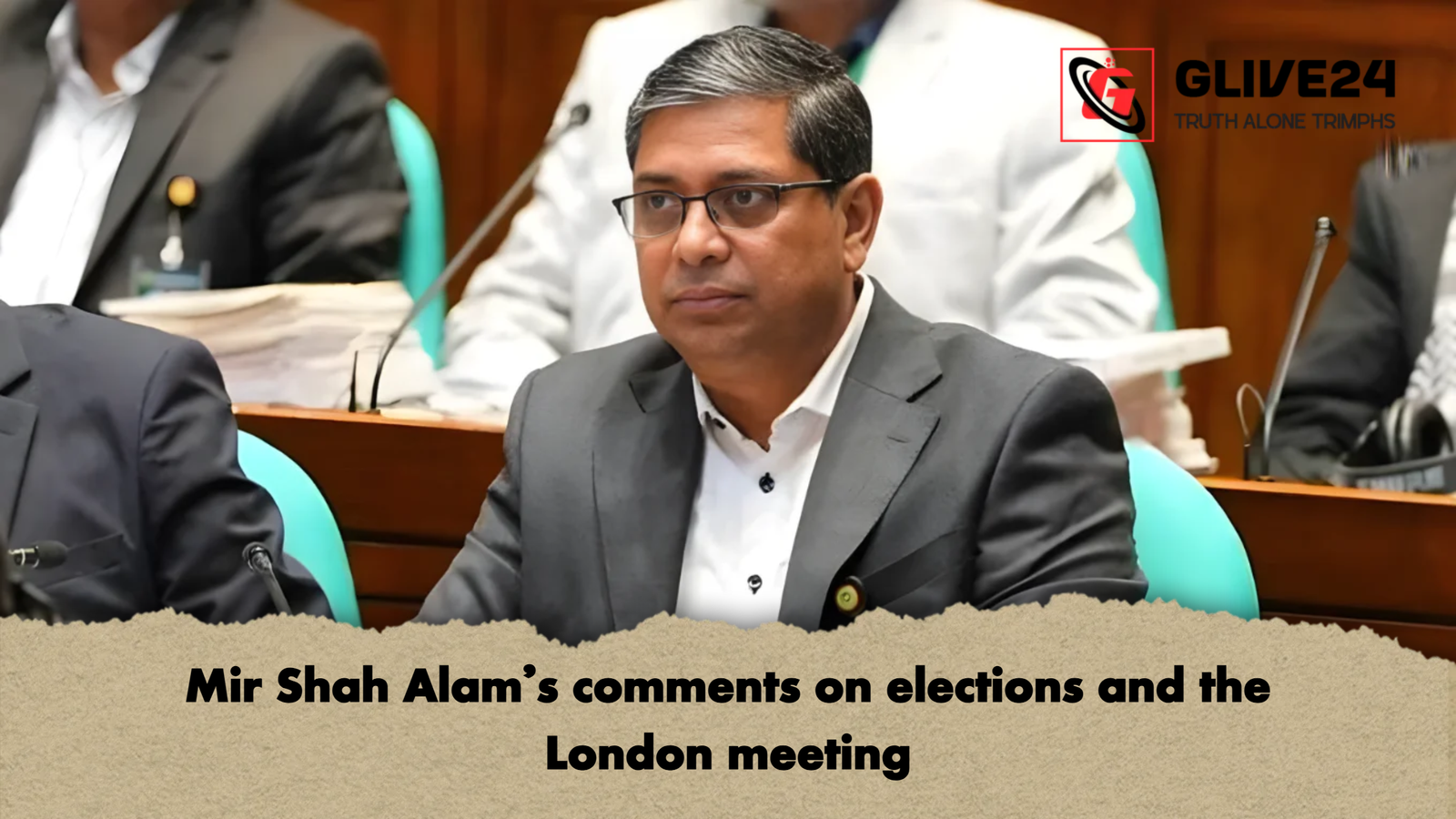
Local Government, Rural Development and Co-operatives Minister Mir Shah Alam has triggered fresh political controversy in Bangladesh’s parliament after making a series of pointed remarks on the country’s historical movements and the role of different political parties.
Speaking during the discussion on the President’s address in the 13th National Parliament session, the Minister responded to comments made by a leader of the National Citizens’ Party (NCP), who had questioned the political ownership of recent and historical mass movements.
Shah Alam argued that opposition parties lack what he described metaphorically as the “trophies” of key national movements, including the 1971 Liberation War and the 1990 pro-democracy uprising. He claimed that the Bangladesh Nationalist Party (BNP) could associate itself with three major political movements in the country’s history—1971, 1990, and the recent July–August movement—suggesting a continuity of political participation across decades.
“In our political narrative, these three major movements are within our sphere of experience,” he stated, adding that no single rival party, in his view, could claim involvement in all of them in the same way.
He further contrasted BNP’s historical claims with those of other major parties, asserting that while the Awami League could highlight its role in 1971 and 1990, it lacked association with the most recent July–August movement. Similarly, he suggested that opposition parties might reference one or two movements but not all three in a unified political legacy.
Shah Alam also referred to the 1986 national elections, alleging that Jamaat-e-Islami participated in that electoral process alongside the Awami League, which he presented as part of broader historical political alignments in Bangladesh.
A significant portion of his remarks focused on political leadership and recent developments involving the formation of a “command structure” within mass movements. Without presenting formal evidence in his speech, he referenced a reported meeting between Nobel laureate Dr Muhammad Yunus, who previously headed an interim government, and BNP acting chairman Tarique Rahman in London. According to his account, discussions during that meeting were linked to the scheduling of national elections and broader political consensus-building.
He suggested that such interactions contributed to setting a date for elections, which he argued eventually enabled what he described as a “free, fair and impartial” electoral process. This, he added, allowed both ruling and opposition parties to take seats in what he termed a historically significant parliament.
Key Political Movements Referenced
| Movement / Event | Year | Political Significance | Minister’s Interpretation |
|---|---|---|---|
| Liberation War | 1971 | Independence of Bangladesh | BNP associated with legacy claims |
| Mass Uprising | 1990 | Fall of military rule | Shared political ownership claimed |
| July–August Movement | Recent | Contemporary political mobilisation | BNP linked, others disputed involvement |
| National Election | 1986 | Controversial multi-party participation | Jamaat cited for electoral alignment |
Shah Alam emphasised that political movements in Bangladesh cannot be viewed in isolation, arguing that they form part of a continuous struggle shaped by multiple actors over time. He maintained that while different parties highlight selective parts of history, the broader political reality is more complex and shared.
His remarks have added to ongoing tensions in parliament, reflecting deeper disagreements over historical interpretation and political legitimacy. Opposition parties have yet to issue a formal response to his statements, but the speech is expected to fuel further debate in the coming days as political narratives around past movements remain highly contested.