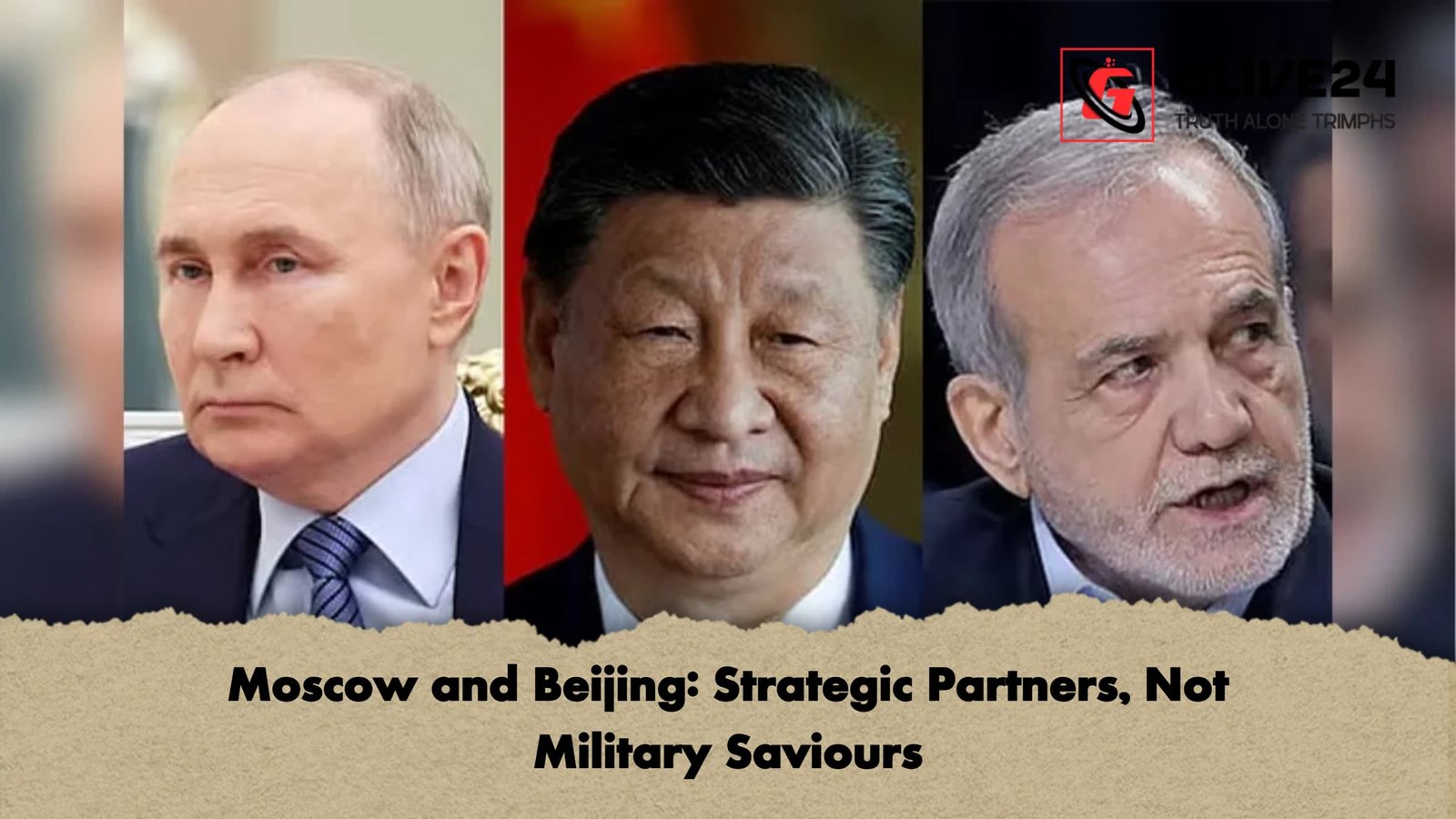
In the wake of escalating hostilities involving the United States, Israel, and Iran—a conflict that has already claimed over a thousand lives—Tehran’s primary diplomatic allies, Russia and China, find themselves in a delicate balancing act. While both nations have condemned the aggression as a flagrant violation of international law, their support has remained strictly rhetorical, leaving many to wonder why these superpowers are maintaining such a calculated distance.
Table of Contents
The Limits of the Russo-Iranian Pact
The relationship between Moscow and Tehran reached a milestone in January 2025 with the signing of a comprehensive “Strategic Partnership Agreement.” This deal was designed to deepen cooperation in sectors ranging from intelligence sharing and military logistics to transport corridors connecting Russia to the Persian Gulf.
However, as the conflict intensified following the assassination of Iran’s Supreme Leader—an act President Vladimir Putin described as a “brutal violation of all humanitarian and moral norms”—the limitations of this pact became clear. Unlike Russia’s 2024 defence treaty with North Korea, the Iranian agreement lacks a mutual defence clause.
Andrei Kortunov of the Valdai Discussion Club highlights that while the North Korean deal mandates military intervention, the Iranian contract merely binds each party to refrain from hostile acts against the other during a conflict. Consequently, Moscow is under no legal obligation to intervene. With Russia prioritising the resolution of the Ukraine crisis and seeking potential American mediation, a direct confrontation on behalf of Tehran is viewed as a risk not worth taking.
Comparison of Strategic Alliances
| Feature | Russia-Iran Agreement (2025) | Russia-North Korea Treaty (2024) | China-Iran Cooperation (2021) |
| Primary Focus | Logistics, Intelligence, Trade | Mutual Defence & Military Aid | Energy & Infrastructure |
| Military Obligation | Neutrality/Non-hostility | Mandatory Intervention | Non-interference |
| Duration | Renewable Term | Indefinite | 25 Years |
| Economic Basis | Transport Corridors | Tactical Supply | Oil Exports (87.2%) |
Beijing’s Pragmatic Restraint
China’s stance is equally pragmatic. Despite a 25-year cooperation agreement signed in 2021, Beijing has drawn a firm “red line” regarding military involvement. Jody Wen, a fellow at Tsinghua University, suggests that China views the relationship through a lens of economic stability rather than ideological warfare.
While Iran is heavily dependent on China—sending roughly 87.2% of its crude oil exports to the mainland—the reverse is not true. For Beijing, Iran is a minor trade partner in the context of its global commerce. China’s primary interest lies in regional stability to protect its energy supply lines, leading it to favour diplomatic mediation over the shipment of arms.
A “Protective” Diplomacy
Ultimately, the “Axis of Three” is less of a solid military bloc and more of a loose coalition against Western hegemony. As Associate Professor Dylan Loh notes, Beijing and Moscow’s roles have become “protective” rather than “active.” They seek to mitigate regional disaster via the UN Security Council, but when the missiles fly, they appear content to remain on the sidelines, shielding their own economic and security interests from the fallout.