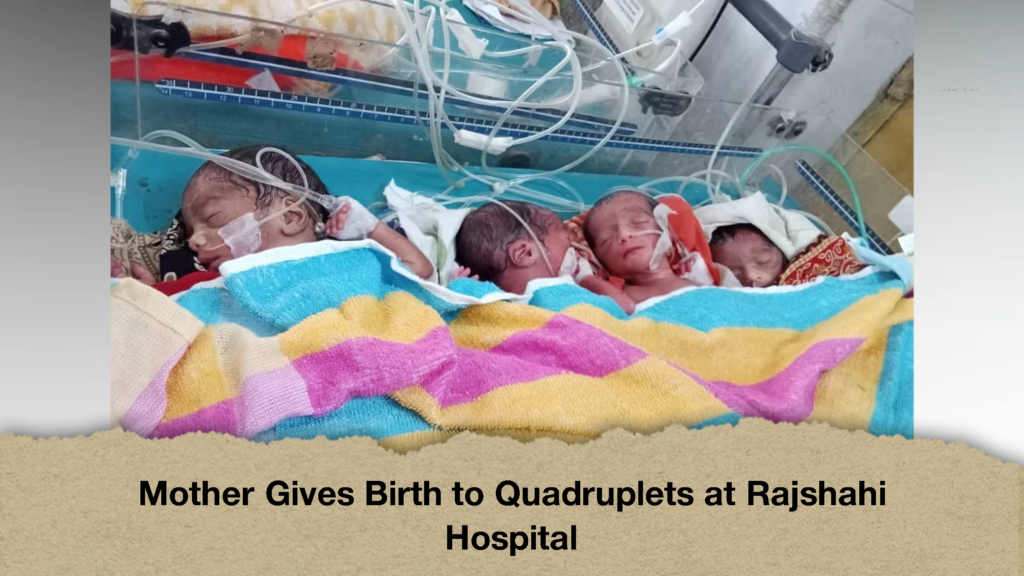
A mother from Rajshahi city has given birth to quadruplets—two boys and two girls—at Rajshahi Medical College Hospital (RMCH). The infants were delivered via emergency caesarean section in the early hours of Tuesday, following early onset labor. Due to their premature birth at 34 weeks, all four newborns were born below standard birth weights, prompting medical staff to place them under continuous clinical monitoring in the hospital’s specialized care unit.
The mother, Tisha Khatun, resides in the Sipaipara area of Rajshahi city alongside her husband, Nayan Islam. According to family members, Tisha experienced sudden labor pains on Monday afternoon and was rushed immediately to RMCH for medical intervention. Medical teams evaluated her condition and performed the surgical delivery at approximately 3:00 am on Tuesday.
All four newborns were initially admitted to Ward 26 before being moved to the hospital’s Special Care Newborn Unit (SCANU) for advanced neonatal support. Expressing mixed feelings of anxiety and relief, Nayan Islam shared his hopes for his children’s recovery, praying that all four infants survive this delicate initial period and grow up to lead healthy, fulfilling lives.
Official details released by hospital authorities highlight the medical challenges associated with multiple premature deliveries. Hospital spokesperson Dr Sheikh Shamim Ahmed disclosed that none of the four infants achieved the expected healthy birth weight threshold of 1.5 to 2 kilograms typical for newborns. Two of the babies weighed precisely 1,000 grams each, a third weighed 1,100 grams, and the fourth registered at 1,300 grams.
Dr Ahmed explained that delivery at 34 weeks gestation frequently leaves infant lungs underdeveloped, posing severe respiratory risks. While their current clinical condition is classified as stable yet critical, the medical team has refrained from oral feeding, administering necessary fluids and essential nutrients via specialized syrup formulations and intravenous methods. Neonatal specialists at RMCH continue to monitor their vital signs around the clock to mitigate potential complications associated with low birth weight and premature organ development.