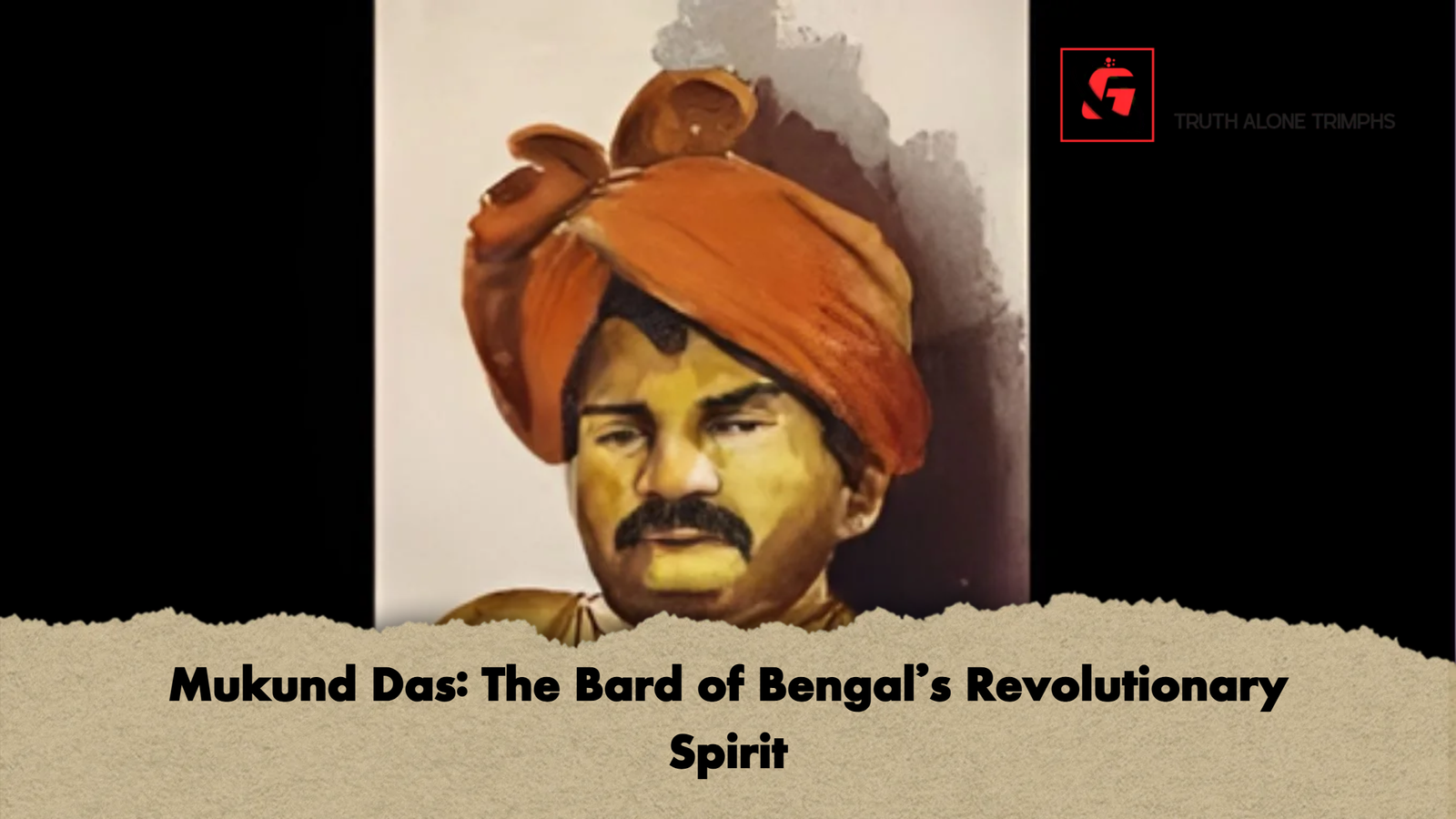
“We shall face the gallows with a smile,
The world shall witness—
Grant me one farewell, Mother, before I return.”
These haunting lines reflect the indomitable spirit of Mukund Das, the legendary Charan Kabi of Bengal—a poet, playwright, composer, and a herald of revolutionary inspiration. Born on 22 February 1878 in Banri village, Vikrampur pargana, Munshiganj district, he entered the world as Yajneshwar De, son of Gurudayal De and Shyamasundari Devi. Later, under the tutelage of Vaishnav ascetic Ramananda Avadhut, he adopted the name Mukund Das, eventually earning eternal fame as the Charan Kabi of Bengali literature.
Early Life and Artistic Beginnings
Mukund Das’s childhood was marked by hardship. The devastating erosion of the Padma River forced his family to relocate to Barishal. There, he joined a kirtan dal, quickly establishing himself as a singer of exceptional talent. By the age of nineteen, he compiled the remarkable Sadhana Sangeet, a collection of 100 songs that showcased his prodigious creativity and devotion.
Inspiring the Swadeshi Movement
During the Bengal Partition of 1905 and the subsequent Swadeshi and Non-Cooperation movements, Mukund Das’s songs and jatra pala performances stirred patriotic fervour and revolutionary zeal in the hearts of Bengalis. His notable works include:
| Work | Theme | Impact |
|---|---|---|
| Matripuja | Devotion to mother and motherland | Banned by authorities; inspired revolutionary courage |
| Samaj | Social awareness and reform | Encouraged critical thinking among the populace |
| Path | Life philosophy and ethics | Promoted humanistic values |
| Pallisewa | Rural development and service | Raised consciousness in villages |
| Karmakshetra | Struggles of workers and common people | Motivated the working class |
His outspoken opposition to British rule led to his arrest and a rigorous two-and-a-half-year sentence in Delhi jail, and his acclaimed play Matripuja was seized by the authorities.
Legacy and Recognition
Mukund Das’s performances in Kolkata were hosted at the invitation of nationalist leader Chittaranjan Das, and acclaimed at the Jorasanko Thakurbari as well as at Acharya Jagadish Chandra Bose’s residence. Renowned poet Kazi Nazrul Islam met him personally to pay homage. Traveling from village to village, he ignited the flame of freedom in countless hearts, serving not merely as a poet but as the voice and inspiration of the people’s struggle.
On 18 May 1934, the fiery voice of Mukund Das fell silent. Yet, his songs continue to resonate, reminding us that for a true patriot, even life itself is secondary to the motherland.
With deep respect and remembrance, we honour Mukund Das, the eternal Charan Kabi of Bengal.