
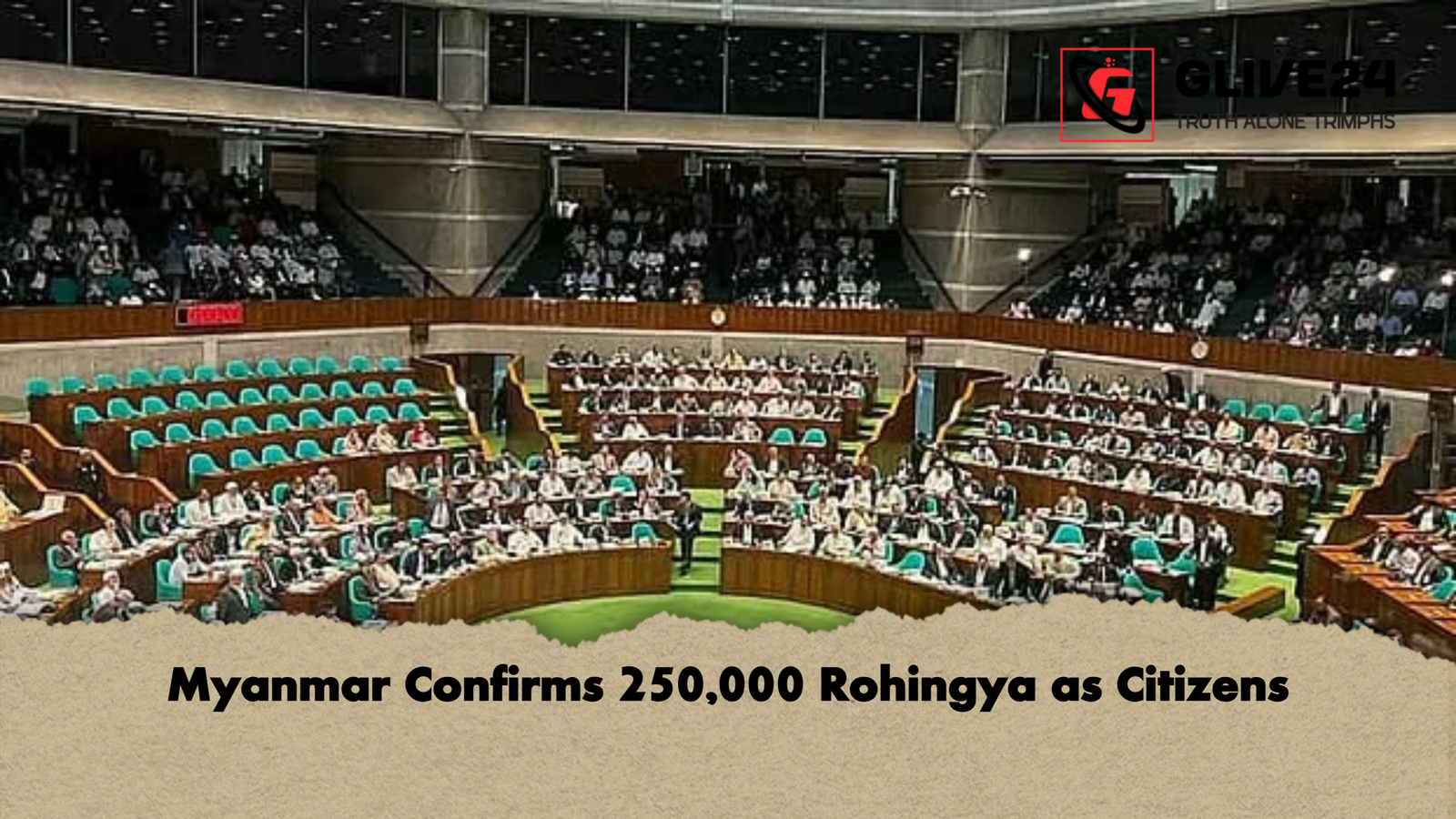
Myanmar has officially verified the identities of only 354,751 Rohingya individuals from the lists submitted by the Bangladesh government, of whom 253,964 have been recognised as citizens of Myanmar. This disclosure was made during Monday’s parliamentary question-and-answer session in Dhaka.
In response to a question by Chattogram-15 MP Shahjahan Chowdhury, State Minister for Foreign Affairs Shama Obaid Islam provided the details on behalf of absent Foreign Minister Dr. Khalilur Rahman. The session, presided over by Deputy Speaker Kaysar Kamal, commenced at 3:30 pm.
Dr. Rahman highlighted that previous Bangladesh administrations under the BNP had successfully repatriated Rohingya populations in 1978 and 1992. He added that the current government has been engaged in regular verification processes with the Myanmar authorities to facilitate eventual repatriation. To date, Bangladesh has transmitted information on 829,036 Rohingya in six separate phases. Of these, Myanmar has verified 354,751 individuals as of January 2026, with 253,964 identified as “former residents of Myanmar.”
Rohingya Verification Status (as of January 2026)
| Phase | Records Sent | Verified by Myanmar | Recognised as Citizens |
|---|---|---|---|
| 1–6 | 829,036 | 354,751 | 253,964 |
Dr. Rahman emphasised that ongoing conflicts in Myanmar currently prevent the start of repatriation efforts. He reiterated Bangladesh’s stance that “a sustainable solution to the Rohingya crisis requires safe, voluntary, and dignified repatriation.” The government continues to pursue diplomatic, legal, and humanitarian initiatives, with strengthened international cooperation.
Bangladesh also extends moral and diplomatic support to international judicial processes addressing the Rohingya genocide. The case Gambia v. Myanmar is currently pending at the International Court of Justice in The Hague, with Bangladesh providing financial assistance and closely monitoring the proceedings to uphold global justice.
On trade and foreign policy matters, Dr. Rahman noted that the government is actively working to expand export markets, attract foreign investment, and promote international relations. Efforts include exploring new markets beyond traditional ones in Europe and North America, targeting emerging economies in the Middle East, Africa, South America, Southeast Asia, and Eastern Europe, with ongoing discussions on bilateral trade agreements, preferential trade arrangements (PTAs), and free trade agreements (FTAs).
The minister also stressed the diversification of export products as a key priority, reducing reliance on the garment sector and promoting multi-sectoral export growth. Diplomatic missions are engaging overseas Bangladeshis through diaspora initiatives to mobilise investment and strengthen the country’s economic development.
Regarding foreign policy, Dr. Rahman highlighted that the government’s strategy prioritises national interests, sovereignty, non-interference in other nations’ internal affairs, and mutually respectful relations. He cited Bangladesh’s recognition as a friendly state by GCC countries and Iran as evidence of the balanced foreign policy approach.
Planning Minister Amir Khosru Mahmud Chowdhury added that, according to the 2024 Labour Force Survey, Bangladesh has 71.01 million economically active individuals, comprising 48.02 million men and 23.69 million women, with roughly 1.36 million entering the workforce annually. Preparations for the 2026 labour survey are currently underway.
This multi-faceted approach reflects Bangladesh’s continued efforts to address the Rohingya crisis while promoting economic and diplomatic growth.