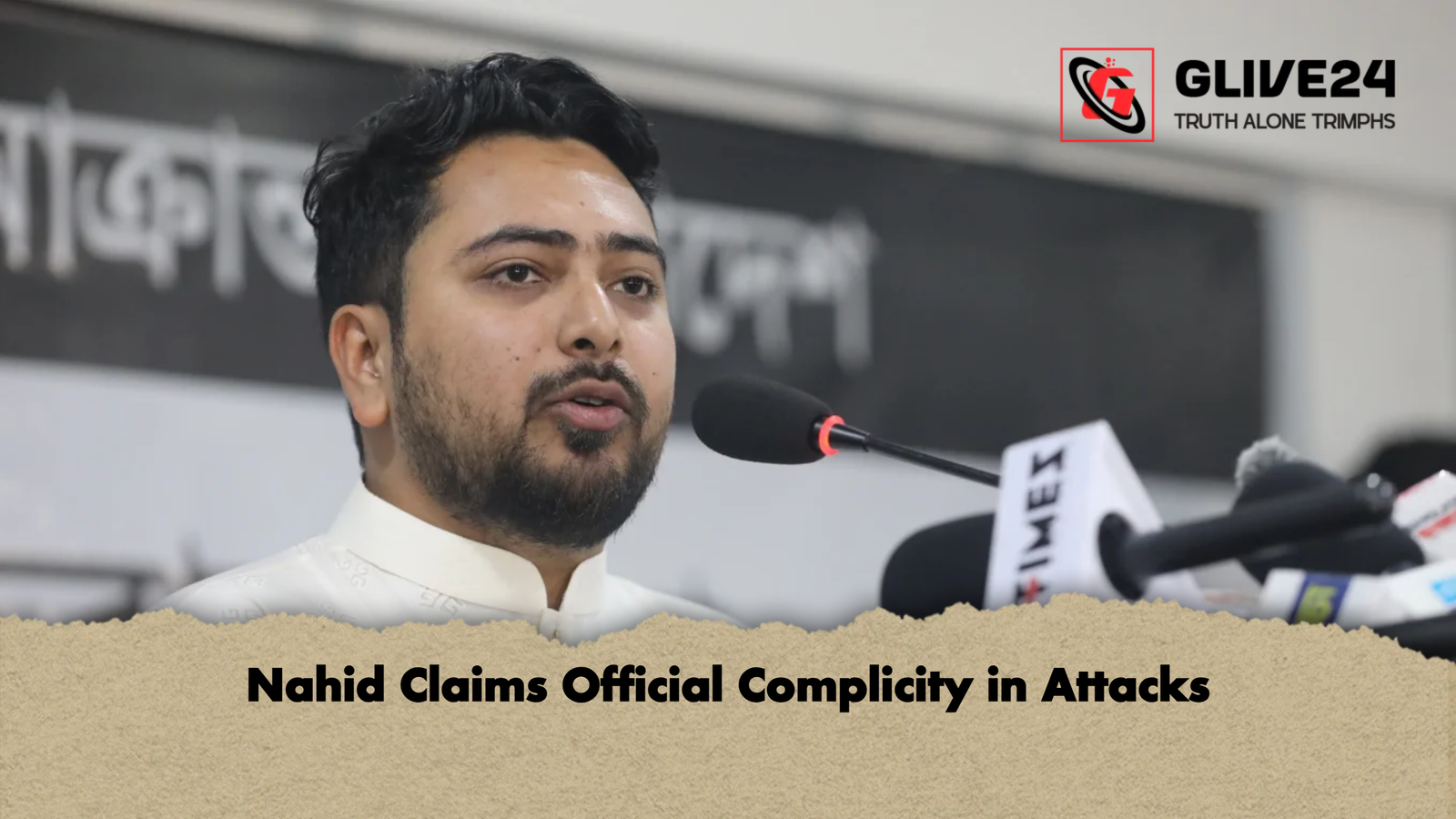
National Citizen Party (NCP) convener Nahid Islam has alleged that elements within the state apparatus were complicit in the recent attacks on the offices of Prothom Alo and The Daily Star, asserting that the incidents were premeditated, politically backed and executed with clear intent rather than being spontaneous outbreaks of violence.
Nahid made the remarks on Monday, 22 December, while addressing a protest meeting at a hotel in the capital. The event was jointly organised by the Editors’ Council and the Newspaper Owners’ Association of Bangladesh (NOAB) to condemn what organisers described as a disturbing rise in “mob violence”, particularly targeting independent media outlets and cultural institutions.
Referring to the death of Sharif Osman Hadi and the developments that followed, Nahid claimed that a detailed plan had been drawn up well in advance. “What would happen after Sharif Osman Hadi’s death, and how subsequent incidents would unfold across Bangladesh, appears to have been carefully planned beforehand,” he said. “From the outset, we have maintained that a section within the government is involved in these events.”
Nahid expressed particular concern over what he described as the deliberate misuse of the slogans and symbols of the July mass uprising. According to him, those behind the attacks invoked the name of Sharif Osman Hadi and appropriated the language of the uprising to legitimise violence against Prothom Alo and several cultural organisations. “They attacked using our slogans,” he said, adding that this had severely distorted the spirit and democratic promise of the July movement.
Placing the events in a broader political context, Nahid lamented that the country was drifting away from the future many had hoped for following the uprising. “We are no longer moving towards the Bangladesh we envisioned. This is particularly painful for those of us who actively participated in that movement,” he remarked.
He further argued that the scale and nature of the attacks suggested coordination, political consent and institutional protection. “These were not incidents involving thousands of people acting spontaneously,” he said. “Such confidence to carry out these acts comes only when there is political backing and prior consent. Without these elements, this would not have been possible.” He added that the sequence of events following Hadi’s death pointed strongly towards a conspiracy.
In a notable moment of self-reflection, Nahid acknowledged that those involved in the July uprising also bore some responsibility. “I personally held responsibility for the Ministry of Information at that time. That makes this situation even more unfortunate for us,” he said.
Addressing the term “mob violence”, Nahid said he had initially resisted its use, as opponents of the July uprising had labelled the movement itself as a mob-driven phenomenon. “We rejected the idea of mobocracy,” he explained. “But one and a half years later, what we are witnessing is no longer revolutionary turbulence. It is organised criminal activity aimed at influencing national politics and the electoral process.”
Nahid called on political parties, civil society and the media to apply collective pressure on the government to ensure an independent investigation and credible judicial process. He also demanded accountability for the shooting of Sharif Osman Hadi, describing it as alarming that a parliamentary candidate and prominent figure of the July movement could be attacked openly in Dhaka.
The meeting was moderated by Dewan Hanif Mahmud, editor of Bonik Barta and general secretary of the Editors’ Council, and was attended by a wide cross-section of political leaders, journalists, academics and human rights activists.
| Key Participants | Affiliation |
|---|---|
| Nahid Islam | Convener, National Citizen Party |
| Nurul Kabir | Editor, New Age; President, Editors’ Council |
| Mirza Fakhrul Islam Alamgir | Secretary General, BNP |
| Dewan Hanif Mahmud | Editor, Bonik Barta |
| Shahidul Alam | Photographer and activist |
| Sara Hossain | Barrister and human rights lawyer |
| Rehnuma Ahmed | Human rights activist |
| Dr Iftekharuzzaman | Executive Director, TIB |
| Zonayed Saki | Chief Coordinator, Ganosamhati Andolon |
Speakers at the gathering unanimously warned that continued impunity for such attacks would erode press freedom, undermine democratic institutions and further weaken public trust in the state.