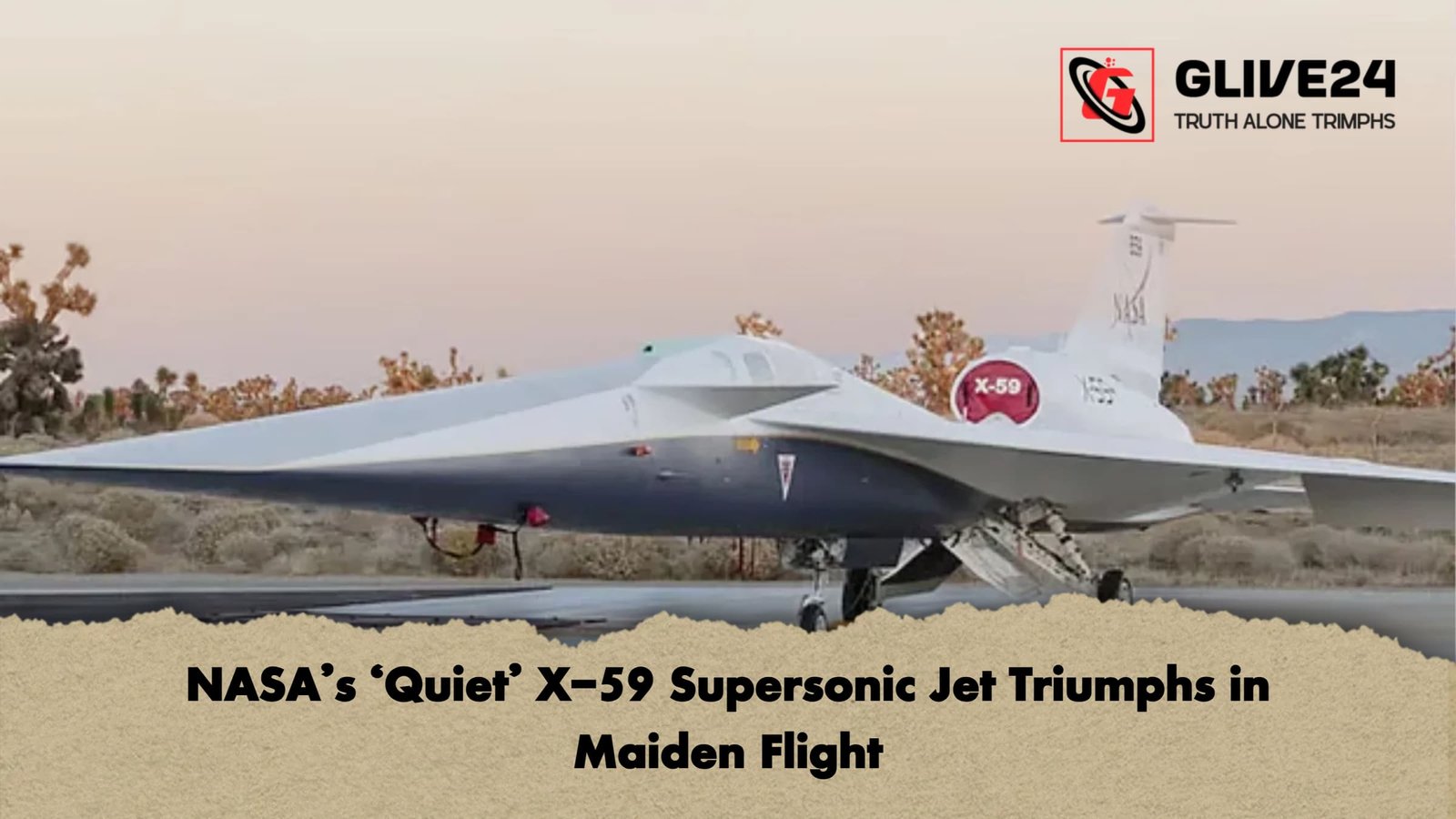
After years of meticulous engineering and anticipation, the X-59 Quiet Supersonic Technology (QueSST) aircraft has successfully completed its first experimental flight. Developed through a high-stakes collaboration between NASA and Lockheed Martin’s Skunk Works, this pioneering aircraft represents a potential revolution in aviation: the ability to break the sound barrier without the thunderous “sonic boom” that has long restricted supersonic travel over land.
Table of Contents
The Historic Flight Path
The inaugural test took place in the clear skies of California. The X-59 departed from the U.S. Air Force Plant 42 in Palmdale and touched down gracefully at NASA’s Armstrong Flight Research Center in Edwards. Although the journey spanned only 26 miles, it marked the official commencement of a flight-test phase that could redefine global transport. NASA officials confirmed that the aircraft performed exactly as predicted, meeting all aerodynamic and structural expectations.
Silencing the Sonic Boom
When a conventional aircraft exceeds the speed of sound, it creates overlapping shockwaves that result in a violent, window-rattling explosion known as a sonic boom. Due to the noise pollution and potential structural damage caused by these booms, supersonic flight over land was banned in the United States in 1973.
The X-59’s unique, elongated geometry—characterised by its 99.7-foot length and 29.5-foot wingspan—is designed to prevent these shockwaves from coalescing. Instead of a boom, the aircraft produces a muffled “thump,” roughly equivalent to the sound of a car door closing down the street.
Technical Specifications
Powered by a General Electric F414 engine, the X-59 is built for high-altitude, high-speed efficiency. One of its most striking features is its windowless nose; pilots navigate using the External Vision System (XVS), which feeds real-time 4K video from forward-facing cameras to a monitor in the cockpit.
| Feature | Specification |
| Length | 99.7 Feet |
| Wingspan | 29.57 Feet |
| Maximum Speed | Mach 1.5 (approx. 990 mph) |
| Cruising Speed | Mach 1.42 (approx. 940 mph) |
| Engine | General Electric F414-GE-100 |
| Vision System | 4K External Vision System (XVS) |
The “Quesst” for a New Standard
The project is a central pillar of NASA’s Quesst mission. Following these initial technical evaluations, the X-59 will be flown over various American communities. Researchers will gather data and public feedback on the noise levels to help international regulators establish new sound standards.
This data is crucial for the future of commercial aviation. In 2025, an executive order by President Donald Trump rescinded the long-standing ban on overland supersonic flight, provided the noise levels are acceptable. By sharing their findings with global authorities, NASA hopes to pave the way for a new generation of commercial jets that can halve travel times between major cities without disturbing those on the ground.