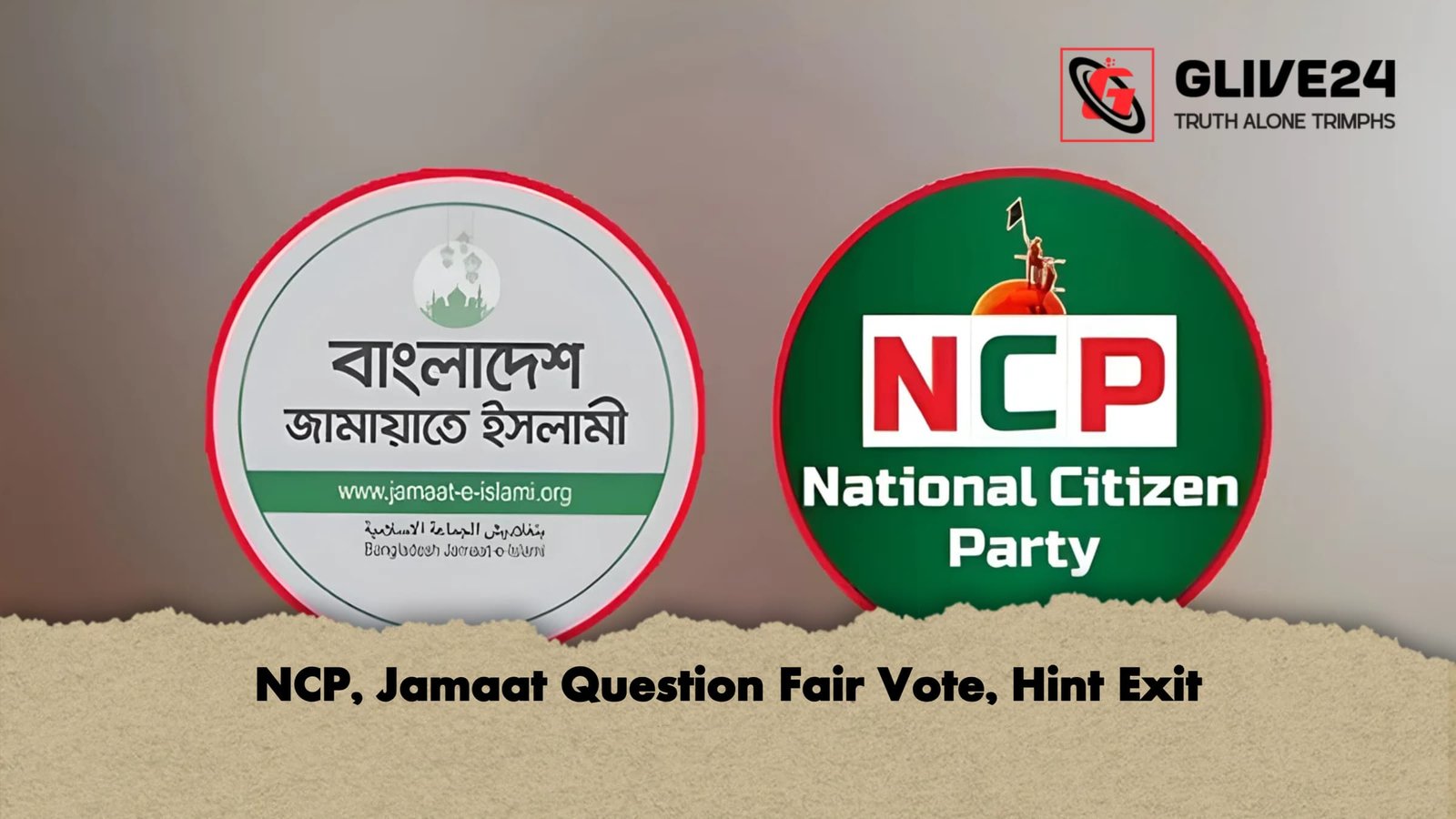
Amid growing controversy surrounding the forthcoming national parliamentary election, the Jamaat–NCP–led 11-party alliance has intensified its criticism of the Election Commission and the state administration. Since the announcement of the election schedule, alliance partners have repeatedly alleged bias, mismanagement and an uneven political playing field, prompting renewed speculation over whether the bloc may ultimately choose to boycott the polls.
Political analyst Zahed-ur Rahman believes that while a boycott is not yet a foregone conclusion, it cannot be ruled out. He notes that even after the deadline for the withdrawal of nomination papers has passed and electoral symbols have been allocated, political alliances retain the option of stepping away from the contest. Bangladesh’s political history, he adds, offers several precedents for such late-stage withdrawals.
In recent days, Jamaat-e-Islami and the National Citizens’ Party (NCP) have accused the administration and the Election Commission of working, in effect, in favour of the BNP. Jamaat’s Nayeb-e-Ameer, Dr Abdullah Mohammad Taher, publicly claimed after meeting election officials that some actors were openly stating their objective was to see Tarique Rahman installed in power. Such remarks have fuelled the alliance’s narrative that the electoral process is already tilted.
According to Zahed-ur Rahman, these allegations may serve two distinct purposes. On the one hand, they can be interpreted as an attempt to exert pressure on the authorities to ensure a fairer process—an approach that can be justified within democratic norms. On the other, they may also be laying the groundwork for a future boycott by consistently asserting the absence of a “level playing field”. Once such a narrative gains traction, withdrawing from the election becomes easier to justify politically.
He further argues that the current electoral climate appears far more unbalanced than in previous landmark elections. While the polls of 1991, 1996 and 2001 were widely regarded as competitive, this time the outcome seems largely predictable well in advance, with the BNP perceived as holding a commanding lead. “Never before,” he suggests, “has it been possible to forecast the likely winner with such confidence.”
This perception of an inevitable victory, Zahed-ur Rahman warns, risks encouraging a “sunflower tendency” among sections of the administration, law enforcement agencies and even parts of the media—an instinctive inclination to align with the anticipated centre of power. Such behaviour, he cautions, could seriously undermine the credibility of the election.
Another key concern for the Jamaat–NCP alliance is the prospect of securing far fewer seats than expected. Should it become clear that the alliance is nowhere near winning even a quarter of parliamentary seats, remaining in the race could weaken its capacity to function as an effective opposition. Poor performance may erode both organisational credibility and supporter morale.
In this context, the threat of a boycott may be deployed as an “ultimate bargaining tool”. Yet Zahed-ur Rahman issues a stark warning: pushing the electoral process into uncertainty could propel the country towards an unpredictable and potentially dangerous trajectory, with the gravest consequences falling upon those who instigate such a move.
He also notes that the participation of the Jatiya Party complicates claims that the election is entirely one-sided. While its presence does not render the contest fully competitive, it does lend a measure of legitimacy to the process.
Ultimately, Zahed-ur Rahman urges political actors not to abandon the electoral field out of fear of unfavourable outcomes. Elections in Bangladesh, he observes, have always been contested and questioned—even the better ones. Accepting this reality and remaining engaged in democratic processes, he argues, remains the safest path for the nation.
Comparative Snapshot of Selected National Elections
| Election Year | Overall Competitiveness | Perceived Neutrality of Administration | Outcome Predictability |
|---|---|---|---|
| 1991 | High | Largely neutral | Low |
| 1996 | High | Generally balanced | Low |
| 2001 | Moderate to high | Mixed but competitive | Moderate |
| Upcoming | Low | Widely questioned | High |