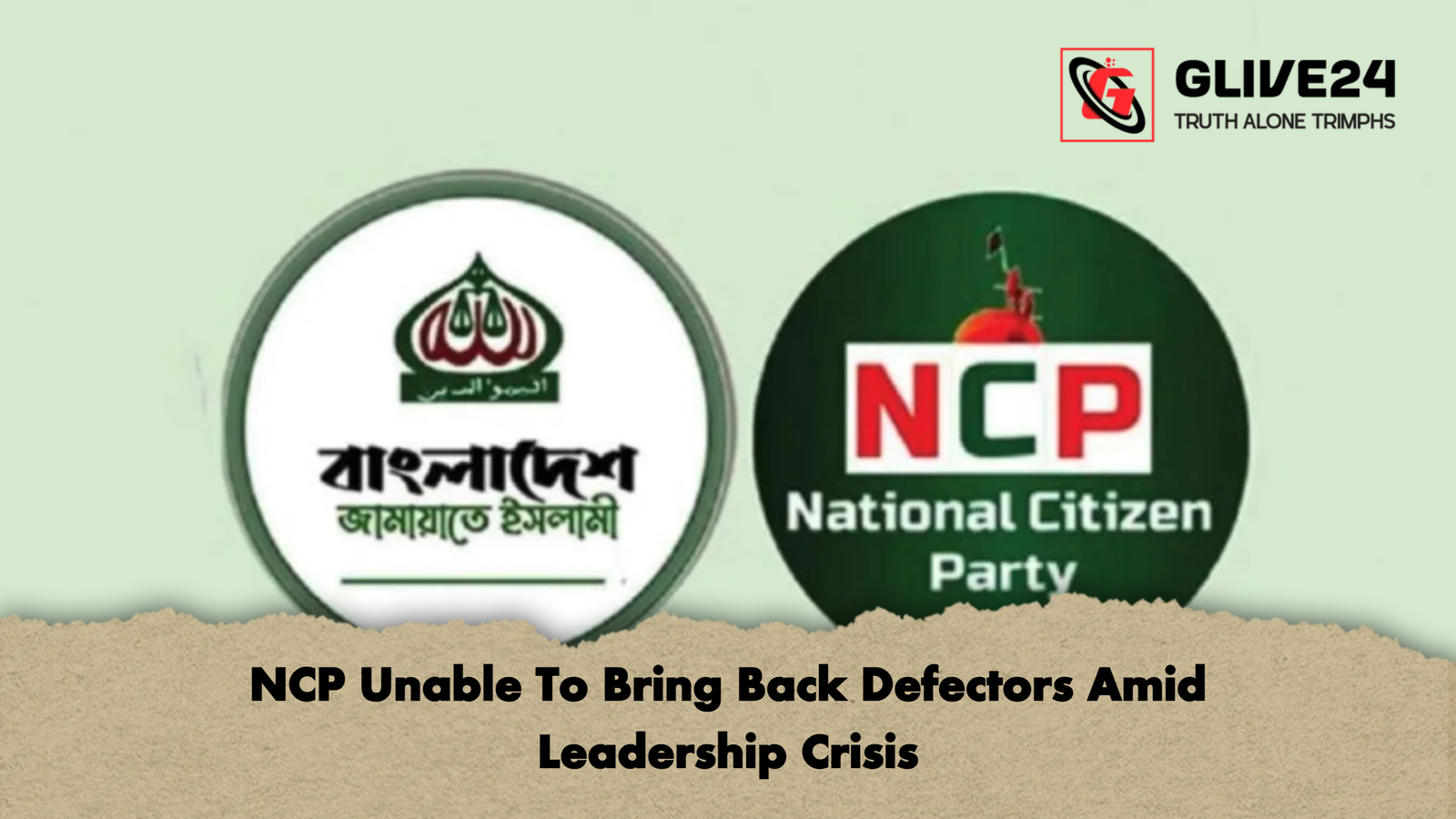
The decision of the National Citizen Party (NCP) to form a political alliance with Jamaat-e-Islami has triggered deep internal turmoil, exposing serious ideological and organisational rifts within the party. Despite repeated efforts by the central leadership, the NCP has so far failed to persuade defecting leaders to return, as resignations continue to undermine party unity ahead of the upcoming national election.
Senior and mid-ranking leaders who have left the party remain firm in their position, stating unequivocally that they will not consider returning unless the NCP formally severs all ties with Jamaat-e-Islami. According to them, the alliance represents a fundamental departure from the party’s founding principles and democratic commitments.
Party leaders, however, present a different narrative. The NCP’s top leadership claims it is maintaining regular contact with former leaders and is actively working to bring them back. Party spokesperson Asif Mahmud Sajib Bhuiyan has said that the resignations cannot be attributed solely to disappointment over the alliance decision. He argued that there are deeper, underlying factors involved, and resolving them will require time and dialogue.
Defecting leaders strongly reject this explanation, describing it as “false and misleading”. They accuse the leadership of attempting to confuse party supporters and the general public ahead of the election, rather than addressing the core ideological crisis at hand.
As of yesterday, at least 15 senior and mid-level leaders—including former senior joint member secretary Tasnim Jara and former joint convener Khaled Saifullah—have formally resigned from the party. In addition, six NCP figures have withdrawn their candidacies for the forthcoming national election. Meanwhile, senior joint convener Samantha Sharmin and joint member secretary Nahida Sarwar Niva have not officially resigned but have remained inactive in party affairs since the alliance announcement, further signalling internal dissent.
At least five former leaders have stated that although they received phone calls from party convener Nahid Islam, chief coordinator Nasiruddin Patwari, and spokesperson Asif Mahmud Sajib Bhuiyan, these communications failed to address their principal ideological concerns. Khaled Saifullah, however, denied having any such contact, saying no authorised party representative had approached him regarding a possible return.
Dissenting leaders have also criticised the alliance decision-making process, describing it as undemocratic and premeditated. One leader, speaking on condition of anonymity, termed it a “bad compromise” that many within the party had opposed from the outset. According to insiders, a meeting announced on 24 December via the executive committee’s WhatsApp group saw around 40 members present, while many alliance opponents were absent. The decision was subsequently pushed through based on a narrow majority of those present.
Former NCP ICT cell chief Farhad Alam Bhuiyan said he resigned immediately after submitting a dissenting note, stating he did not wish to be part of what he described as “this kind of politics”. Although senior leaders later urged him to reconsider, he made it clear that he would not return unless the party cut all ties with Jamaat.
Party sources reveal that an internal meeting to discuss reinstating defectors was planned but abruptly cancelled after details leaked outside the party. Despite this, the leadership insists that the door remains open.
Founded in February last year by activists from the July uprising, the NCP has previously experienced leadership exits over various disputes. Observers say the current crisis may prove to be the most consequential yet.
Key Developments at a Glance
| Issue | Details |
|---|---|
| Main cause of crisis | Alliance with Jamaat-e-Islami |
| Leaders resigned | At least 15 |
| Candidacies withdrawn | 6 |
| Senior leaders inactive | 2 |
| Defectors’ main demand | End alliance with Jamaat |
| Leadership stance | Dialogue ongoing, door open |
As the election draws closer, political analysts warn that unless the NCP resolves its ideological divisions swiftly, internal fragmentation could significantly weaken its electoral prospects.