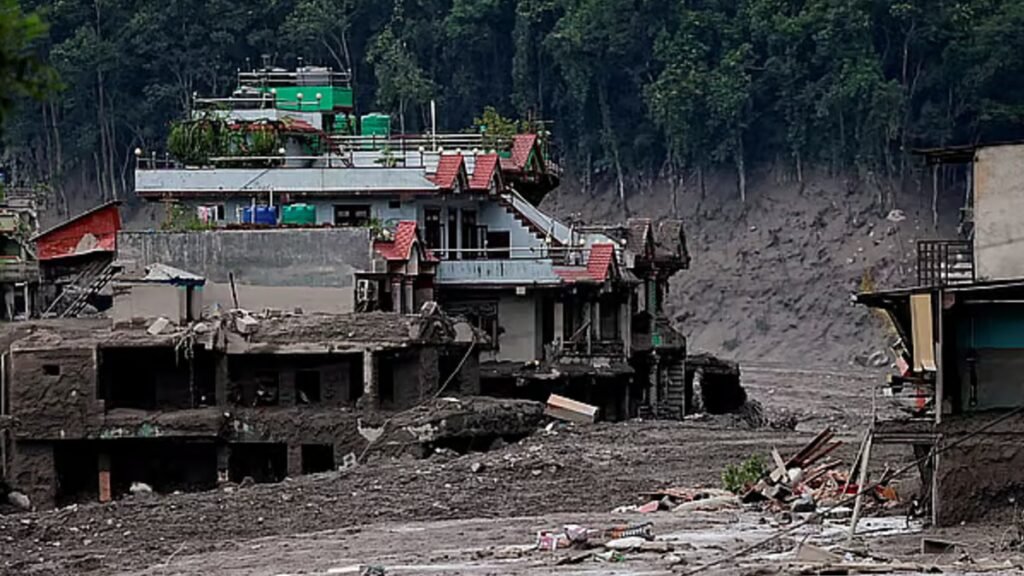
A sudden and devastating flood has struck Nepal’s mountainous region along the Tibetan border, leaving a trail of deaths, destruction and uncertainty over what triggered the disaster.
At least 162 people have reportedly died, while around 1,500 remain missing, according to Reuters. About 800 of those missing are believed to be foreign nationals. The scale of the disaster has been compounded by its speed: torrents of water, mud and debris swept through settlements with little apparent warning, destroying homes, roads and vehicles.
Scientists have yet to establish a definitive cause. Initial assessments, however, are focusing on the possibility that a major landslide blocked a river, creating a temporary natural dam. If water accumulated behind the obstruction before the barrier suddenly failed, it could have produced a powerful surge downstream.
The possibility is particularly significant in the Himalayas, where steep slopes, narrow valleys, glaciers and rapidly flowing rivers create a complex environment in which relatively localised geological events can quickly develop into major disasters.
Table of Contents
Was the Earthquake a Cause or a Consequence?
Nepal’s Foreign Minister Shishir Khanal initially suggested that an earthquake may have triggered the landslide. Under that scenario, a landslide would have blocked the normal course of a river, allowing water to build up behind the blockage. The eventual collapse of the natural barrier could then have released a large volume of water downstream.
Analysis by the United States Geological Survey, however, has raised a different possibility. The agency detected a magnitude 4.4 seismic event in the area. While an earthquake might initially appear to be a possible trigger for a landslide, subsequent analysis indicated that the seismic event may instead have been caused by the landslide itself.
That distinction could be important in determining how the disaster unfolded.
Preliminary observations by the International Centre for Integrated Mountain Development, based in Kathmandu, have also found no evidence of a major abnormal event on the Chinese side of the border. Sarthak Shrestha, a geospatial analyst at the organisation, suggested that a large collapse involving rocks and ice on the Nepalese side may have obstructed the Lende River.
If that assessment is confirmed, the resulting accumulation of water and the sudden failure of the obstruction could explain the extraordinary force of the flood.
Why Was the Flood So Severe Without Heavy Rain?
One of the most striking features of the disaster is the apparent lack of significant rainfall before the flooding.
Hatim Sharif, a hydrologist at the University of Texas at San Antonio, said such a severe flood following relatively little rainfall was highly unusual. The observation has prompted scientists to look beyond conventional weather-related explanations.
Most flood-warning systems rely heavily on rainfall and river-level monitoring. Such systems can provide valuable preparation time when flooding develops gradually. A landslide-induced flood presents a different challenge.
If a landslide suddenly blocks a mountain river, water can accumulate behind the obstruction without immediately producing the kind of downstream signal associated with conventional flooding. When the barrier fails, the stored water may be released within minutes.
The resulting flow can contain enormous quantities of mud, rocks and other debris. Rather than behaving like ordinary floodwater, it can become a dense and destructive mixture capable of sweeping away vehicles, buildings and infrastructure.
For people caught in such an event, attempting to escape by road may offer little protection. Reaching higher ground quickly can be far more effective when a debris-laden torrent is approaching.
Concerns Over Another Surge
The danger may not have ended with the first flood.
Experts are concerned that parts of the upstream river system could remain obstructed. Chiangong Zhang, head of the climate and environmental risks division at the International Centre for Integrated Mountain Development, warned that water trapped upstream could potentially generate another powerful surge if an obstruction were to fail.
Dorothy Heinrich of the University of Reading has also highlighted the characteristics of Himalayan rivers. Many flow through narrow and steep-sided valleys. When landslides or avalanches temporarily block such waterways, water can accumulate rapidly. A sudden breach can then send a destructive torrent into lower-lying areas.
Such conditions make emergency monitoring particularly difficult. A river may appear relatively normal downstream until a natural barrier upstream collapses.
Climate Change Remains an Open Question
Scientists have not established a direct link between climate change and the latest disaster. Determining whether warming contributed to the event will require further investigation and detailed analysis.
There are, however, broader environmental changes taking place across the Himalayan region. Rising temperatures, retreating glaciers and changes in the amount and timing of snow and ice melt are altering mountain environments. Scientists have warned that such changes can influence the stability of slopes, river systems and glacial lakes.
One associated hazard is a glacial lake outburst flood. As glaciers melt, water can accumulate in mountain lakes. If a natural dam fails, large quantities of water can be released suddenly, causing severe flooding downstream.
Nepal and other Himalayan countries face risks from such events. But there is currently no confirmation that a glacial lake outburst was responsible for the latest flooding.
Nepal has experienced other sudden flood disasters in recent years. In July last year, a powerful surge originating from China’s Gyirong area struck Rasuwa district in Nepal. The incident demonstrated how events in high-altitude areas can rapidly affect communities downstream and across borders.
A Wider Challenge for Himalayan Disaster Preparedness
The latest disaster is likely to prompt further scientific investigation. Researchers will need to examine geological evidence, river conditions, satellite observations and other available data to determine precisely how the flood developed.
Scientists may also investigate whether changing climatic conditions have altered the likelihood of such events. This type of research can involve comparing the probability of extreme events under today’s warmer climate with conditions before the industrial era.
The disaster also highlights a limitation of relying solely on rainfall forecasts to assess flood risks in mountainous terrain. Rainfall remains an important factor, but it is only one part of a much larger system.
Monitoring glacier conditions, snow and ice, river flow, slope stability and possible landslide activity could provide a more complete picture of emerging hazards. Early-warning systems in vulnerable mountain communities may need to incorporate these factors together rather than treating flooding simply as a consequence of heavy rainfall.
For Nepal, the immediate priority remains the safety of people in affected areas and the assessment of further risks. For scientists, the event offers a critical opportunity to understand how landslides, rivers and changing Himalayan conditions can combine to produce catastrophic flooding with little warning.
The precise cause of the disaster remains under investigation. What is already clear is that in the Himalayas, a seemingly local geological disturbance can rapidly become a large-scale humanitarian emergency.