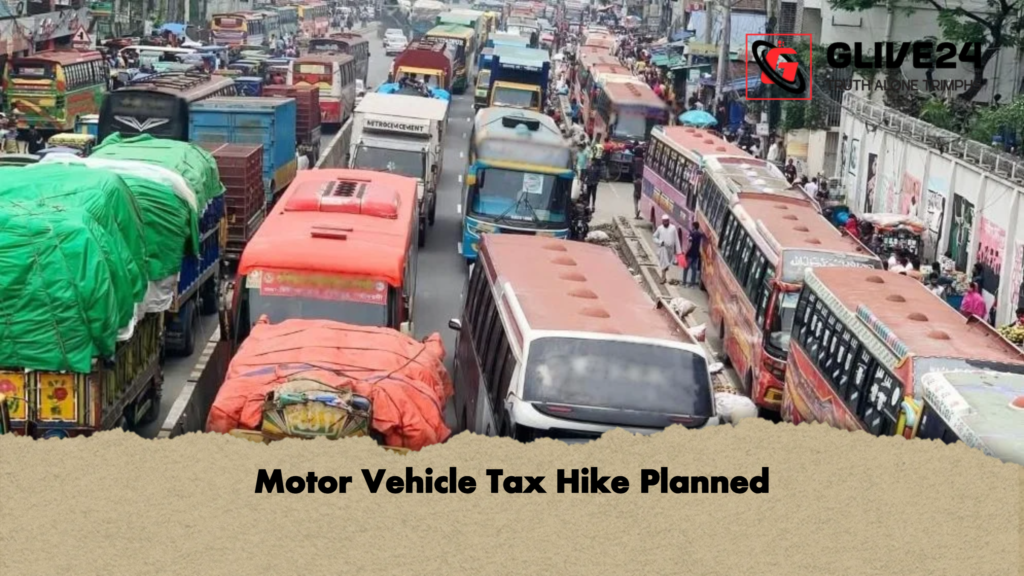
The government is preparing to significantly increase the advance income tax rates applicable to commercially operated motor vehicles in the 2026–27 fiscal year, alongside an expansion of the vehicle categories subject to taxation. The proposed reforms are aimed at broadening the tax base in the transport sector, enhancing revenue collection, and tightening compliance mechanisms.
Under the revised framework, the payment of advance tax at prescribed rates will be made compulsory at the time of vehicle registration or fitness renewal. Authorities will not be permitted to complete registration or renewal procedures unless proof of tax payment is submitted. This measure is intended to curb tax evasion and ensure a more disciplined revenue collection system.
The updated structure proposes substantial increases across a wide range of vehicles, including buses, minibuses, coaster buses, trucks, lorries, covered vans, prime movers, pickup vans, human haulers, auto-rickshaws, and taxi cabs. In several categories, the advance tax has been raised by between 50 per cent and nearly 100 per cent.
For instance, the advance tax for a 52-seat bus has been increased from Tk 16,000 to Tk 25,000. The rate for minibuses has been revised upward from Tk 11,500 to Tk 20,000, while coaster buses now carry the same revised rate of Tk 25,000, up from Tk 16,000. Similarly, trucks and lorries with a carrying capacity of 5 to 20 tonnes will now be subject to Tk 30,000, compared to the previous Tk 16,000. Heavier vehicles exceeding 20 tonnes will face a sharp rise to Tk 50,000, up from Tk 16,000.
In addition, several specialised and heavy-duty vehicles are being formally brought under the tax net in the new fiscal framework. These include tractors, dump trucks, cargo vans, cranes, excavators, dredgers, road rollers, and concrete mixers. For such categories, the proposed advance tax ceiling is also set at up to Tk 50,000, depending on vehicle type and usage classification.
The draft provisions further stipulate stricter timelines for compliance. In cases where vehicle registration or fitness renewal is granted for multiple years, the tax for subsequent years must be paid by 30 June of the relevant year. Failure to meet the deadline will result in arrears being added to the following year’s tax liability, which will then be collected in full.
Revised Advance Tax Structure for Motor Vehicles
| Vehicle Category | Previous Tax (Tk) | Proposed Tax (Tk) |
|---|---|---|
| 52-seat bus | 16,000 | 25,000 |
| Minibus | 11,500 | 20,000 |
| Coaster bus | 16,000 | 25,000 |
| Truck/Lorry (5–20 tonnes) | 16,000 | 30,000 |
| Truck (above 20 tonnes) | 16,000 | 50,000 |
Officials indicate that the restructuring is designed not only to increase revenue collection but also to introduce a more rational and categorised tax system, particularly placing heavier vehicles in higher tax brackets in line with their road usage and economic capacity.